
Natural disasters have long been a defining part of Japan’s story. Earthquakes, typhoons, and tsunamis shape not only the landscape but also the resilience of the people who endure them. In 2024, amid the devastation of the Kumamoto Earthquake, a story emerged that captivated the nation — not of human heroism, but of an animal whose will to live astonished everyone.
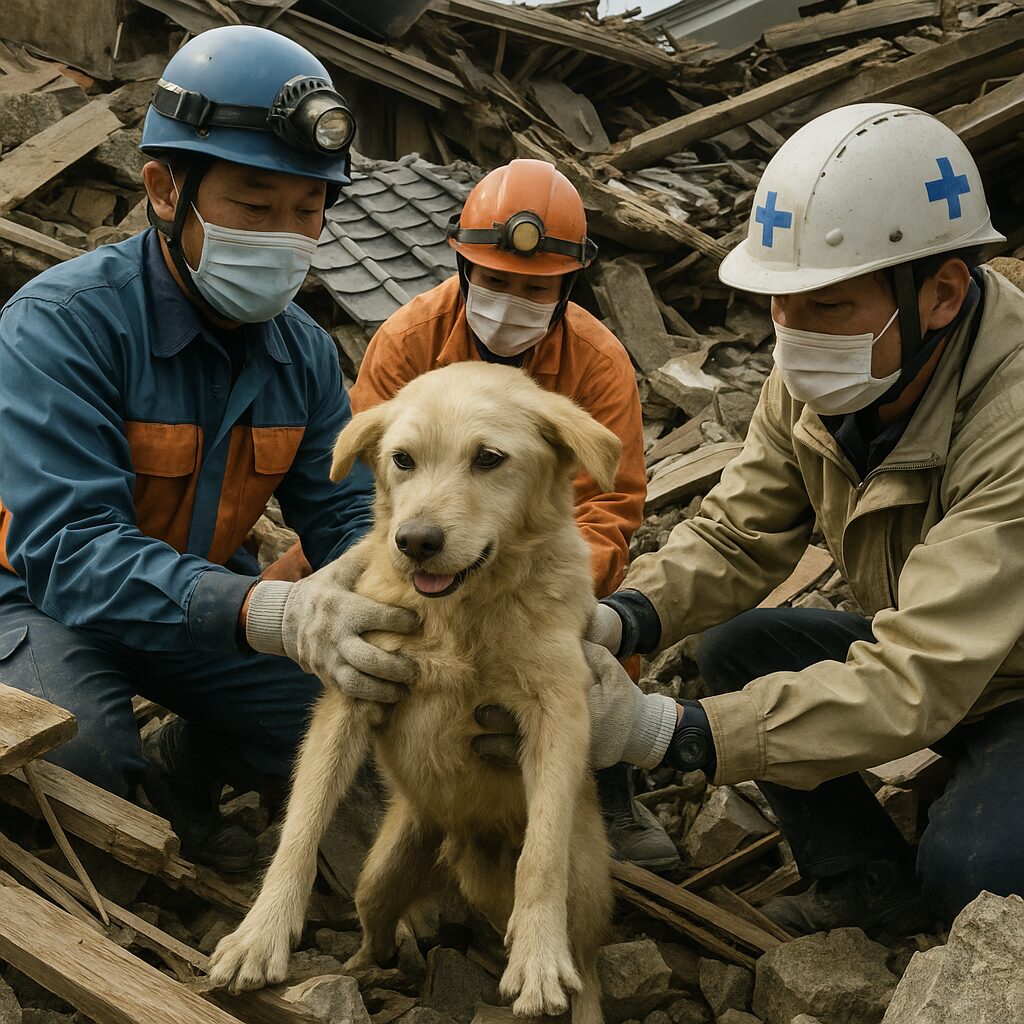
For 18 long days, buried beneath the rubble of collapsed buildings, a dog clung to life. When volunteer rescuers from Team U-Nyan finally pulled the pup from the debris, it was weak, trembling, and covered in dust — but it wagged its tail. That simple gesture, fragile yet determined, became a symbol of hope in a time of despair.
The Kumamoto Earthquake: A Disaster Remembered
To understand the miracle of this rescue, it is important to grasp the context of the Kumamoto Earthquake. Japan, located on the Pacific “Ring of Fire,” is no stranger to seismic activity. But some quakes carve themselves into the national memory more deeply than others.
The 2024 Kumamoto Earthquake struck with devastating force, toppling homes, cracking roads, and leaving communities in chaos. For many, the disaster was a grim reminder of the 2016 Kumamoto Earthquakes, which killed dozens and displaced thousands. Families once again faced trauma, uncertainty, and the painstaking process of rebuilding.
Amid collapsed houses and crushed neighborhoods, rescuers focused on saving human lives. But as days turned into weeks, the survival of one dog reminded everyone that life — in all its forms — deserved saving.
The Discovery: A Faint Sound in the Rubble
Eighteen days after the initial quake, most assumed that any animals trapped beneath the ruins had perished. Food, water, and oxygen would have been long exhausted. But members of Team U-Nyan, a volunteer rescue group dedicated to helping both people and animals, refused to give up hope.
While combing through a devastated neighborhood, they heard faint whimpering. At first, they thought it might be an echo or a trick of the wind. But as they dug carefully, the sound grew stronger. And then they saw it: a pair of frightened, dirt-caked eyes blinking in the darkness.
The dog, astonishingly alive, had endured nearly three weeks without consistent food or clean water. How it survived remains a mystery — perhaps by licking condensation from rubble, or by finding small scraps within reach. Regardless, its survival was nothing short of miraculous.
When pulled free, the dog staggered weakly but managed a tail wag, as if to signal: I made it. I am still here.
The Science of Survival: How Did the Dog Last 18 Days?
Veterinarians who later examined the dog explained that canines, though vulnerable, possess remarkable survival mechanisms.
- Fat Reserves: Dogs can live without food for extended periods if their body taps into fat and muscle reserves.
- Water Sources: Even minimal moisture — dew, condensation, or stagnant droplets — can prolong survival.
- Instinctual Energy Conservation: Trapped animals often enter a near-dormant state, conserving energy by minimizing movement.
Still, 18 days is extraordinary. Most estimates place canine survival without reliable water at fewer than 10 days. This particular dog beat the odds, demonstrating resilience that inspired people around the globe.
Team U-Nyan: Heroes of Compassion
The rescue would not have been possible without Team U-Nyan, a group of dedicated volunteers known for their work in disaster zones. Their mission extends beyond humans; they recognize that pets are family members and that saving them helps heal communities.
In Kumamoto, Team U-Nyan worked tirelessly, often under dangerous conditions, combing through unstable structures. Their persistence not only saved this dog but also uplifted countless families who feared their own pets had been lost.
Their philosophy is simple: in times of disaster, no life should be overlooked.
The Dog’s Recovery
After being freed, the dog was rushed to a veterinary clinic. Malnourished, dehydrated, and weak, it required immediate intravenous fluids and gradual refeeding. Yet within days, its condition began to improve.
Volunteers documented the progress, sharing photos and updates online. The images of the once-dusty, frail dog slowly regaining strength captured the hearts of thousands. Comments poured in:
- “A true miracle.”
- “This gives us hope after so much pain.”
- “Even in tragedy, life finds a way.”
By the end of several weeks, the dog’s transformation was astonishing. Fur brushed clean, muscles restored, eyes bright — it had emerged not only as a survivor but as a symbol of resilience for an entire region.
Why Animal Stories Matter After Disasters
Some may ask why so much attention is given to the survival of a single dog when human lives are at stake. The answer lies in the emotional connection between people and animals.
- Pets Are Family: For many, dogs and cats are not “just animals” — they are loved ones. Their survival provides comfort when everything else is uncertain.
- Hope Amid Despair: Stories of survival, however small, shine a light in times of overwhelming darkness. They remind communities that not all is lost.
- Symbols of Resilience: Animals like this dog embody the will to live, becoming metaphors for human perseverance.
In Kumamoto, the rescued dog gave people something to smile about in a season of grief.
Lessons in Preparedness
Michi’s story on the Camino taught us about kindness in travel. This dog’s survival in Kumamoto teaches us about preparedness in disaster. Japan has made significant progress in pet disaster planning, but challenges remain.
- Evacuation Shelters: Many still struggle to accommodate pets, forcing owners into heartbreaking choices.
- Emergency Kits: Families are urged to prepare kits with pet food, water, and medical supplies.
- Training and Microchipping: Identification ensures pets can be reunited with owners if separated.
This dog’s ordeal is a reminder that disaster preparedness must include our animal companions.
A Broader Cultural Context: Dogs and Disasters in Japan
This is not the first time a dog’s survival during disaster has inspired Japan. After the 2011 Great East Japan Earthquake and tsunami, stories circulated of dogs refusing to leave injured companions, or of rescues where dogs waited patiently until help arrived.
These accounts resonate deeply with Japanese culture, where loyalty and endurance — traits often attributed to dogs — are revered. The tale of Hachikō, the Akita who waited years for his deceased master, remains one of the nation’s most beloved symbols.
The Kumamoto survivor dog now joins that lineage of canines who represent devotion, resilience, and unyielding spirit.
Adoption and a New Beginning
Once fully recovered, the question arose: what next for this earthquake survivor? Rescue groups carefully screened potential adopters, knowing the dog deserved stability and compassion after enduring so much. Eventually, a family stepped forward — one that had also been affected by the quake but wanted to give back by offering love and care.
For the family, adopting the dog was both healing and symbolic. They too had lost much in the disaster. By giving this survivor a home, they embraced hope and continuity amid loss.
Why This Story Resonated Globally
News of the 18-day survivor spread beyond Japan. International media outlets highlighted the rescue, drawing comparisons to other famous survival stories. Animal welfare groups used it as an example of why disaster response must include pets.
The global response showed how animal stories cross cultural and linguistic boundaries. Compassion for animals is universal, and the joy of their survival is shared across borders.
The Enduring Power of Survival Stories
Why do stories like this touch us so deeply? Perhaps because they remind us of life’s fragility — and its strength. When a small creature survives against impossible odds, we see reflected the resilience we all hope to find within ourselves.
For Kumamoto residents, the image of a wagging tail after 18 days in darkness became a metaphor: even when buried under the weight of disaster, hope can emerge.
Conclusion: From Rubble to Renewal
The 2024 Kumamoto Earthquake left scars on both land and hearts. But amid the tragedy, the rescue of a single dog offered a beacon of resilience. For 18 days, silence and rubble surrounded the animal. Yet when the world found it again, it greeted life not with fear, but with a wag of its tail.
This incredible survival story is more than an anecdote. It is a lesson — about compassion, about preparedness, and about the unbreakable will to live.
The dog rescued in Kumamoto is no longer just a nameless stray. It is a symbol, a reminder, and an inspiration. Out of destruction, life emerged. Out of despair, hope wagged its tail.