
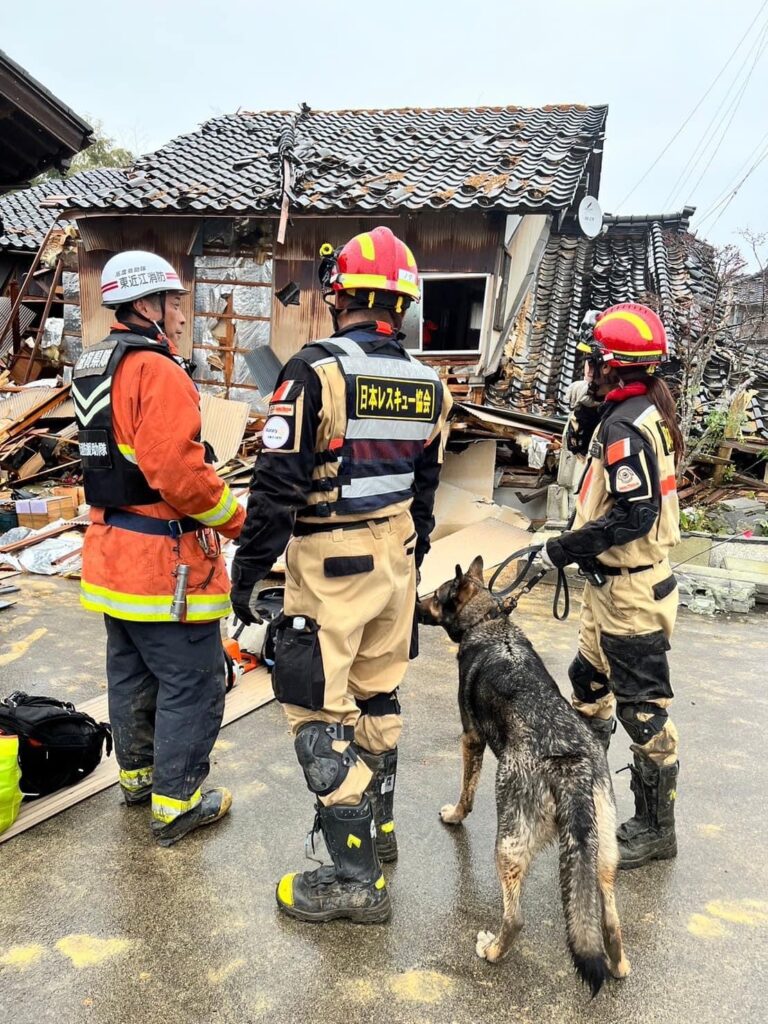
In the wake of disaster, when cities tremble and lives are shattered, rescue efforts are often defined by the bravery of those who step forward. In Japan, a nation that has endured some of the world’s most devastating earthquakes, the stories of survival are not only about human resilience. They are also about dogs — trained rescue companions who rush into danger, risking their lives to save others.
Among these heroes stand two names that have entered Japan’s modern folklore: Kongo and Myoken, military rescue dogs who became symbols of courage during some of the country’s darkest hours. Their loyalty, strength, and instinctual drive to find survivors in the chaos of collapsed buildings made them legends. And beyond their individual stories, they represent a larger tradition of canine heroism in Japan.
Earthquakes in Japan: A Harsh Reality
Japan sits on the Pacific “Ring of Fire,” where multiple tectonic plates collide. This geography has blessed the country with mountains, hot springs, and fertile landscapes — but it has also cursed it with earthquakes. From the 1923 Great Kanto Earthquake that devastated Tokyo and Yokohama, to the 1995 Kobe Earthquake, to the catastrophic 2011 Great East Japan Earthquake and tsunami, seismic disasters have repeatedly tested Japan’s preparedness and resilience.
In these moments, the need for search and rescue is overwhelming. Lives can be saved in the crucial hours after a quake if survivors are found under rubble before dehydration, injury, or exposure take their toll. While human teams bring expertise and technology, dogs bring something unique: the ability to detect life with extraordinary speed and accuracy.
The Origins of Rescue Dogs in Japan
The use of dogs in rescue missions has global roots, from Saint Bernards in the Swiss Alps to search-and-rescue teams in modern cities. In Japan, the concept of military and police rescue dogs grew in the postwar period, as earthquakes and typhoons demonstrated the need for specialized response teams.
By the late 20th century, Japan began to invest in training programs for rescue dogs, often drawing on breeds like German Shepherds, Labradors, and Belgian Malinois. These dogs were chosen not just for their intelligence and strength, but also for their temperament and ability to remain calm under pressure.
Kongo and Myoken emerged as standout figures in this movement — dogs whose missions became household stories, representing the promise and power of canine assistance.
Kongo: The Symbol of Strength
Kongo’s name has become synonymous with resilience. A German Shepherd with a sharp nose and unshakable focus, Kongo was deployed during one of Japan’s major earthquake crises in the 20th century. He was known for his ability to push through debris fields that even human rescuers hesitated to enter.
Kongo’s defining trait was his endurance. He could work long shifts in unstable rubble, tirelessly sniffing for survivors. His handlers often spoke of how he refused to leave an area until he was satisfied he had searched every corner.
What made Kongo a national symbol was not just his effectiveness but his visibility. News reports and images of him navigating dangerous zones captured public imagination. For many Japanese citizens grieving after the earthquake, Kongo became a beacon of hope: proof that even in devastation, life could be found.
Myoken: The Guardian of Survivors
If Kongo represented strength, Myoken represented compassion. Another celebrated rescue dog, Myoken worked alongside military units during earthquake aftermaths, earning praise for his sensitivity to survivors. Rescuers often noted that Myoken seemed to have an almost spiritual presence — approaching survivors gently, alerting his handlers without aggression, and staying close to those in need.
The name “Myoken” itself has Buddhist connotations, linked to a deity associated with protection. True to his name, Myoken became a guardian figure in the public’s eyes. Survivors recalled the comfort of seeing his calm eyes in the rubble, a reminder that they were not forgotten.
Like Kongo, Myoken’s image appeared in newspapers and TV broadcasts, cementing his role as a cultural icon of disaster response.
Training a Hero: What It Takes to Be a Rescue Dog
Becoming a rescue dog in Japan requires intense preparation. Dogs like Kongo and Myoken underwent rigorous training to develop the following skills:
- Scent detection: Learning to distinguish live human scent from rubble, animals, or corpses.
- Agility: Navigating collapsed structures, climbing ladders, balancing on unstable surfaces.
- Focus under stress: Working in noisy, chaotic environments filled with dust, smoke, and crowds.
- Bond with handler: A deep trust between dog and trainer ensures that commands are followed even in life-threatening scenarios.
Handlers often speak of the emotional bond as being just as important as the training. Rescue dogs must sense their human partner’s confidence and vice versa. It is a relationship built on absolute trust.
Rescue Dogs in Action: Earthquake Missions
During earthquakes, time is the greatest enemy. Dogs can detect survivors much faster than machines or human senses. They alert handlers by barking, scratching, or, in some cases, freezing in place to signal life beneath the rubble.
In the Kobe Earthquake of 1995, rescue dogs were deployed for one of the first large-scale missions in Japan’s history. In the 2011 Tohoku Earthquake and tsunami, Japanese rescue dogs worked side by side with international teams from the U.S., Switzerland, and other nations. They were seen wearing protective vests and goggles, demonstrating how essential they had become to global disaster response.
Kongo and Myoken’s earlier missions paved the way for these modern deployments, showing the Japanese public — and the government — that dogs were not just companions but vital first responders.
The Emotional Impact of Rescue Dogs
One of the most profound contributions of dogs like Kongo and Myoken is psychological. For survivors trapped under debris, the sound or sight of a dog can mean the difference between despair and hope. Dogs represent life, loyalty, and the promise of rescue.
For rescuers, too, dogs provide motivation. In grueling conditions where exhaustion sets in, watching a dog continue to work with determination can re-energize human teams. Many handlers describe their dogs as “partners” rather than tools — partners who share the risks and the victories.
Cultural Legacy: Dogs as Symbols of Courage
Kongo and Myoken’s legacies endure not only in rescue dog training programs but also in Japan’s cultural memory. They are remembered alongside other famous Japanese dogs, such as Hachikō the loyal Akita, as examples of how animals embody values cherished in Japanese society: loyalty, perseverance, and selflessness.
Schools, community centers, and even disaster-preparedness programs sometimes reference these dogs when teaching children about resilience. Their stories remind people that courage does not always come from size, rank, or power — sometimes it comes on four legs, with a wagging tail.
Lessons for the Future: Preparing for Tomorrow’s Disasters
Japan continues to face seismic risks, and the role of rescue dogs remains vital. Modern technology, including drones and thermal imaging, has advanced, but dogs still outperform machines in certain tasks. Their speed, agility, and ability to detect life beneath rubble remain unmatched.
Training schools across Japan continue to honor the legacy of Kongo and Myoken, producing new generations of canine heroes. These programs not only prepare for disasters but also raise awareness about the importance of animal welfare, adoption, and the human–animal bond.
Beyond Japan: Global Recognition
The stories of Kongo and Myoken also resonate beyond Japan. International rescue communities recognize their contributions, and Japanese handlers often collaborate with teams worldwide. This global cooperation has elevated the status of Japanese rescue dogs, showing that their courage is not just a national treasure but part of a universal story of human–animal partnership in times of crisis.
Conclusion: Courage Comes in All Shapes and Sizes
When the earth shakes and buildings fall, the instinct is often to flee. Yet, dogs like Kongo and Myoken ran toward danger. Their paws touched unstable ground, their noses searched through dust and debris, and their presence gave hope where there was none.
Their stories remind us that courage is not measured by words or medals, but by actions. A dog may not understand the scale of a disaster, but it understands loyalty. It understands the call to search, to protect, to save.
In Japan’s long history of resilience, Kongo and Myoken stand as furry, four-legged heroes — forever remembered as proof that even in the darkest times, light can be found in the bond between humans and dogs.