
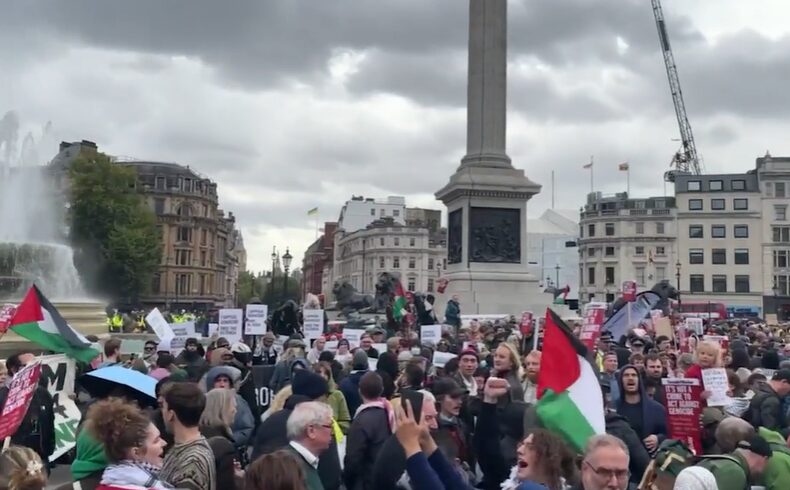
The heart of London became ground zero for a movement that defied bans, challenged authorities, and reframed global debate. On a crisp October day, thousands of pro-Palestinian demonstrators converged on Trafalgar Square, Westminster, and surrounding avenues—even after the government warned that protests would not be tolerated. What began as a silent vigil morphed into a defiant march, and soon into a day of confrontation, mass arrests, and political tension.
This wasn’t just another protest. It was a flashpoint in the war of narratives over Gaza, a moment when competing ideals of security, expression, and justice collided in one of the world’s most symbolic cities. In London, a new battle was being fought—not just in the sky over Gaza, but in the streets of the metropolis.
The Spark: Defiance in the face of prohibition
The warning came days before: authorities implored protest organizers to cancel their planned London rally, citing recent violence at a synagogue in Manchester and fears the capital was too fragile to host mass demonstrations. Under growing pressure, the group behind the protest—Defend Our Juries—refused to back down. The protest had been scheduled weeks earlier; its aim was not spontaneous impulse but deliberate opposition to the proscription of Palestine Action, a grassroots network recently declared a terrorist organization.
When Saturday arrived, thousands of people ignored the call to stand down. They came not only from London, but from across the UK, carrying flags, banners, and placards demanding ceasefire in Gaza. In Trafalgar Square, people sat, wrote their demands, held silent vigils. Later they stood, waved signs, strode toward Westminster. Though police cordoned off key roads, the crowd spilled forward. In defiance of bans, they marched.
By mid-afternoon, the situation had escalated. Riot police in helmets lined the edges of the square. Tear gas canisters were fired. Protesters lit flares. Chants of “Free, Free Palestine” echoed against the backdrop of Big Ben and the Houses of Parliament. Some protesters attempted to write slogans directly on pavements or unfurl banners on bridges. The standoff deepened.
Clash and arrest: order, resistance, and chaos
As dusk approached, the metropole transformed into a theater of confrontation. Chains of police advanced, dragging individuals away. Reporters captured lines of uniformed officers struggling to control surging crowds. The arrests came in waves. By day’s end, nearly 442 to 492 people had been detained. Many were arrested simply for writing slogans, holding placards, or sitting in defiance. Some elderly protesters—some in their eighties—were handcuffed and led off, while onlookers cheered or jeered.
Police defended their actions as necessary to maintain public order. Officials said they arrested those supporting a proscribed organization, violating protest conditions, or obstructing public ways. Authorities pointed to the prior synagogue attack in Manchester as evidence that these protests could inflame intercommunal tensions, particularly in London’s Jewish communities.
But for many protesters, the arrests are proof positive of something they’ve long claimed: that the government is trying to silence dissent. Some supporters argued that the proscription of Palestine Action conflated symbolic protest with terrorism. Defend Our Juries insisted their rally was peaceful, that they sought accountability—not violence.
In the hours following the crackdown, images spread across social media: protesters being carried off, locked in handcuffs, surrounded by helmeted officers. Gas canisters drifting in historic squares. Banners fluttering in the glow of streetlights. London’s landmarks—Westminster Bridge, Trafalgar, the Victoria Embankment—became icons of resistance.
Fault lines: security, free speech, and politics
Behind the visuals lay a deeper tension: the uneasy balance between public safety and free expression. The government defended its decision to ban the protests, pointing to recent antisemitic incidents and the need to protect vulnerable communities. The Home Secretary announced enhanced police powers to restrict repeated demonstrations, citing the cumulative impact of protests on city life and cohesion.
Critics, however, denounced the move as authoritarian. They argued that banning protests and arresting peaceful demonstrators threatened core democratic values. Human rights groups warned against conflating dissent with extremism. They cautioned that if governments can outlaw symbolic support or messaging for a banned group, then protest becomes hostage to political discretion.
The arrests and bans have also sharpened political divisions. Some conservative voices lauded police for acting decisively, calling for stronger crackdowns. Others—even within the ruling party—warned that overreach could backfire, inflaming tensions and radicalizing moderates. Opposition leaders, especially on the left, framed the crackdown as a stepping stone toward eroding political liberties.
Meanwhile, Jewish, Muslim, and Arab communities across London watched with apprehension. For some in the Jewish community, the protests felt like incursions on safety and mourning. For Palestinians and their allies, they were an expression of long-suppressed anguish and solidarity. In both camps, the fear is that London itself becomes a battlefield not just of ideas, but of identity.
London as global symbol: reframing the conflict in real time
That a protest in London would become an international story was inevitable. The city is not just a capital—it is a global stage. Images of these clashes circulated worldwide, headlining news outlets in New York, Beirut, Tokyo, and beyond. For many in the pro-Palestinian movement, London was validation: this conflict is global, not local. That people in the West are rising to protest matters.
But London also became a laboratory. How governments respond to Gaza protests in Western democracies will influence norms elsewhere. Is protest the safety valve, or a liability? Can states ban demonstrations in the name of security? How will social media amplify or sanitize vérité? The UK’s decisions may presage similar tensions in Paris, Berlin, Washington, and Tokyo.
From Rome to Madrid, protests erupted across Europe on the same weekend, with hundreds of thousands demanding ceasefire and judicial scrutiny. In that context, London’s protest was not isolated—but strategically pivotal. The crackdown in London wasn’t just about policing one rally—it signaled to states and protest movements alike how far authorities might go.
Human stories: faces behind the placards
Amid the mass arrests and political posturing, individual stories poured out.
Ishrat, a British-Bangladeshi teacher, held a sign reading “Justice for Gaza” before being led away in handcuffs. She told journalists she felt compelled to march even at risk of arrest. “Silence is complicity,” she said, tears in her eyes.
Thomas, 66, a retired nurse, came clutching a handwritten poster. When police told him he was being arrested, he responded: “I’m peaceful. I carry no weapon.” He was marched past stunned tourists and shuttered shops.
Young students chanted in unison: “If Gaza burns, London burns too.” Some filmed confrontations with police, livestreaming them to supporters abroad. Social media captions read: “Big Ben watches us. We won’t be silenced.”
At Coventry Garden’s side streets, families tried to push past cordons, shouting for the release of detainees. In nearby mosques, prayer calls echoed into the night. In synagogues, leaders held vigils, cautioning against conflation of criticism of Israel with hatred of Jews.
One image went viral—a cluster of teenagers, scarves over faces, their hands raised in solidarity. Behind them towered Westminster, lit by floodlights, as flares and smoke swirled. The visual struck many as a metaphor — teenage voices rising beneath the watch of age-old power.
What this means: a crisis of narrative and democracy
London’s protest was more than civil disorder—it was a message. That when war rages abroad, fissures open at home. That a democracy’s ability to hold space for dissent becomes a barometer of its health. That silent vigils evolve into street marches not just because people are angry, but because they feel unheard.
Here are key takeaways:
- Erosion of protest norms. The decision to ban protests under lines of security risk marks a shift. States may feel emboldened to curtail demonstrations citing communal sensitivity. The danger is precedent.
- Legitimacy via suppression. The arrests may backfire. Protest movements often gain momentum when repression is visible. The imagery of people being dragged away can galvanize sympathizers.
- Polarization of urban space. London’s streets—once the site of many protests—may feel saturated by political conflict. Authorities may penalize symbolic gathering in zones deemed too sensitive. The right to assemble may become spatially regulated.
- Identity politics intensifies. Jewish and Muslim communities may feel besieged—either by state inaction against hate, or by protest movements that cloak anti-Israel speech in extremism. Social trust is strained.
- The diplomacy of dissent. When protests in London reverberate globally, they sharpen country-by-country debates on Gaza. Governments will confront external pressure—not only from foreign publics, but from their own diaspora and media.
The UK government’s next move will matter. It has already announced new powers allowing police to curb repeated protests and consider the “cumulative impact” of demonstrations. How that is used—or abused—will become case law. Citizens, human rights bodies, civil society groups will all watch.
Epilogue: London’s moment, and what comes next
As night fell and sirens faded, London’s Grand Plaza returned to near silence. A few candles still flickered where protesters sat before. Leaflets flicked around pavements. Arrested individuals were released on bail or held overnight. The echoes remained — in hashtags, news headlines, and in conversations across homes, mosques, synagogues, and cafés.
For some, London’s protest was a moral act — a stand when much of the world felt powerless. For others, it was reckless spectacle that jeopardized public safety. But whatever the verdict, one thing is clear: the London episode will not be forgotten.
Because in London, a new front opened. Not of stones or bombs, but of ideas, of rights, of civic identity. And that may just be the most consequential battlefield of all.