
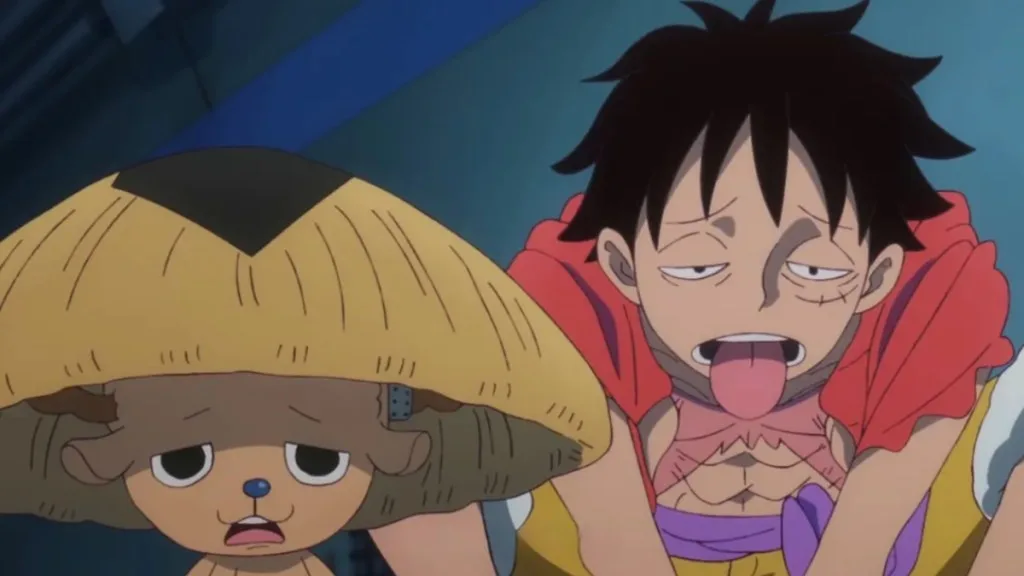

Two seemingly separate threads are suddenly converging into one compelling narrative—and it’s worth pausing to take them in together. On one hand: the release of Chapter 1165 of One Piece, a cultural event in its own right. On the other: the ongoing and now ten-year deep campaign of the “ONE PIECE 熊本復興プロジェクト 10年展” (ONE PIECE Kumamoto Revival Project) in Japan. By looking at them side-by-side we see not just fandom and spectacle, but how media franchises are embedding themselves into regional identity, civic recovery and global cultural momentum.
Here’s what I found — and why it matters.
Part 1: Chapter 1165 — The Build-Up to a Narrative Pivot
Let’s get the facts straight:
- Chapter 1165 of One Piece is scheduled to drop Sunday, November 9, 2025, at 10 AM ET (which corresponds to Monday, November 10 at midnight JST for Japanese readers).
- Fans are counting down fiercely because Chapter 1164 left major reveals and hints—especially around the mysterious “Will of D”, the legendary villain status of Davy Jones, and the next major turning point of the so-called “Final Saga”
- The release schedule places it in Week 46 of 2025, and some community forums suggest leaks/spoilers might surface around November 5–6.
Okay — now why this isn’t just another chapter release.
A. The Final Saga’s Momentum
We’ve been hearing “Final Saga” for years now—but now it genuinely feels accelerated. Everything is pointing toward major narrative closure: world-government secrets, ancient kingdoms, inheritance of the “Will of D.” Chapter 1164 upped the ante by suggesting Davy Jones might even be a former “King of the World”.
So the stakes in Chapter 1165 are bound to be massive: revelation, confrontation, transition. For a series that’s run for decades, fans know the drill: big chapter = big shift.
B. The Global Fandom Engine
While One Piece is Japanese in origin, its release is globally synchronized in effect: the timing across time-zones, the simultaneous discussions on Reddit (/r/OnePieceSpoilers), the social-media speculation. In short: this is an event, not simply a chapter
When the fandom is primed like this, two things happen:
- Expect huge traffic on official platforms (MANGA Plus, Shonen Jump+, VIZ Media) as readers schedule around the drop.
- The chapter becomes more than content—it becomes a cultural moment. Memes, livestream watch-parties, recap videos, deep-dive threads.
C. The Merchandise & Reveal Rhythm
It’s no accident merchandise, event announcements and narrative beats often align. As we’ll examine later, the industrial side of One Piece is running in parallel with the story progression. When Chapter 1165 drops, expect tie-in announcements.
Part 2: The Kumamoto Revival Project — When Pop-Culture Supports Real-World Recovery
Switching gears—but not fully. Because what’s happening in Kumamoto Prefecture (Japan) with One Piece is worth understanding in full, and it ties into fandom, locality and meaning in surprising ways.
What is the project?
- After the devastating 2016 Kumamoto earthquakes, manga author Eiichiro Oda, native to Kumamoto, lent support to the region, issuing a strong message of help.
- The “ONE PIECE Kumamoto Revival Project” (ONE PIECE 熊本復興プロジェクト) was launched as a collaboration between Oda, Kumamoto Prefecture and various regional stakeholders — using the international appeal of One Piece to bolster tourism, morale and regional identity.
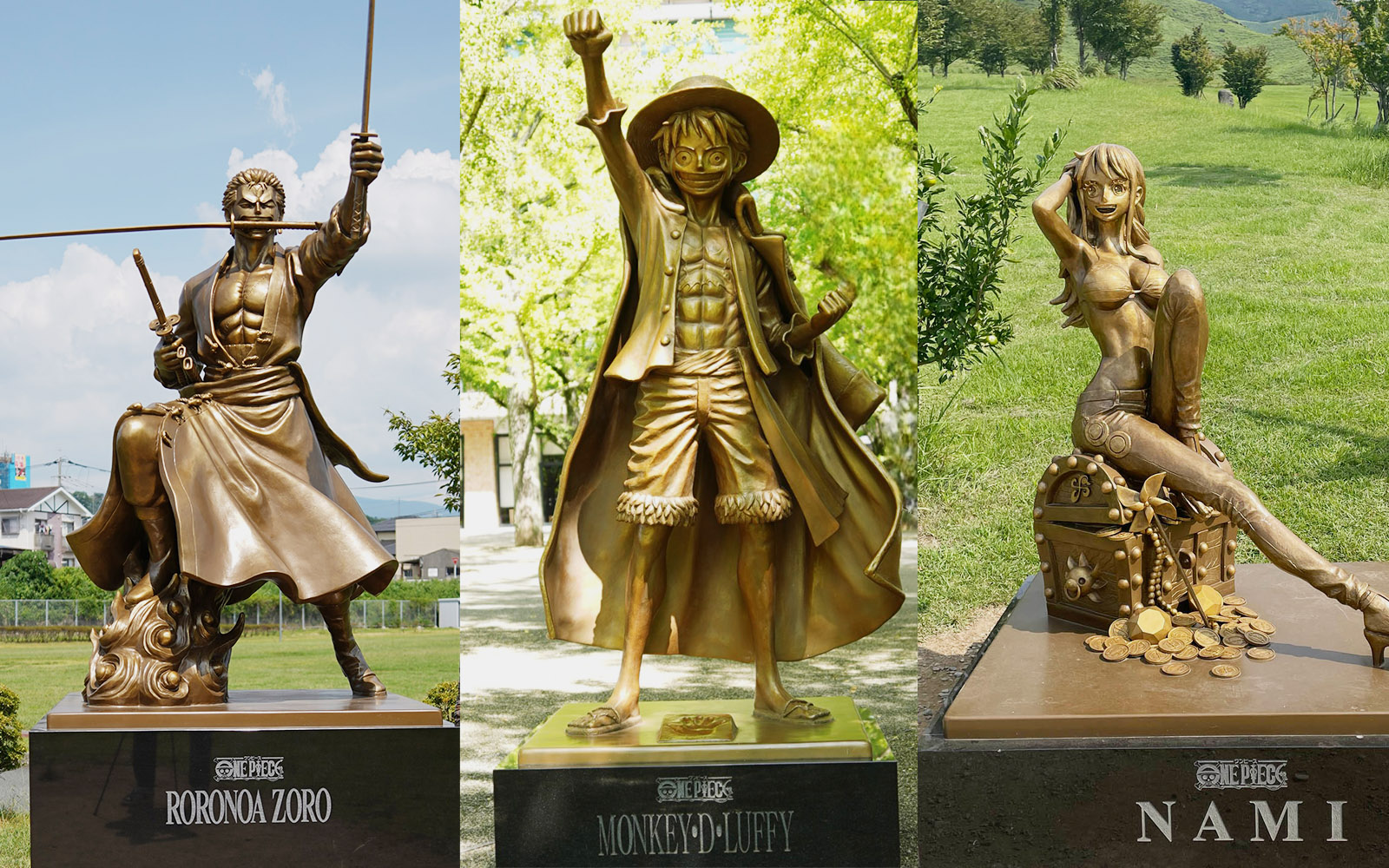
- One tangible outcome: the installation of 10 bronze statues across 9 municipalities in Kumamoto of the Straw-Hat crew. Each statue is carefully located and designed to reflect local character, disaster recovery themes, and the values of the series.
- Now, ten years on, the “10 Year Exhibition” is set for March 20 to May 24, 2026 at the Kumamoto Prefectural Museum, themed “SHI-RU-SHI” (しるし: mark/insignia), representing both the “mark of comradeship” from the manga and the “mark of recovery” in the region.
Why this matters
- It shows One Piece has transcended “just a manga/anime” role. It becomes a regional branding, societal tool, a tourist magnet.
- The project links narrative (comrades fighting adversity, building their dream) with real-life adversity (earthquakes, reconstruction). That resonance is powerful.
- For fans, this gives the series extra real-world weight: you’re not just following fictional pirates, you’re engaging with a living project of renewal.
Key trends this project illuminates
- Transmedia, place-based activation: A fictional IP anchoring itself into physical geography and real social impact.
- Fan pilgrimage + cultural tourism: The statues and exhibits become hotspots for fans (domestic & international), thus boosting Kumamoto’s visibility.
- Narrative-inspired civic branding: Using themes of adventure, resilience, friendship from One Piece to shape a region’s identity.
Part 3: Two Stories, One Pattern
Putting Section 1 and Section 2 side by side, here’s what they jointly suggest:
1. Storytelling as global “time-marker”
Chapter 1165 isn’t just another release—it’s part of a major saga turning point, and the fandom knows this. The simultaneous global reading, speculation and community reaction make it a collective moment.
Meanwhile, the Kumamoto project marks a temporal milestone: ten years of recovery, ten years of One Piece collaboration, culminating in a 2026 exhibition. Both are about “we’re moving to the next phase.”
2. Franchise as social infrastructure
One Piece is doing what many brands wish they could: creating lasting value beyond commercial product. The statues? Public art, tourist draw, communal memory. The upcoming chapter? A cultural event, discussion driver, digital spectacle.
This shows how modern media properties become infrastructural—they generate experiences, locations, community rituals.
3. Fan culture meets zone of convergence
Fans tuned in for Chapter 1165 are part of a global network. Fans traveling to Kumamoto to see statues are participating in place-based culture. Both streams are about participation—of fandom, of meaning, of identity.
When there’s synergy between narrative (chapter drop) and real-world activation (exhibition + figures + announcements), the brand isn’t just telling a story—it’s becoming a living ecosystem.
4. Narrative escalation synchronised with industrial escalation
As the story reaches its final phases (Chapter 1165, Final Saga), the merchandise, events and exhibitions also ramp up (figure announcements, BASE SHOP reservations, Kumamoto 10-Year event). The industrial side supports narrative stakes and vice versa.
This points to a larger strategy: content + commerce + experience all reinforcing each other. The “next big chapter” is not just within the pages of a manga—it’s in how fans engage, travel, buy, display and connect.
Part 4: What to Watch For
Since we’re here, let’s consider what to keep an eye on (and what might disappoint).
For Chapter 1165
- Major revelation: Will One Piece deliver light on the “Will of D”, Davy Jones’ identity and the world government’s secrets? Many expect something seismic.
- Global synchronisation: Expect spikes in community discussion, official social-media push, maybe even a livestream “watch party”.
- Spoiler window & leak risk: Community speculation expects leaks around Nov 5–6. If you want the first experience, avoid spoilers. Yahoo+1
- Tie-ins: Possibly new figure announcements, visuals, or other merch drops aligning with this chapter.
For the Kumamoto Project / Merchandise
- The “ONE PIECE BASE SHOP” is taking reservations for January 2026.
- The figure page (official site) includes characters like Monkey D. Luffy and the Five Elders — telling: they’re tying older lore (Five Elders) into collectible releases.
- For the exhibition: “SHI-RU-SHI” theme hints at deeper reflection—not just “look at these statues” but “trace the marks, understand the journey”. Expect some reveal of new content re: the statues and the region.
Risks / caveats
- Narrative: If Chapter 1165 underdelivers (just filler or small reveal), the hype may lead to backlash. High stakes = high potential for disappointment.
- Activation fatigue: With so many tie-ins (figures, exhibitions, announcements), there’s a risk the “special” becomes routine. The challenge is maintaining freshness.
- Regionalism vs globalism: While Kumamoto’s story is powerful, if the brand leans too hard into regional strain, it might alienate global fans who feel “outside”. Managing that balance matters.
Part 5: Why This Matters — Beyond the Fandom
Why should someone who isn’t deeply into One Piece care? Because this hybrid of narrative moment + regional project + brand activation reveals broader cultural dynamics worth noticing.
Content as cultural event
We’re moving into a world where content releases are less passive (“read when you like”) and more eventised (“read now together, live reaction, social moment”). Chapter 1165 is another marker of that shift.
Brands as local place-makers
Brands (including media IPs) are increasingly acting as anchors for place-based experiences. The Kumamoto example shows how fiction can translate into statues, tourism, regional recovery. That’s a new role for entertainment properties.
Participatory culture
Fans are no longer observers. They’re commentators, travellers, consumers, documentarians. They shape how these stories land. The dual movement (narrative + real-world) emphasises that fan culture is part of the ecosystem, not outside of it.
Narrative maturity
After decades, One Piece is mid-final act. That implies reflection, legacy, closing of arcs. For media watchers, it’s worth asking: how do long-running franchises conclude? What models of closure, of fan satisfaction, of cultural wrap-up emerge? Chapter 1165 is part of that experiment.
Final Thoughts
So yes: the drop of Chapter 1165 and the launch of merchandise/events tied to the Kumamoto revival project are separate facts—but together they signify something bigger. The One Piece universe is simultaneously:
- dragging us deeper into the story’s mythic core;
- bending outwards into real world regions, tourism, fandom activism;
- orchestrating a moment where story, commerce and place co-here into a single cultural wave.
In short: this is where fandom meets geography, where story meets civic identity, and where we as consumers become part of the activation.
If you’re counting down to November 10 (JST) for Chapter 1165 — cool. But also glance at Kumamoto, the statues, the collaboration, the regional boost. Because you’re not just reading a chapter. You’re witnessing the next phase of what One Piece as a franchise is becoming.
What do you think? Do you expect Chapter 1165 to deliver the big “reveal” everyone’s waiting for — or will it be more of a build-up installment? And how much do you think the real-world activation (Kumamoto exhibition, figures, flagship store) adds to or detracts from the storytelling experience?