
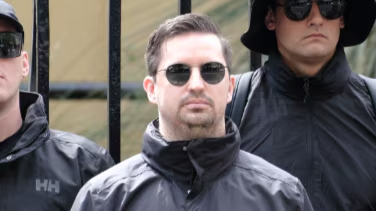
On a warm November afternoon in Sydney, the steps of the New South Wales parliament briefly turned into a stage for something that felt unsettlingly out of place in a modern, multicultural country. Around sixty men, most of them young and dressed in black, gathered in tight formation and lifted a banner calling for the dismantling of what they called the “Jewish lobby.” Their voices rose in unison as they chanted “blood and honor,” a phrase pulled straight from the lexicon of the Hitler Youth and long associated with neo-Nazi ideology.
They didn’t hide their identities. They didn’t flinch at the cameras or the bystanders. They seemed intent on being seen.
Among them stood a man who, until that moment, lived an ordinary life in Australia. His name was Matthew Gruter, a South African engineer who had moved to the country with his wife three years earlier. His visa had been sponsored by Aurecon, the engineering and design firm where he worked.
In every outward sense, he had settled into Australian life, building a home and presumably weaving himself into the rhythms of his new community. But his presence at the rally threw him into a national debate about extremism, immigration, and the responsibilities that accompany the privilege of living in a country not one’s own.
By evening, images of the demonstration had spread across social media.
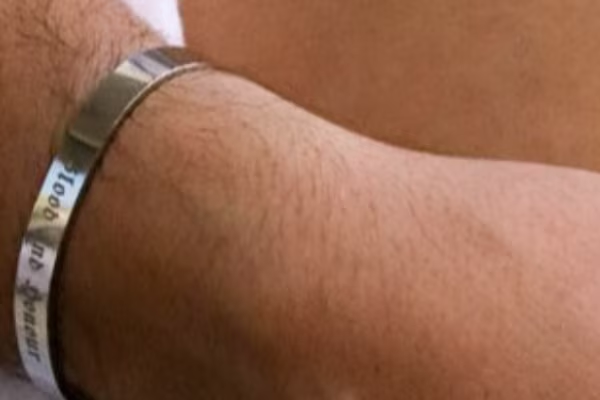
One photograph showed Gruter at the front of the group, wearing a silver bracelet engraved with the same phrase the crowd had been shouting.
It did not take long for officials to link the man in the photo to a temporary migrant whose right to stay was tied to both his employment and his conduct. Within days, his visa had been cancelled.
The announcement came from Minister for Home Affairs Tony Burke, who explained the decision in terms that were firm rather than fiery. A citizen, he said, is a full member of the national community. A temporary visa holder is a guest. And a guest who uses their time in Australia to spread hate or undermine the values of the society that welcomed them can be asked to leave.
There was a weariness in Burke’s explanation, as if he were correcting a misunderstanding that should never have arisen. A guest does not attack the household. A guest does not turn up on the front lawn shouting slurs at the neighbours. There was no attempt to dress the principle in legal jargon; it was presented as something close to common sense.
The situation touched a nerve, partly because Australia has always balanced a generous immigration system with an insistence on social cohesion. Many people accepted the decision as a straightforward application of that balance. Others saw it as a warning sign about a broader problem as extremist groups that had once been dismissed as fringe are now more willing to step into public view.
For years, organizations like the National Socialist Network lingered on the margins of Australian life, but they have grown bolder and more visible, drawing confidence from the wider global rise of far-right movements.
These groups tap into the grievances and uncertainties that form online, presenting themselves as guardians of tradition or identity while relying on slogans and symbols pulled from the darkest parts of the twentieth century. Their message is not new, but the openness with which they now deliver it is unsettling.
Gruter’s appearance at the rally showed how easily this ideology crosses borders. His online activity suggested a familiarity with extremist symbols well before he arrived in Australia. What changed on that November day was the clarity with which he displayed them.
Attention quickly turned to his employer, Aurecon, which confirmed it was reviewing the matter.
Companies that sponsor visas take on a distinct responsibility, and any link between an employee and a public display of extremist ideology forces a reckoning. Sponsorship is not just an employment arrangement. It is a declaration that the person is of good character and able to contribute to the community. When that trust is broken, the consequences are immediate.
Critics argued that even repugnant speech should not result in deportation. They warned that cancelling a visa over participation in a protest could set a troubling precedent. But that line of reasoning overlooked a basic fact of the system: temporary migrants agree to standards that go beyond those applied to citizens. They are bound by expectations of conduct. And when that conduct involves publicly celebrating an ideology grounded in violence and exclusion, the government has the authority, and many would say the responsibility, to act.
NSW Premier Chris Minns made his own position clear, warning that the state would not tolerate the normalization of extremist groups and signalling support for tightening hate speech laws. His words reflected a wider frustration that such a demonstration had taken place on the steps of the state’s democratic institutions. The sight of unmasked neo-Nazi sympathizers gathering so openly was, to many, a sign that complacency carries a cost. Minns pushed back against the idea that one can participate in such movements while still enjoying the full privileges of civic life. In his view, the men on those steps had made a choice, and choices carry consequences.
The rally and its aftermath have forced Australia to look more closely at the rise of extremist movements within its borders. The cancellation of one man’s visa will not dismantle these groups, nor will it undo the disturbing images that circulated afterward. But it has sparked a deeper conversation about what the country should tolerate, how free expression is balanced against community safety, and what responsibilities come with choosing to live in a diverse society.
Those conversations will continue, and they won’t always be easy. Lawyers, civil rights advocates, lawmakers, and community leaders will debate the limits of acceptable speech and the role of the state in protecting social harmony. But behind those debates is a simpler question: what kind of society does Australia want to be?
The government’s response suggests an answer. A temporary visitor who plants himself in the front row of a neo-Nazi rally cannot reasonably expect to remain in a country built on the values he is actively undermining. The cancellation of Matthew Gruter’s visa is an administrative act, but it speaks to a larger truth about the country’s threshold for tolerance. Australia is choosing to draw a clear line before extremism sinks deeper roots.
This moment will not define the nation’s long-term struggle with far-right movements, but it marks a point of clarity. It signals that democratic values are not abstract ideals; they are standards that impose obligations. And those who violate them do so with full knowledge of the risks.
For most Australians, the episode has served as a reminder that extremism does not diminish on its own. It has to be confronted, firmly and consistently. The events of November have made that task feel more urgent and has shown that the government is prepared to meet it.