
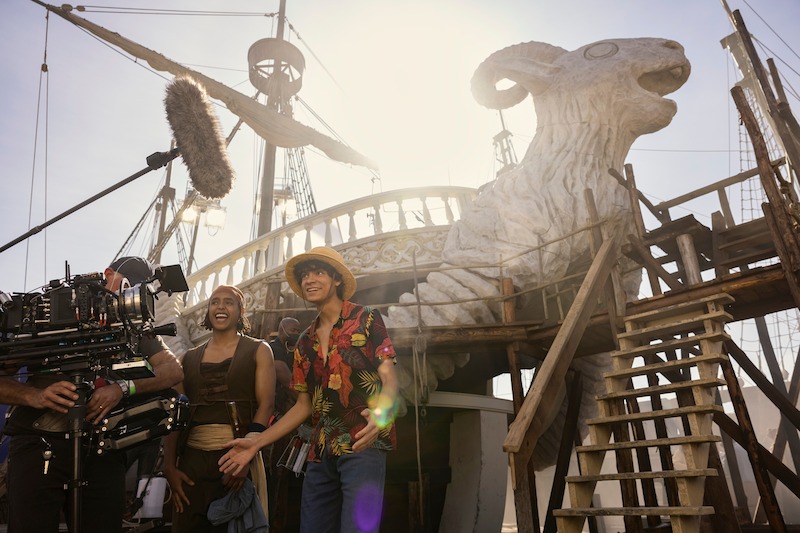
Netflix’s live-action One Piece was never supposed to work this well. That was the quiet consensus among critics, fans, and even parts of the industry right up until the moment the series dropped in 2023 and steamrolled expectations. It became one of Netflix’s top global releases, won praise from audiences who had never touched a manga in their lives, and earned something rare: Eiichiro Oda’s public approval.
That success changed the conversation about what long-form fantasy adaptations could be. And now, as production gears up for the show’s next chapter, the question isn’t whether Netflix can repeat its success, but whether it can grow into the sprawling, emotional, and intensely strange world the Grand Line demands.
The story naturally picks up where Season 1 closed: Luffy, his crew finally assembled, heading toward the Grand Line, unaware of how violent and unpredictable that ocean truly is. The final shot of Smoker lighting a cigar in Loguetown wasn’t subtle; it telegraphed that the next leg of the story begins where the Pirate King ended his. What many fans don’t realize is that the Loguetown set was already reconstructed at Cape Town Film Studios by late 2024. Production documents confirm a recreation of the execution platform, complete with daylight exterior shoots, storm rigging, and an enormous wind machine array that almost certainly exists to bring Dragon’s weather-shifting presence to life. This scene is essential to the live-action’s overall tone. Up to now, Luffy’s dream has looked charming and naïve. On the execution platform, when lightning cracks through the sky and a mysterious man places a hand on Luffy’s back, the fantasy finally collides with destiny. Netflix knows that if this moment feels weightless, the season’s emotional stakes won’t stick.
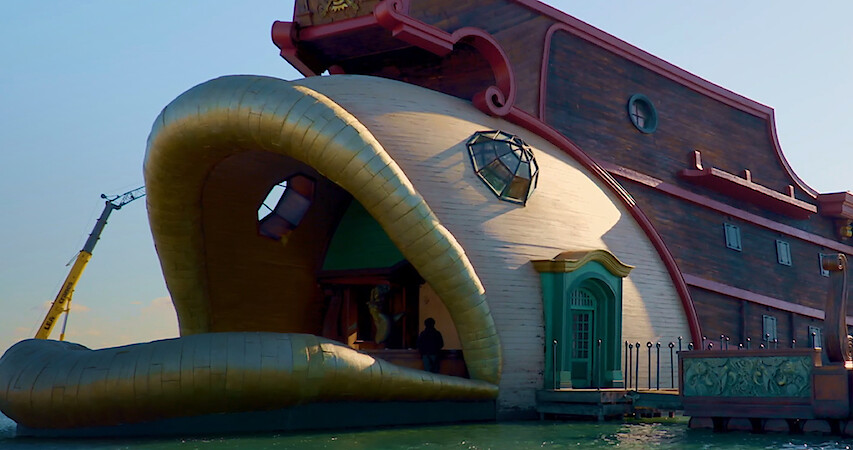
From Loguetown, the crew heads straight for Reverse Mountain, the entry point into the Grand Line and home to Laboon, the whale who has been waiting half a lifetime for a crew that promised to return. What makes this segment particularly interesting is also the technology. Netflix presented its new hybrid animatronic-digital creature pipeline at the 2024 FX Technology Summit, using, according to several attendees, a whale head as the practical example. That’s almost certainly Laboon. And because the show’s future depends heavily on the believability of creatures like Chopper, Sea Kings, and later even Zoan-hybrid transformations, Reverse Mountain becomes a quiet tech trial. If Laboon works emotionally, audiences will accept stranger things later: reindeer doctors, giants, moles with bazookas, and gods who descend from the sky with thunder. If Laboon doesn’t work, the Grand Line will start to feel like CGI soup.
Once inside the Grand Line, the Straw Hats land at Whiskey Peak, a deceptively warm welcome built on the false smiles of Baroque Works agents. This is where the show begins its slow, deliberate shift from pirate adventures to political intrigue. Leaked casting calls from 2024 describe “a blue-haired woman with aristocratic bearing hiding a secret,” almost certainly Vivi in her Miss Wednesday disguise. Other roles, Mr. 5, Miss Valentine, Mr. 3, have been confirmed behind the scenes but not yet publicly announced. The production’s internal documents also reference a small desert set scheduled for late-season filming. That’s a subtle but telling clue that the finale will indeed push the story into Arabasta territory, even if the real civil war arc won’t begin until Season 3. Netflix appears committed to letting Vivi join the crew by the end of Season 2, which matches both the pacing of the manga and the emotional arc the season needs.
Whiskey Peak bleeds directly into Little Garden, the prehistoric island that reminds every newcomer that the Grand Line is old, far older than the Marines or the World Government, and violently indifferent to the lives passing through it. Drone footage captured in Spain in late 2024 revealed enormous skeletal props, giant carved legs for forced-perspective shots, and volcanic ridges being dressed by set teams. These are unmistakable signs of Little Garden’s massive scale: dinosaurs that tower over the trees, twin giants who have been dueling for a century, and landscapes that look untouched by civilization. Handling giants in live action is tricky; they can easily appear cartoonish or weightless. But Netflix seems to be using a mix of partial suits, large-scale prosthetics, and digital limb extension, an approach similar to The Lord of the Rings’s classic forced perspective method, modernized with CGI cleanup. This matters not just for this season but for the long-term roadmap.
If the giants look believable now, Elbaf, one of the most anticipated future arcs, suddenly becomes feasible.
And then the snow begins. Drum Kingdom, with its blizzards, tyrant king, and heartbreaking flashbacks, is shaping up to be the emotional heart of Season 2. Icelandic news outlets confirmed a large Netflix production filming around Vatnajökull, and crew leaks mention sled tracks, mountain fortress sets, and heavy winter exteriors. There is no other arc this could be. Drum is also the arc that introduces Tony Tony Chopper, a character many considered “impossible” to translate into live action. Yet multiple insiders report that Netflix’s creature division is using a hybrid method: a partial animatronic puppet for Chopper’s base form, facial-capture overlays for expression, and digital augmentation for movement. Think of Rocket Raccoon’s expressiveness blended with Grogu’s physicality, and you get the general idea. If they pull this off, Chopper could become the breakout character of the entire adaptation.
Dr. Hiluluk’s flashback, the origin of the iconic pink-sakura snow, is planned as its own extended sequence. Production designers hinted in an interview with FX Insider that a “standalone emotional chapter” was being storyboarded, similar to how Nami’s backstory dominated Episode 7 of Season 1.
This tracks, because Hiluluk’s story is the moment the series establishes the Straw Hat ethos: broken people finding a ship that gives them a reason to live. That theme shaped the anime for a thousand episodes, and if Netflix wants audiences to invest through Arabasta, Water 7, and beyond, it needs this one moment to land with maximum impact.
Wapol, Drum’s cannibalistic, power-obsessed king, is another test case. He introduces a different flavor of villain: childish, cruel, and politically enabled. His role also ties directly into the larger World Government storyline, which Netflix seems determined to expand. Season 1 already added scenes of Garp and Koby training Marine recruits, moments that don’t exist in the manga but help flesh out the Navy as a parallel narrative track. Season 2 appears ready to continue that trend. Multiple internal documents reference “Marine Base North Window Scenes,” and insiders say Smoker and Tashigi will receive expanded screen time, giving the Marines more narrative weight as the Straw Hats begin disrupting global power structures.
Smoker, played by Callum Turner, has been undergoing smoke-based VFX tests since late 2024. Turner has also been photographed in motion-capture gear specifically for Logia-body modeling. His presence is more than episodic; he is the first Marine to treat Luffy as a threat rather than a curiosity. Freya Allan as Tashigi has trained in iaido swordwork for months. The showrunners have repeatedly expressed a desire for the swordsmanship in Season 2 to feel more grounded, less “flashy anime physics” and more like stylized but weighty martial arts. Early test footage reportedly prioritizes steel contact, real choreography, and practical stunts.
Crocodile, on the other hand, remains intentionally shadowed. Reliable industry sources say his actor is already cast, his silhouette is being filmed, and his voice will likely appear in the finale, but Netflix wants to hold his identity for the Season 3 marketing cycle. His presence will be felt through coded orders, Baroque Works hierarchy references, and early Arabasta tension. But the full reveal is being saved.
All of this comes together under a season structure that mirrors the pacing of Season 1 without rushing the story. Eight episodes remain the confirmed count. Production documents and industry leaks point toward a structure that begins with Loguetown, shifts through Reverse Mountain and Whiskey Peak, builds tension through Little Garden, and closes on Drum Kingdom’s emotional crescendo before handing the audience a desert-flavored preview of Arabasta. That final tease is almost guaranteed. The desert set in Cape Town is already confirmed, and Vivi’s hairpiece was reportedly tested during late-season makeup sessions.
Visually, the season is escalating dramatically. Netflix increased the VFX budget by roughly 30%, added a mocap studio in Cape Town specifically for hybrid-animal characters, and upgraded its water simulation capabilities to handle the Grand Line’s erratic storms. For fans who noticed the CGI roughness in a few Season 1 moments, this is a clear indication the studio understands the stakes. Season 2 features logia-type abilities, Zoan transformations, prehistoric wildlife, giant warriors, and a reindeer doctor with fully tracked facial expressions. If Season 1 felt grounded, Season 2 must make the surreal feel natural without breaking the immersion.
Filming is expected to run through most of 2025, with VFX work taking the first half of 2026. Netflix’s internal scheduling grid places Season 2 in the late-summer to early-fall window, with August through October 2026 as the most likely release range. That gives the show enough room to finish its creature work without rushing.
What all of this means is simple: Season 2 is the make or break season. Season 1 showed the adaptation can work. Season 2 must show the world can work. It needs to blend emotional storytelling, political intrigue, absurd fantasy, and blockbuster-scale action without losing the heart that made viewers fall in love with the Straw Hats in the first place. If Netflix succeeds, it will set the stage for a long-running, high-budget epic that carries One Piece’s energy into arcs that many once considered impossible to adapt. And if the early production signs are anything to go by, Netflix seems committed to proving that impossible isn’t in their vocabulary.