
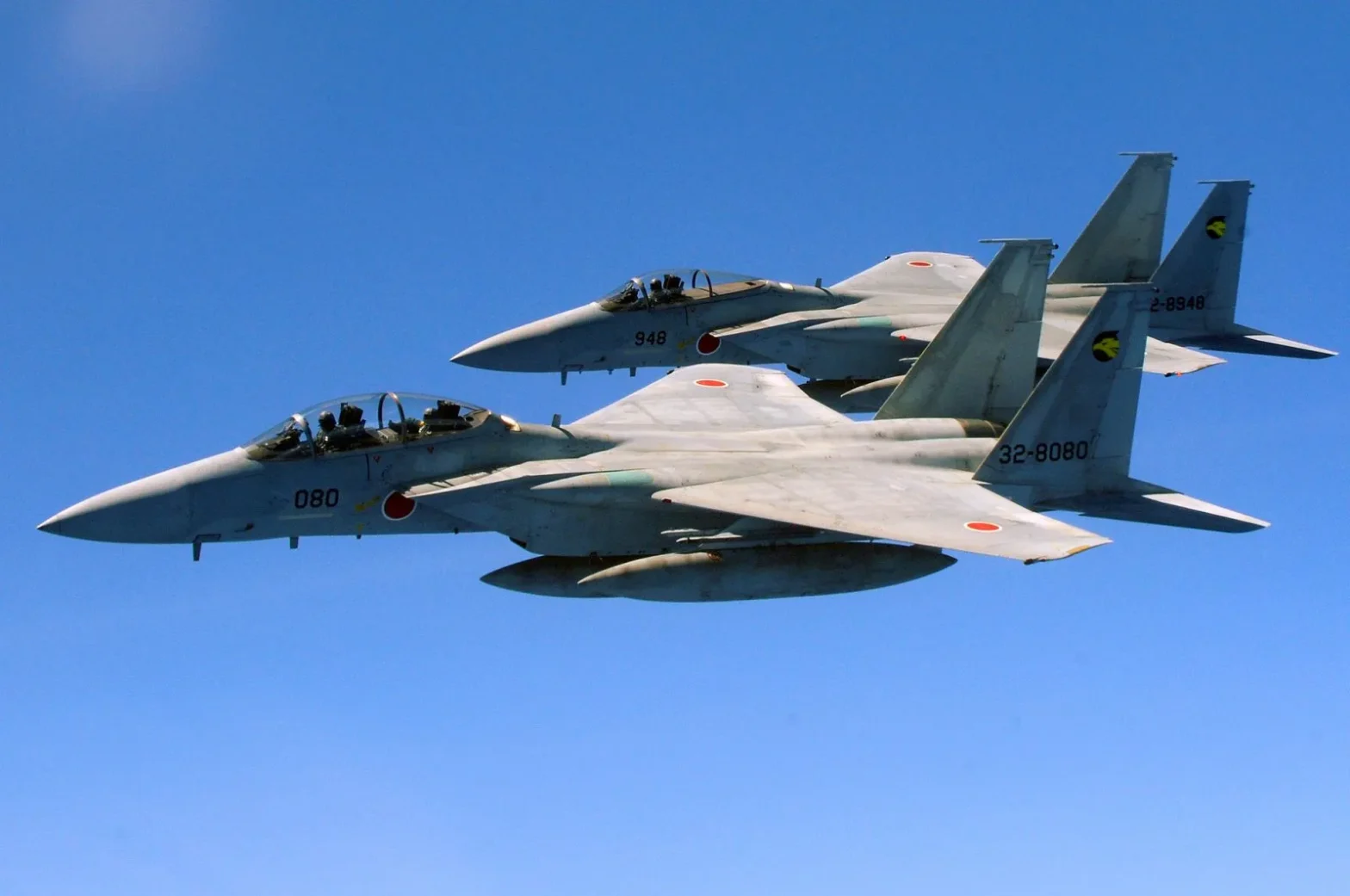
Japan’s latest confrontation with China was as a quiet signal on a radar screen. On Monday, a drone believed to be Chinese crossed the narrow band of airspace between Taiwan and Yonaguni, Japan’s westernmost island. By Tuesday, Tokyo had confirmed that the Japan Air Self-Defense Force scrambled fighter jets from its southwestern air defense command in response.
The incident would have been notable in any week. Yonaguni sits roughly 110 kilometers east of Taiwan, at the outer edge of Japan’s island chain, a place where fishing boats, tourism plans, and military strategy have been colliding for years.
But this particular drone flight came at a moment when relations between Tokyo and Beijing are already under strain, and it landed precisely in the space where several disputes now overlap: Taiwan’s security, Japan’s evolving defense posture, and China’s anger at being named explicitly in Japan’s contingency planning.
According to the defence ministry, the unmanned aircraft “believed to be Chinese” passed between Yonaguni and Taiwan on Monday before moving on, prompting the regional Air Self-Defense Force to scramble jets on an emergency basis.
China has so far declined to publicly confirm or comment on the drone, a familiar pattern in this kind of grey-zone activity: operations that fall short of open conflict but are meant to probe, test, and normalize a presence in contested airspace.
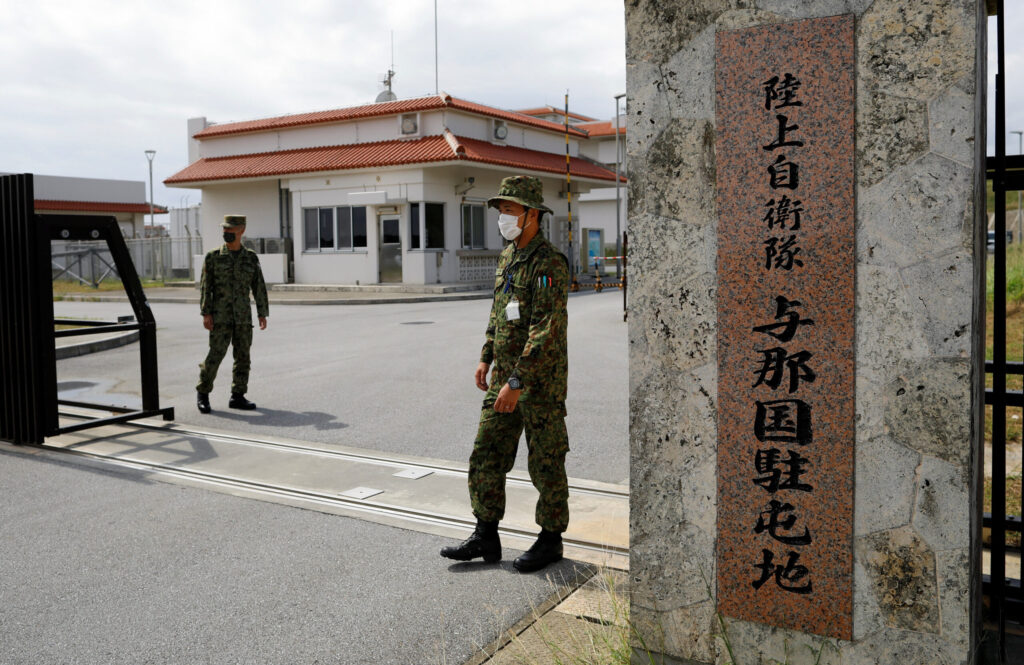
Yonaguni is not just any outlying island. Since 2016 it has hosted a Ground Self-Defense Force radar station, built after years of local debate over how much militarization residents were willing to accept.
Now Tokyo is preparing to go further by deploying the Type 03 medium-range surface-to-air guided missile (Chu-SAM), a truck-launched system with a range of roughly 48 kilometers designed to counter hostile aircraft and incoming missiles.
It is this planned deployment, combined with Prime Minister Sanae Takaichi’s recent remarks about Taiwan, that has turned Yonaguni into a symbol.
Beijing’s reaction has been sharp. Chinese officials have described Japan’s missile plan as “extremely dangerous,” a “deliberate attempt to create regional tension and provoke military confrontation,” and part of an alleged drift back toward militarism.
In Beijing’s narrative, the drone incident is simply another manufactured excuse for Japan to justify a military build-up near “China’s Taiwan.”
Tokyo tells a different story. Defense Minister Shinjiro Koizumi has stressed that the Chu-SAM deployment is defensive in nature, aimed at protecting Yonaguni and strengthening deterrence along the first island chain rather than preparing for strikes on foreign territory.
The underlying logic is simple: the more clearly Japan can signal its ability to intercept aircraft and missiles in its southwest, the less tempting it becomes for any adversary to test those gaps in a crisis.
The timing of the drone flight matters because it arrives on top of a separate, highly charged argument over what Japan would do in a Taiwan contingency. Earlier this month, during a Diet committee session, Takaichi said that a Chinese naval blockade of Taiwan could amount to a “survival-threatening situation” for Japan, using the precise legal language that activates the country’s 2015 security laws and allows for collective self-defense with the United States.
For China, that crossed an important line. Foreign Minister Wang Yi accused Japan of “crossing a red line” and warned against any move that could be read as direct military intervention over Taiwan.
Beijing followed up with a formal protest, a sharply worded letter to the United Nations portraying Takaichi’s comments as a grave violation of international law, new restrictions and warnings aimed at Japan, and a wave of rhetoric invoking wartime history.
That is the backdrop against which a single drone passed between Yonaguni and Taiwan and set off a scramble.
Taipei, meanwhile, has quietly backed Tokyo’s moves. Taiwan’s deputy foreign minister Francois Wu told lawmakers that Japan has every right as a sovereign state to harden its defenses in such a sensitive location, noting Yonaguni’s proximity to Taiwan’s east coast.
Taiwan’s foreign ministry later put it more bluntly: Japan’s strengthening of its facilities on Yonaguni “helps maintain security in the Taiwan Strait,” not least because Japan has no territorial claims or hostile intent toward Taiwan.
For Taipei, Japanese radar coverage, air-defense systems, and rapid response capabilities in the area are part of a wider effort to complicate any Chinese move in the strait.
Layered on top of this local geometry is a familiar triangle: Japan, China, and the United States. On Monday, Donald Trump spoke with Xi Jinping, a call that, on the surface, centered on trade, agricultural purchases, and the broader state of U.S.-China relations.
The next day, he called Takaichi. According to both Japanese and U.S. accounts, Trump briefed her on his discussion with Xi and reinforced the strength of the U.S.–Japan alliance, telling her she could “call me anytime.”
For many in Tokyo, that sequence raised an obvious question: was Washington quietly asking Japan to soften its language on Taiwan in order to ease U.S.–China tensions, or was it offering reassurance that Japan would not be left exposed if it held firm? Publicly, Takaichi emphasized only that the call confirmed “close coordination” between the two allies and refused to say whether her Taiwan remarks came up, citing diplomatic protocol.
The ambiguity is deliberate. It allows her to maintain a tough line at home while avoiding an explicit clash with Washington’s own balancing act.
The drone incident underscores how narrow the margins have become. Unlike a large naval exercise or a missile test, a single unmanned aircraft can be written off as routine reconnaissance. Yet where it flies, when it appears, and what it flies over are all messages. Passing between Yonaguni and Taiwan, in the middle of a public fight over missiles on that island and over Japan’s right to respond to a Taiwan attack, is hardly neutral.
There is also a legal dimension that rarely makes headlines but shapes how both sides behave. Japan’s air defense identification zone (ADIZ) around Yonaguni already overlaps with Taiwan’s, a situation created years ago when Tokyo pushed its ADIZ boundary westward to match its territorial waters.
That overlap gives militaries extra room to operate in the gaps between formal sovereignty and air-defense practice. Drones are especially useful in this space because they probe reactions without risking pilots’ lives.
What makes the current moment combustible is that several trends are converging at once. China is more openly warning that foreign interference over Taiwan will be “crushed,” a phrase that reflects both domestic messaging and a growing confidence in its military.
Taiwan is responding with plans for a massive increase in defense spending, including new investments in missiles and drones of its own.
Japan, under Takaichi, is testing how far it can stretch its postwar constraints without snapping them, using the legal concept of a “survival-threatening situation” as the hinge. And the United States is trying to hold together alliances while keeping space open for tactical deals with Beijing.
Within that larger picture, the suspected Chinese drone over Yonaguni might seem like a minor episode. But it is exactly these low-level encounters that shape habits and expectations: who responds and how fast, which routes are tolerated, which deployments draw loud protests and which gradually become normal. Each decision taken in those moments becomes a precedent for the next crisis.
The question for Tokyo and Beijing is whether they are still interested in drawing lines they both understand, or whether incidents like this will simply be folded into a deeper pattern of pressure and pushback. For now, the signals are mixed. Japan insists its new defenses are stabilizing; China says they are provocative; Taiwan quietly cheers them on; Washington speaks of alliances and stability while talking trade with Beijing.
Somewhere in that tangle of messages, a drone crosses a narrow stretch of sky, and fighter jets rise to meet it.