

Akio Toyoda built his reputation as the steady heir to Japan’s most influential industrial powerhouse, Toyota. For years he guided the company through recession, recalls, technological shifts, and rising global competition, showing the restraint and discipline expected of someone carrying both a family legacy and a national institution.
That image held for much of his tenure.
But over the past decade another story has taken shape, one that raises difficult questions about Toyota’s direction and the political world it chooses to move in. The shift unfolded gradually, beginning with trade anxieties and ending in a public posture that places Toyota far closer to America’s MAGA movement than most consumers realize.
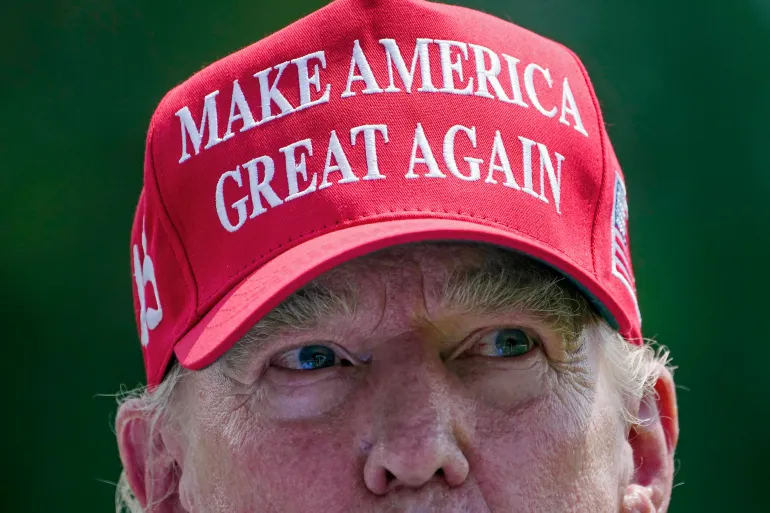
When Trump campaigned in 2016 on economic nationalism and the threat of tariffs, Toyota responded carefully. Trump warned of a “big border tax” aimed at Toyota’s plans to build cars in Mexico, a direct shot at a company built on cross-border supply chains. Toyota spent the next several years trying to appear like a safe political partner. It announced new US investments, expanded factories, and tried to ease America’s suspicion of Japanese automakers. By 2025, Reuters and others reported that Toyota had pledged another ten billion dollars in US investment after Trump publicly claimed the commitment came from Akio Toyoda himself.
Intentional or not, the message was clear: Toyota would do what it needed to stay on the favorable side of a volatile White House.
The financial relationship became more visible in late 2024, when Toyota confirmed a one million dollar donation to Trump’s second inauguration fund. Ford and General Motors made similar contributions, but Toyota’s decision carried different implications. At the time, the company was lobbying hard against aggressive federal EV rules and looking for relief from potential tariffs on vehicles assembled in Mexico.
The donation was small in corporate terms but meaningful in context. It signaled a willingness to support political actors whose priorities aligned with slowing the pace of the energy transition.
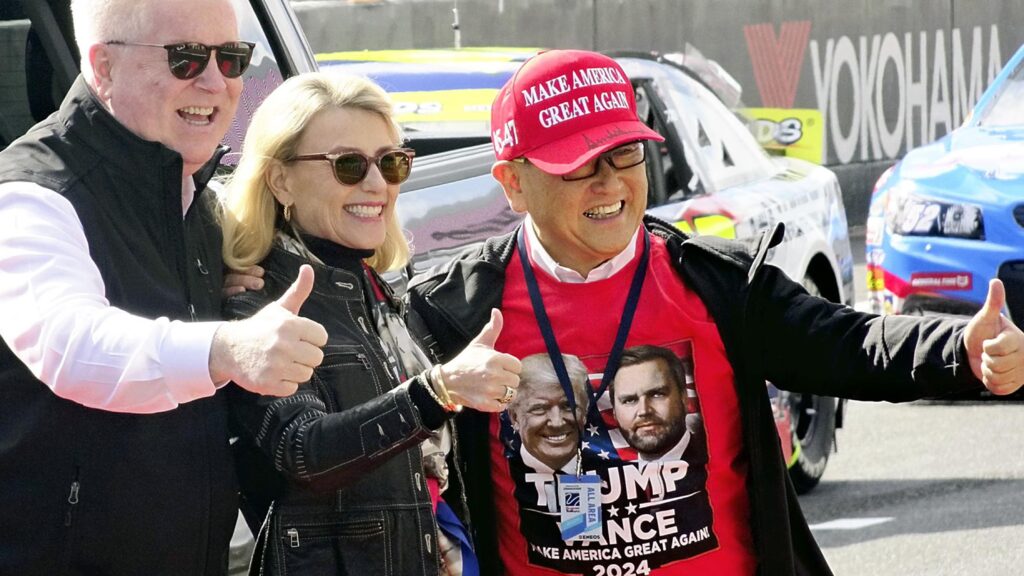
What had been a careful, mostly hidden dance shifted in 2025. At a motorsports event at Fuji Speedway, Akio Toyoda appeared wearing a MAGA hat and a Trump–Vance campaign shirt. The photo circulated quickly. Announcing investments to avoid tariffs was one thing. Appearing in partisan campaign gear aligned with a movement known for climate skepticism and regulatory rollback was something else entirely. For the chairman of Japan’s most famous multinational to show up in that outfit, in public, was more than political positioning. It was a declaration of identity.
Yet the political optics are only part of the story. The larger issue, and the one with global consequences, lies in Toyota’s long-running stance toward climate policy under Akio Toyoda’s leadership.
Independent assessments paint a consistent picture. InfluenceMap has ranked Toyota at the bottom of major automakers for climate lobbying. Greenpeace’s “Toyota Files” outlined years of efforts to weaken or delay EV mandates in Australia, Mexico, New Zealand, and other markets. Investor groups representing trillions in assets have repeatedly demanded that Toyota disclose and reform its climate lobbying. Each time, the board has pushed those proposals aside.
Campaign finance data adds another layer.
A January 2025 report from Public Citizen found that Toyota donated to more climate-denying members of Congress than any other automaker. Electrek summarized the point bluntly: Toyota had become the largest supporter of climate deniers in the industry. Streetsblog noted that the company was increasing its spending to help elect lawmakers hostile to climate science. This pattern doesn’t look incidental. It reflects a worldview that sees strong climate policy as a commercial risk and views rapid shifts to battery-electric vehicles as something to slow, not embrace.
Akio Toyoda has given these views a public voice. He has warned that all-EV mandates could make cars unaffordable, describing the situation as a “flower on a high summit” that people can admire but can’t reach. He has said he speaks for a “silent majority” in the auto industry who doubt fast electrification timelines. As a senior leader within the Japan Automobile Manufacturers Association, he has been one of the most influential voices pushing back on aggressive decarbonization plans. Raising questions about speed and cost is not unreasonable on its own. But a consistent pattern of resistance, backed by political alliances with those who deny the science altogether, moves the company from caution to obstruction.
This shift is striking because Toyota was once the global symbol of responsible automotive innovation. The Prius didn’t just sell well. It became cultural shorthand for environmental awareness, a proof point that thoughtful engineering could shrink emissions without compromising everyday usability. Toyota’s branding leaned into that promise. Today it is harder to reconcile that image with a company routinely identified as the most aggressive anti-climate lobbyist among its peers, financially aligned with politicians who reject climate science, and led by a chairman whose public gestures now resonate with the aesthetics of Trump-era populism.
Consumers are noticing. Investors are as well, even if they respond quietly. Political alignment carries reputational risk for any global firm, but it also has strategic consequences. The energy transition is already reshaping supply chains and national industrial planning. China dominates battery manufacturing and EV production because it backed the sector early and consistently. European automakers, after wavering, are accelerating electrification under regulatory pressure. Even US automakers, long dependent on profitable combustion platforms, now see that delaying the EV transition risks losing entire market segments.
Toyota understands these forces. It is investing heavily in solid-state batteries and expanding its electrified lineup. The complication is the tension between its engineering ambitions and the political signals coming from the top. When the chairman publicly aligns with movements that frame climate action as a cultural threat, it becomes harder for Toyota to position itself as a long-term leader in future mobility. Markets respond not only to technology but to narrative, and Toyota’s narrative has grown muddled.
This is why the present moment matters. Toyota remains one of the world’s most respected industrial powers. Its choices influence global emissions trajectories and the pace of technological change. When a company of that scale appears aligned with the MAGA movement through donations, rhetoric, and public imagery, the signal reaches far beyond American politics. It suggests that the world’s largest automaker sees more advantage in slowing the transition than leading it. It suggests that obstruction looks safer than innovation.

From the United States to Japan and beyond, Toyota’s visible drift toward Trump-aligned politics has unsettled audiences who once saw the company as a model of steady global stewardship. In the U.S., Toyota’s $1 million inauguration donation and public investment pledges served as political trophies for Trump’s economic nationalism, even as many Americans felt betrayed watching a onetime Prius-era climate leader align with climate-denialist politicians. In Japan, Akio Toyoda’s MAGA-branded appearance struck a deeper chord, undermining the image of a national champion that traditionally anchors Japan’s diplomacy with predictability and restraint. Across Europe and Asia, where the EV transition is accelerating, Toyota’s stance is widely read as resistance rather than leadership, raising doubts about whether the pioneer of hybrids is now positioning itself on the wrong side of an industrial shift. The global expectation is that Toyota should behave like a forward-looking steward, yet its embrace of MAGA aesthetics makes the company appear less like a 21st-century leader and more like an industrial giant negotiating the anxieties of a fading past.