
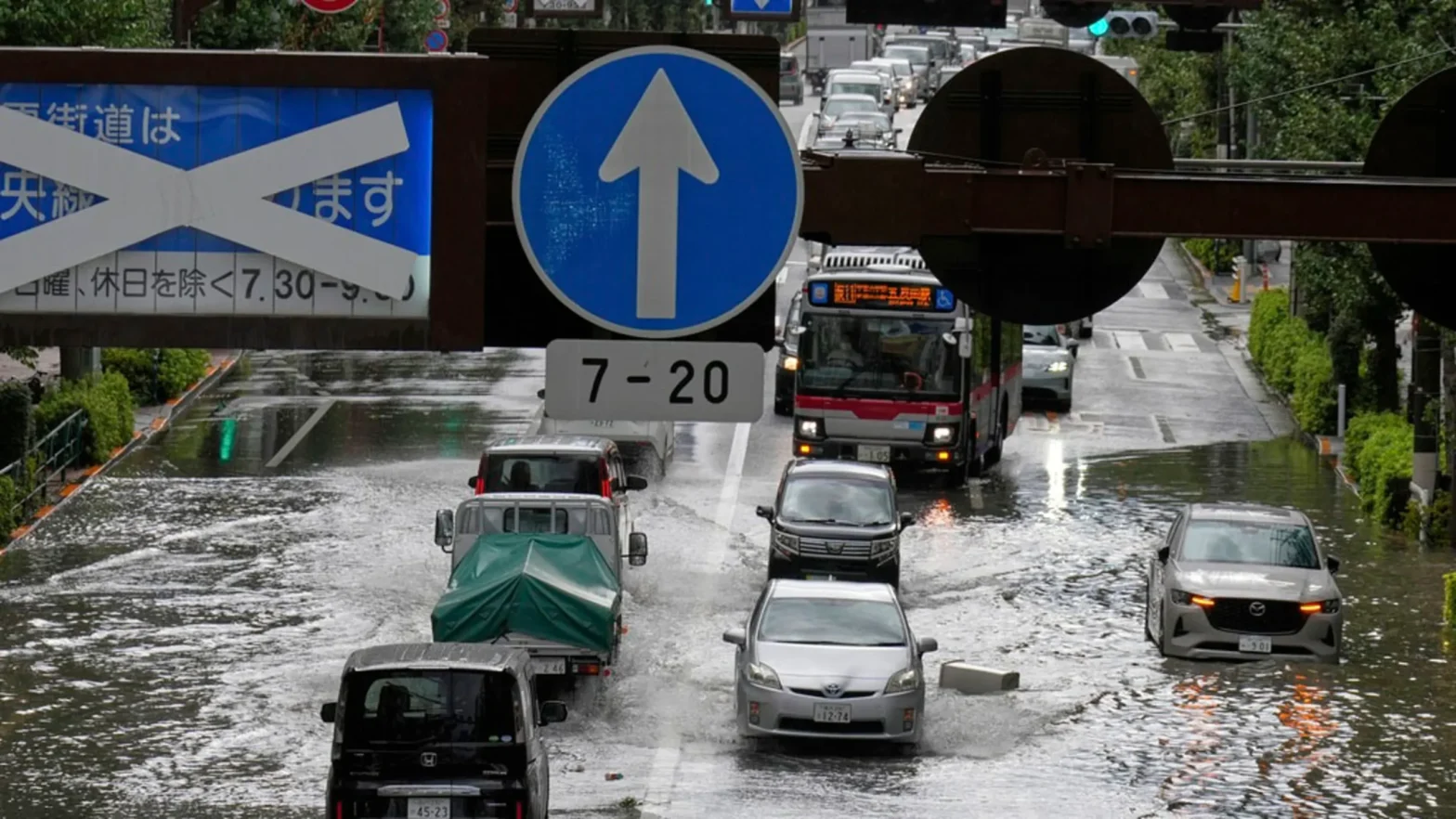
Tokyo, September 11, 2025 — The city awoke to chaos. The clouds overhead thickened by mid-morning, growing heavy and ominous. Then, as if someone opened a tap, 12 centimeters of rain poured in a single hour. Streets vanished under deluge, the drainage grid groaned under the sudden load. In that hour, the familiar Tokyo rhythm snapped.
Water surged through avenues where people minutes before had been commuting to work. Cars splashed through knee-deep streams, tires gripped nothing but murky currents. In some neighborhoods, rivers breached their banks, forcing families to flee homes now half-submerged. Trains glided out of their stations only to be forced to stop, powerless against flooding tracks; even the Shinkansen bullet train came to a still. At Haneda Airport, lightning hammered the ground so fiercely that ground services and air traffic control suspended operations. Flights were delayed. Flights were canceled. Thousands were stranded. Powerlines overloaded. Over 7,000 homes plunged into darkness.
Amid the chaos, one worker died—crushed when a stack of containers collapsed at a port in Ota Ward. Others were injured. In Setagaya Ward, a record rainfall nearly tore through infrastructure: 92 millimeters in one hour. In other districts, Ota among them, figures approached that same, staggering intensity. Officials issued alerts for landslides, river flooding. Warnings came to stay inside. To avoid unnecessary travel. To stay safe.
This wasn’t a storm Tokyo should’ve weathered so badly.
Modern life thrives in the city’s ceaseless motion. Bullet trains punctuate silence with speed. Airports echo with ambition. Skyscrapers rise with pride. Yet none of this comfort could resist a downpour engineered by nature’s unpredictability.
What happened here wasn’t only about rain. It was more. It was a symptom.
Extreme weather, increasing
When over 100 millimeters of rain falls in an hour, something beyond the usual has snapped. These kind of torrential downpours, once rare, are now far more frequent across Japan. They emerge as “guerrilla rainstorms”—violent cloudbursts that burst without much warning. They localize. They concentrate. They overwhelm prepared systems. The name suggests ambush. They hit swift. Hard. Messily.
Tokyo knows this pattern well. In July, in 2024, heavy rains flooded precincts, turned subways into rivers, forced emergency services into overdrive. The city’s massive underground drainage system—nickname “cathedral”—was strained. Engineers have poured billions into expansions. Tunnels, storage reservoirs, backup pumps. Still, even these colossal works are beginning to show their limits. When nature delivers torrents in these volumes, whole sections of infrastructure simply cannot cope.
Why now? Why so bad?
The answer lies in a convergence of climate change, urban growth, and design that assumed slower patterns of rain.
Climate models had long predicted that warming would produce more moisture in the air. Moisture is fuel. Enough energy in the sky, and storms grow denser, heavier, more extreme. This is not some distant projection—it is already here.
Cities enforce concrete jungles. Hard surfaces, asphalt, even tightly packed green space can only do so much. Rain has fewer places to soak in. Stormwater drains are built for certain maximums. Too often those maximums assume steady rains. Gentle declines into calm. They do not always assume 12 centimeters in an hour.
Add heat islands that trap warmth, encourage convective activity. Add rivers hemmed in by walls. Add even occasional natural barriers long compromised by development. The recipe becomes harsh: storm develops, drainage fails, water piles up, damage ensues.
The human cost
Tokyo’s deluge killed one person. But the toll is more than what numbers can reveal.
For workers stranded in transit, hours lost. For residents whose homes flooded, immediate damage and lasting dread. Furniture ruined, electronics lost, documents soaked. Communities in low-lying wards—or those near rivers—feel vulnerable, exposed to nature’s whims. Power failures mean hospitals, elderly care, refrigeration, everyday essentials go dark.
The cost in public transit delays cascades: people miss jobs, connections, meetings. Airports shut down, business delayed. Markets shaken. Once streets become waterways, the delicate choreography of a city’s life bends and sometimes breaks.
Tokyo’s battle plan
City leaders do not pretend solutions are easy. They have several massive projects underway or on the drawing board.
One is to expand the subterranean “cathedral”—the vast network of tunnels and giant storage facilities that siphon off water when rivers rise. Another is to upgrade levees and overflow channels for rivers and creeks. Yet more emphasis is going into early warning systems, real-time data from sensors, radar, weather forecasting that can catch flashes before they grow ruinous.
Urban planning is slowly shifting too. Green roofs, permeable pavement, parks that double as flood retention zones. Regulation to prevent construction in flood-prone areas. Every reclaimed plot, every new building has to consider water.
But upgrades take time. Engineers. Money. Land. Bureaucracy does not move at the speed of a sudden storm.
Lessons beyond Tokyo
Tokyo’s plight is not unique. Cities around the world are learning the same lesson the hard way. Beijing. Mumbai. Houston. São Paulo. When urban density meets volatile weather, the stresses magnify.
Climate adaptation is no longer optional. It is the front line for survival in urban hubs. Water management can’t be an afterthought. Building codes must anticipate extremes. Infrastructure must be resilient—not just efficient under normal conditions, but robust under strain.
What you need to know
If you live in or near Tokyo, or any city prone to intense rainfall:
-
Stay alert. Follow meteorological agency updates. When warnings go up, take them seriously.
-
Know your ward’s topography and flood-risk spots. Which areas flood first? Which routes become impassable fast?
-
Prepare basic emergency kits: power banks, lights, waterproof bags for valuables, medicine.
-
Incentivize local green infrastructure: support tree planting, rain gardens, permeable ground surfaces.
-
Press for resilient urban planning: demand that new developments respect flood zones, drainage capacity, not just aesthetics or short-term convenience.