
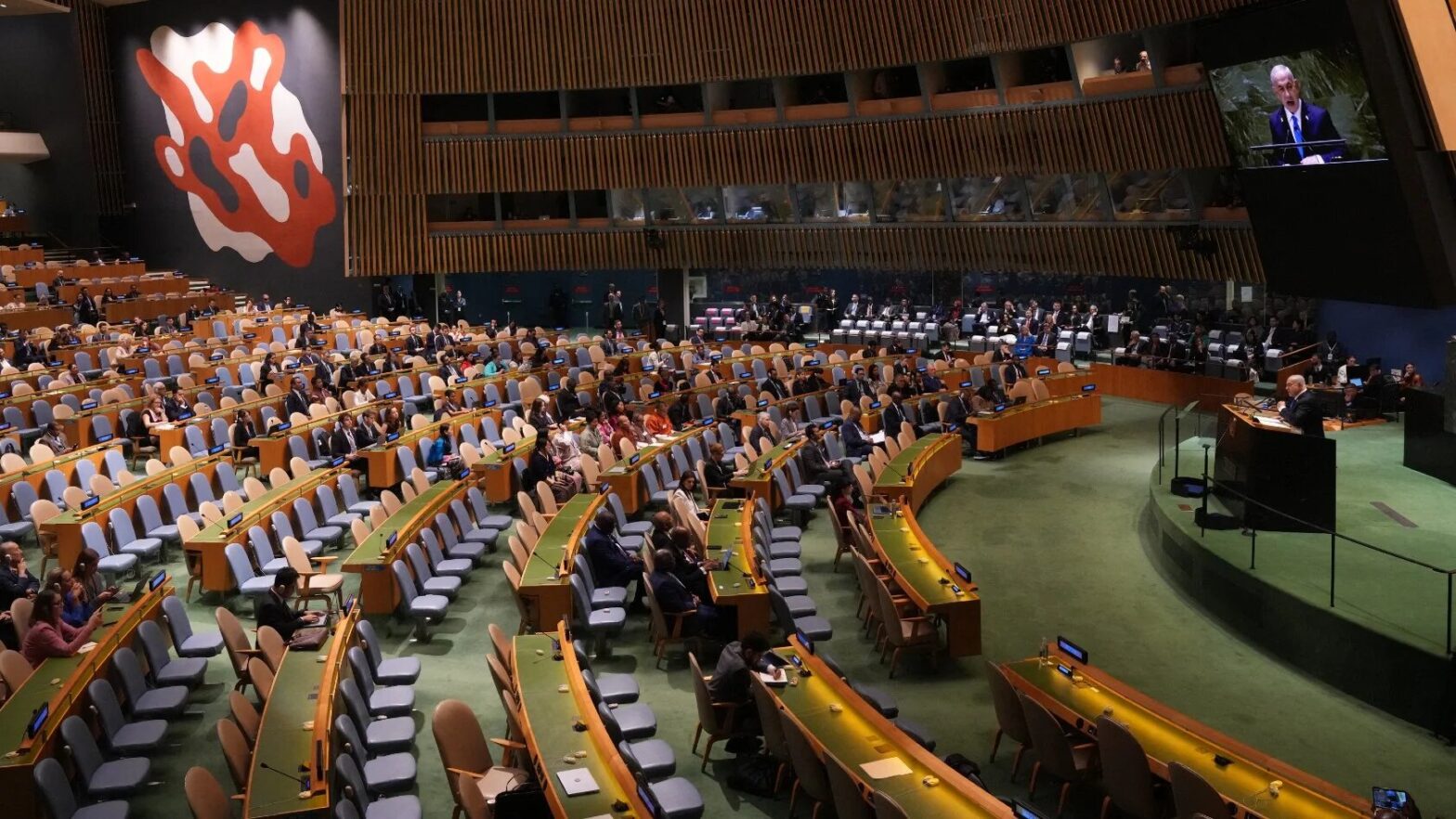
When Israeli Prime Minister Benjamin Netanyahu took the stage at the United Nations General Assembly on September 26, 2025, the spotlight was already blazing. The war in Gaza, months of escalating civilian casualties, and mounting international criticism had set the stage for one of the most scrutinized speeches of his political career. Yet what unfolded before the global community was more than just another diplomatic address. It was a spectacle of protest. Over one hundred diplomats from more than fifty countries stood up and walked out—some silently, some in open defiance—sending a clear and undeniable message: Israel is facing growing isolation on the world stage.
This dramatic moment was not without precedent. Walkouts at the UN are symbolic gestures, reserved for moments when the representatives of nations wish to express condemnation without engaging in verbal clashes. But the scale of this particular protest was extraordinary. Rows of empty seats, once occupied by diplomats from Europe, Africa, Latin America, and Asia, became the visual backdrop to Netanyahu’s words. For many observers, it crystallized the widening gap between Israel’s government and a large portion of the international community.
Netanyahu’s Message: Defiance and Determination
Netanyahu’s speech itself was crafted to project resolve. He struck a combative tone, insisting that Israel would not bend to international pressure or accept external dictates regarding the conflict in Gaza. At the heart of his address was a rejection of the recent wave of recognitions of Palestinian statehood by countries including the United Kingdom, France, Canada, and Australia. Rather than viewing these developments as steps toward peace, Netanyahu declared them proof that, in his words, “murdering Jews pays off.”
The line was provocative, designed to rally support at home and among Israel’s staunchest allies. Yet it was also a direct rebuke to some of Israel’s closest democratic partners, who argue that recognizing Palestine is necessary to keep alive the vision of a two-state solution. By choosing such incendiary language, Netanyahu ensured headlines—but also deepened the rift between Israel and nations that have traditionally walked a fine line between supporting its security and urging it toward compromise.
Netanyahu also doubled down on Israel’s military objectives. He vowed to “finish the job” in Gaza, insisting that Hamas remained a mortal threat and that Israel would not rest until the group was dismantled. For him, this was not just a war of defense but an existential struggle for survival. He portrayed Israel as a nation standing alone against a tide of terrorism, unwilling to relent despite international protests.
The Humanitarian Shadow
While Netanyahu spoke of resolve, critics point to the humanitarian catastrophe unfolding in Gaza as the unavoidable shadow of Israel’s military campaign. Months of relentless bombardment have left large portions of the territory in ruins. Hospitals are overwhelmed, food and water supplies are strained, and the number of civilian casualties has steadily risen.
International organizations, from the UN Relief and Works Agency to the International Committee of the Red Cross, have issued increasingly dire warnings. Entire neighborhoods have been reduced to rubble, and hundreds of thousands of people have been displaced. For many countries, especially in the Global South, this humanitarian toll makes Netanyahu’s call to “finish the job” ring as a justification for further suffering rather than a legitimate defense strategy.
It is this context that fueled the mass walkout. For those diplomats who left the chamber, remaining seated while Netanyahu defended his government’s approach would have amounted to tacit approval. Walking out was a statement in itself—a refusal to normalize rhetoric that many see as detached from the human cost of the war.
A Broadcast Into Gaza
Despite the dramatic protest in the General Assembly hall, Netanyahu made clear that his intended audience extended beyond the diplomats in New York. His office arranged for the speech to be broadcast into Gaza through loudspeakers positioned along the border. Israeli officials also claimed that the remarks were streamed directly to phones within Gaza, though the accuracy of this claim remains debated.
The symbolism was clear: Netanyahu wanted his words to be heard not just by world leaders but by the very population enduring the war. For supporters, this demonstrated strength and psychological warfare against Hamas. For critics, it was an act of propaganda, meant to reinforce dominance rather than signal any willingness to pursue peace.
The Walkout: Symbolism and Strategy
The image of mass emptying seats during a head of state’s speech is a powerful one. Diplomatic walkouts are carefully coordinated acts, typically planned in advance by delegations that wish to send a unified signal. In this case, representatives from across continents took part, underscoring how criticism of Israel’s approach transcends traditional geopolitical divides.
Such gestures matter because they shape global perception. The UN, though often criticized as ineffective, remains the central stage for international diplomacy. To be publicly shunned there is to be branded as an outlier, at least symbolically. For Netanyahu, who has long embraced an “us against the world” narrative, the walkout may serve to reinforce his domestic political standing among supporters who see international criticism as proof of Israel’s righteousness. But internationally, it underscores the isolation Israel increasingly faces.
Reactions from Around the World
Europe
In Europe, where recognition of Palestinian statehood has been gaining momentum, reactions to Netanyahu’s speech were swift. Leaders in Paris and London defended their decisions, emphasizing that peace requires equal recognition and that recognition of Palestine is not a reward for violence but an investment in stability. The walkout was portrayed as a necessary stand against inflammatory rhetoric.
The Middle East
In Arab capitals, Netanyahu’s remarks were condemned as dismissive of Palestinian suffering. Countries that have normalized relations with Israel under the Abraham Accords faced domestic pressure to distance themselves from the speech. For them, balancing strategic ties with Israel and solidarity with Palestinians has become increasingly difficult.
The United States
In Washington, the response was more measured. While U.S. officials did not join the walkout, they expressed “deep concern” over the humanitarian toll in Gaza and reiterated support for a two-state solution. The Biden administration remains caught between strong pro-Israel sentiment among parts of the American electorate and growing frustration within its own ranks over the direction of the conflict.
The Global South
From Latin America to Africa, leaders criticized Netanyahu’s words as evidence of a refusal to acknowledge Palestinian rights. Many of these countries have become increasingly vocal in calling for international mechanisms to hold Israel accountable, including potential investigations by the International Criminal Court.
Protests Beyond the UN
The walkout was mirrored by street protests in New York, where demonstrators gathered outside the UN headquarters carrying Palestinian flags and banners calling for an immediate ceasefire. Their chants echoed through the city, demanding accountability for civilian deaths and accusing Israel of war crimes.
These protests were part of a broader wave of global activism. Across Europe, Asia, and North America, rallies have been held regularly to condemn the war in Gaza. For many demonstrators, Netanyahu’s speech was not a defense of national security but a denial of human suffering.
Netanyahu’s Calculated Gamble
For Netanyahu, the UN address was both a risk and an opportunity. Domestically, his hawkish stance strengthens his standing among hardline supporters who see compromise as weakness. His portrayal of Israel as a lone nation standing against terror resonates with those who view global criticism as hypocrisy.
Internationally, however, the speech may deepen fractures. Israel depends on diplomatic partnerships not only for security cooperation but also for economic ties and legitimacy. Every walkout, every recognition of Palestine, chips away at the broad support Israel once enjoyed among Western democracies.
Netanyahu’s gamble is that Israel’s military superiority and strategic alliances with the United States and a handful of others will outweigh the costs of global isolation. Yet history shows that even the strongest alliances can erode under sustained diplomatic pressure.
The Larger Picture: What Comes Next
The walkout at the UN is unlikely to shift Israel’s immediate strategy in Gaza. Netanyahu has staked his political future on defeating Hamas, and he is unlikely to scale back in the face of international criticism. However, the long-term consequences could be significant.
-
Diplomatic Isolation: With more countries recognizing Palestine, Israel may find itself increasingly marginalized in international forums.
-
Economic Consequences: Isolation can spill over into trade and investment, as public pressure in democratic countries influences business decisions.
-
Legal Challenges: Calls for international investigations may intensify, placing Israeli leaders under scrutiny.
-
Shifts in U.S. Policy: While Washington remains Israel’s strongest ally, pressure is growing within the U.S. political system to reconsider unconditional support.
Conclusion
The walkout during Netanyahu’s UN General Assembly speech was more than just a symbolic act. It was a moment that captured Israel’s increasingly fraught position in the global arena. Netanyahu’s defiance, while resonant with parts of his domestic audience, is deepening the divide between Israel and much of the international community.
For those who walked out, the message was clear: the world is no longer willing to sit silently as Israel pursues a war in Gaza that has left immense human suffering in its wake. For Netanyahu, the empty seats may serve as proof that Israel stands alone, embattled but unyielding. Whether this posture can be sustained in the long run is one of the defining questions of the current geopolitical era.