
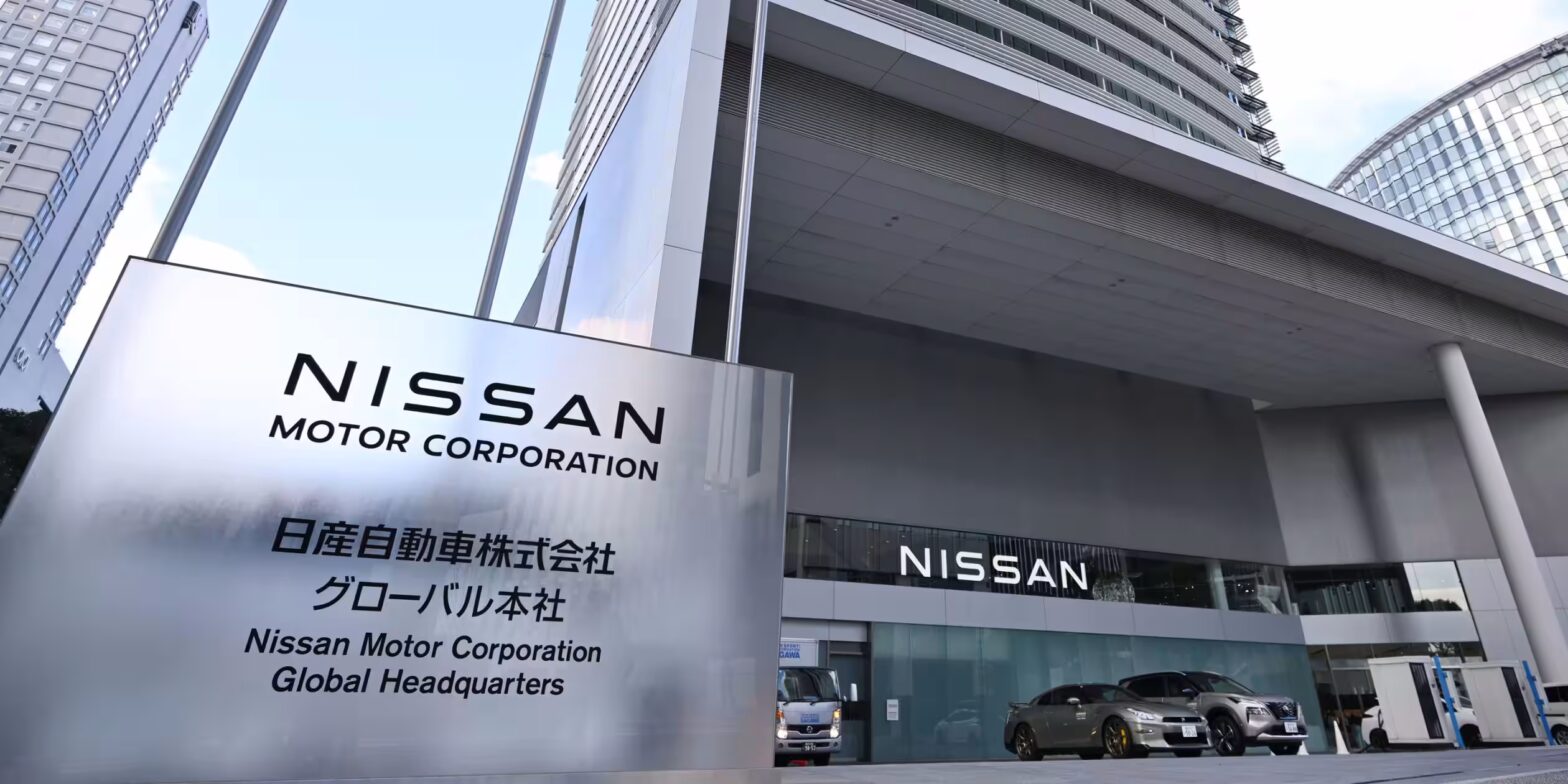

The announcement that Nissan Motor Co. has sold its Yokohama headquarters in a ¥97 billion sale‐and‐leaseback deal is a highly symbolic and strategically significant step, reflecting the company’s broader recalibration and pressure to grow revenue amid mounting pressures in the global auto market.
There are three benefits/affects from this sale for Nissan, with one being fiscal in improving liquidity, the other being operational as Nissan changes its focus towards innovation, and a third affect in symbolic– perception and culture.
The deal allows Nissan to record about ¥73.9 billion (roughly US $490‐$650 million depending on exchange rate) in extraordinary income in the fiscal year ending March 2026.
From a financial‐management perspective, a sale‐and‐leaseback converts a fixed asset into liquid capital while allowing the company to maintain occupancy and operations, albeit now as a tenant. In Nissan’s case this provides breathing room at a moment of heavy strain financially:
- The company posted significant losses in recent periods and faces large debt maturities.
- The restructuring effort (“Re:Nissan” according to media) envisions deep cost cuts, platform reductions, and factory closures. This sale was necessary.
Thus the real‐estate move is not cosmetic. It is a tool to shore up the balance sheet, free up cash, and signal to investors that Nissan is proactively adjusting its asset base.
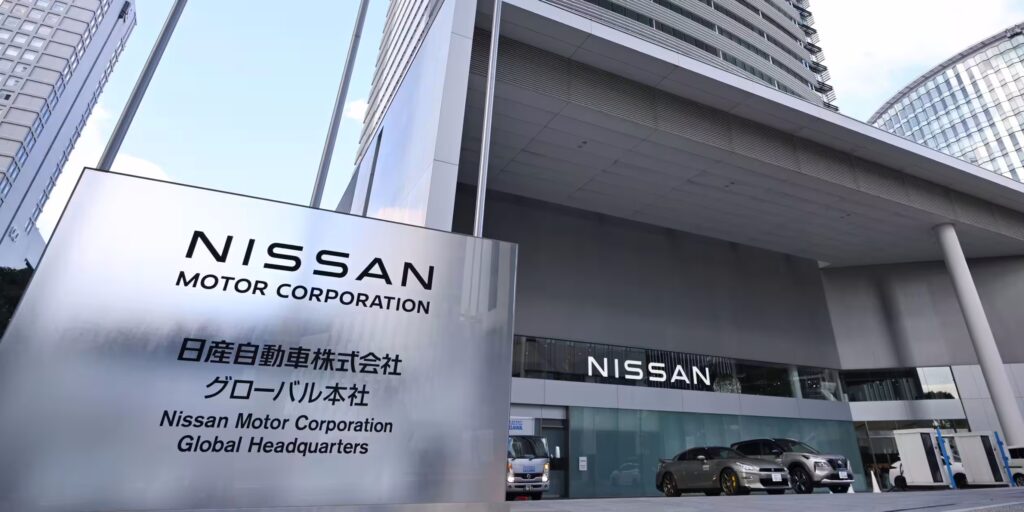
While securing liquidity is the immediate motive, the move is also consistent with Nissan’s stated strategy of shifting resources toward innovation and agility rather than purely scale. A few observations:
- The auto industry is undergoing a rapid transition: electrification, software‐defined vehicles, new mobility business models. Incumbents face competition from Chinese brands, agile startups, and shifting regulatory regimes.
- For Nissan, selling the headquarters, an asset that may be underutilized if the company is cutting capacity, allows allocation of capital toward newer priorities including but not limited to EV architectures, software development, global platform rationalization.
- However, the sale‐and‐leaseback signals that Nissan is not abandoning its Yokohama base; it continues operations there, which suggests continuity of function but more flexibility of capital.
In short: Nissan wants to take this sale not as a retreat from their HQ but more of a “redeployment” of resources; now they focus less on the real estate capital as owners but on their key business operations as tenants.
The Yokohama headquarters is no mere office building. It has been the public face of Nissan since 2009 when it moved its global HQ from Tokyo’s Ginza to a landmark glass and steel tower in Yokohama’s Minato-Mirai district.
Thus, the sale evokes deeper questions:
- What does it say about Nissan’s self‐image? A company once proudly rooted in place now monetizing its landmark base.
- What about employee morale, brand identity, and stakeholder perception? Headquarters have intangible value being a center to identity, company culture, and even pride for the organization.
- Does the leaseback soften the impact? Yes, to the extent that the company retains its visual location and public presence. But the asset is no longer on its books. Some critics may see the move for liquid as desperate, in a harsh analysis of the lack of ownership now.
From a reflective standpoint: corporate environments matter. When you monetize your home base, you send a message not just about efficiency, but about commitment and identity.
Why now?
Several factors converged that make the timing of this decision logical for the company, despite the visual look for the company no longer owning its own Headquarters.
- As reported, Nissan is facing urgent cash‐flow and restructuring pressures. The target of recording extraordinary income via the sale fits into its broader plan to stabilize the finances.
- In a purely logical sense, selling the HQ meets this end for now. Owning a building does nothing for generating new revenue besides whatever the lot is owned at.
- The value of the headquarters asset (estimated at over ¥100 billion in earlier reporting) means it was a realistic candidate for monetization.
- The company’s pivot to innovation & efficiency demands freeing up capital and narrowing focus, rather than being tied to legacy real‐estate costs.
In other words: it’s a “now or never” moment as it is better to act proactively than later be forced into a distressed sale. In paying off the lease Nissan is going to have a loss over the span of time it requires, but this single-year jump is necessary for revenue to keep up.
While the move has clear merits, the path ahead is not without risk. Among the cautions:
- Lease obligations become fixed costs: although capital is released, the company now commits to ongoing occupancy costs—over a 20-year lease in this case.
- Symbolic value does not easily translate into performance improvement. The sale alone does not solve the deeper issues which is market competitiveness, product relevance, supply chain cost pressures.
- The public may interpret the move as a sign of weakness, weakening brand prestige or signaling retreat rather than strength. Managing that perception is crucial.
What it signals about Nissan’s future
Putting it all together, the headquarters deal is a signal more than balance sheets. It indicates that Nissan is:
- Willing to rethink legacy assets in favour of flexibility
- Prioritising capital efficiency and liquidity
- Acknowledging the necessity of change in an auto industry under duress
- Attempting to balance heritage (retaining the Yokohama site) with renewal (by leasing its own former building)
For stakeholders (employees, suppliers, investors) this offers a plausible narrative: Nissan is shifting from “volume business” toward “value business”, from “big factory, full roster” to “leaner platform, smarter output.”
For those of us observing or participating in the automotive ecosystem (investors, analysts, suppliers, even philosophically as observers of corporate behavior), here are a few take-aways:
- Asset monetization can serve as a bridge in transition periods but it should not be mistaken for the destination. The outcome will hinge on how effectively Nissan reinvests the liquidity. Let’s see in 2045 when the lease ends, will Nissan sale the building in an attempt to release again, if there is liquidity pressure during that year?
- Headquarters sales or sale-and-leasebacks are increasingly deployed in capital‐intensive industries under stress. The driver is not just debt but flexibility via cash flow.
- Watching where the freed capital flows will be telling. If Nissan directs it toward EV platforms, software investment, or entering new mobility services, the sale becomes meaningful. If it simply shores up cost gaps, the effect may be short‐lived.
- Symbolism matters. Transformations within iconic companies often provoke interim dislocations. How Nissan handles communication, employee morale, and brand identity will affect the qualitative outcome.