
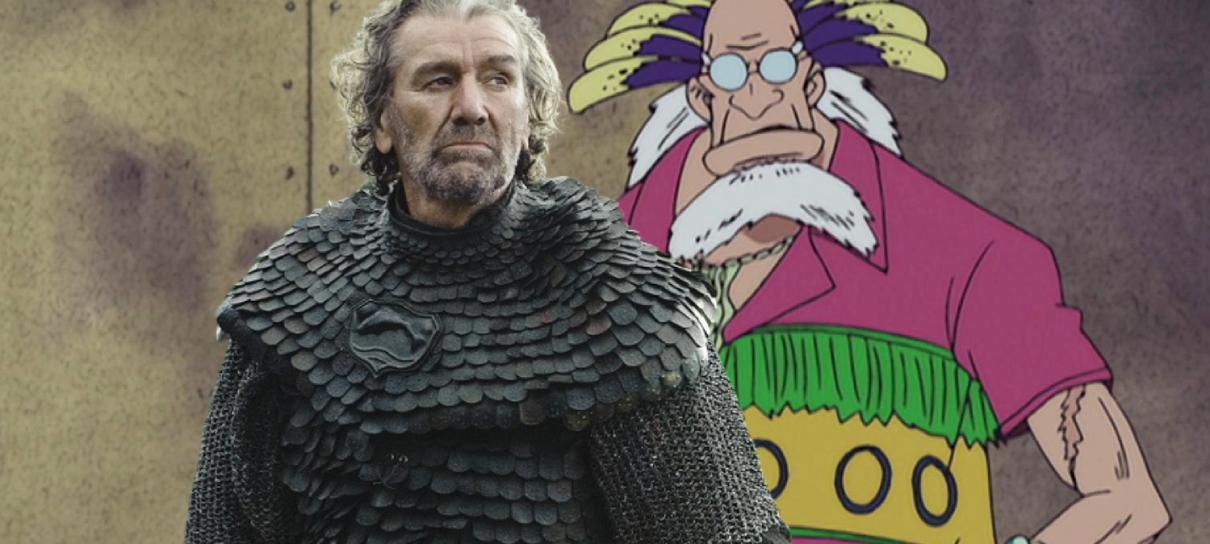
Netflix has once again thrown the world of entertainment into frenzy, and this time it’s all thanks to a whale. With the release of the first official visuals for One Piece Live-Action Season 2, the streaming giant has reignited the excitement of millions who followed the Straw Hats’ first live-action voyage. The images, unveiled through Entertainment Weekly, showcase two monumental figures in the series’ early Grand Line arc — Laboon, the massive whale whose emotional story left fans teary-eyed, and Crocus, the eccentric but wise lighthouse keeper brought to life by none other than Game of Thrones veteran Clive Russell.
For longtime fans, these reveals are more than just character introductions; they’re emotional milestones. They mark the beginning of One Piece’s next chapter — the crew’s entry into the Grand Line, the treacherous and wondrous ocean that transforms rookies into legends. Season 1 may have been about assembling the crew, but Season 2 looks ready to test their hearts, loyalty, and dreams on an entirely new scale.
Setting Sail for the Grand Line
The Grand Line is the beating heart of One Piece — a place where impossible things become possible and dreams are either made or shattered. For many, it’s the moment the story truly begins. When the live-action adaptation premiered in 2023, skeptics doubted Netflix could pull off even the first arcs. But the show’s success — blending faithfulness to Eiichiro Oda’s vision with cinematic flair — surprised everyone. It shattered streaming records, brought in new fans, and earned the blessing of Oda himself.
Now, as the crew prepares to set sail beyond the Red Line, the story is entering sacred territory. The Grand Line is where One Piece transforms from a lighthearted pirate adventure into an odyssey of emotion and mythology. It’s where the tone deepens, mysteries unfold, and the Straw Hat Pirates begin to encounter forces far greater than themselves.
The inclusion of Laboon and Crocus in the first promotional material sends a clear signal — Netflix is not just adapting the Grand Line; it’s embracing its heart and soul.
Laboon: The Whale Who Waited
If you ask any fan what makes One Piece special, most won’t mention its battles or powers. They’ll talk about the emotion — the way Oda weaves compassion and pain into the fabric of his world. And no storyline embodies that better than Laboon’s.
When Luffy and his crew first encounter Laboon in the original series, he’s not just a whale; he’s a mountain of emotion. His massive body is scarred and battered from decades of ramming his head into the Red Line — a desperate attempt to break through the barrier separating him from the friends who once promised to return. Those friends were the Rumbar Pirates, a joyful band of musicians who once traveled with him when he was a small whale. Before they sailed into the Grand Line, they promised to come back. Decades later, Laboon still waits.
It’s one of the earliest, most devastating examples of Oda’s genius for quiet tragedy. The crew’s interaction with Laboon is brief, but it defines everything that One Piece stands for — loyalty, friendship, and the beauty of keeping one’s promises.
To see this moment brought into live-action is to revisit one of the emotional cornerstones of the series. The visuals reveal a massive CGI rendering of Laboon, his scarred face and sad eyes rendered with striking realism. The early fan reactions have been overwhelmingly positive, praising the creature’s design for maintaining the emotional gravity of his anime and manga counterpart.
For longtime fans, this isn’t just a technical achievement. It’s validation that Netflix understands the heart of the story. Laboon isn’t spectacle — he’s soul.
Clive Russell as Crocus: Wisdom at the Edge of the World
If Laboon represents loyalty and loss, Crocus represents understanding and endurance. He’s one of the few living connections to the series’ deepest mysteries — a man who once sailed with Gol D. Roger, the Pirate King himself. When Luffy meets him, he’s not a warrior or villain but a caretaker — tending to Laboon, watching over Reverse Mountain, and embodying a quiet wisdom that only time and pain can bring.
Casting Clive Russell in this role is nothing short of inspired. Known for his work in Game of Thrones (as Brynden “The Blackfish” Tully), Sherlock Holmes, and The Angel’s Share, Russell brings a commanding presence, weathered humanity, and deep gravitas — all qualities that make Crocus one of One Piece’s most memorable supporting figures.
Russell’s acting style fits perfectly within the world Netflix has built: grounded yet fantastical. In an early statement, showrunner Matt Owens reportedly said they wanted Crocus to feel like “a bridge between eras — someone who’s seen the rise and fall of legends, yet chooses compassion over bitterness.” Russell embodies that effortlessly.
Fans of the manga will recognize Crocus as a pivotal figure whose ties to Roger hint at the deeper history of the world — the Void Century, the ancient weapons, and the mysterious “Will of D.” His brief but powerful dialogue with Luffy about dreams and destiny resonates even decades after it was first written. In the live-action, Crocus is expected to play an expanded role — offering not only exposition but emotional mentorship, something Oda has subtly threaded through the original story.
Faithfulness Meets Expansion
One of the most impressive aspects of Netflix’s first One Piece season was how it respected the source material while giving certain characters more depth. Nami’s backstory gained emotional focus; Buggy was transformed from comic relief into a compelling menace; and Mihawk’s scenes were given the gravitas of a samurai epic.
Season 2 looks poised to continue that trend. Early leaks and interviews suggest that while the Grand Line arcs will follow the original narrative order — from Reverse Mountain to Whiskey Peak, and eventually Arabasta — the showrunners plan to expand character interactions and fill in moments that the anime or manga only hinted at.
For instance, we might see flashbacks of Laboon’s time with the Rumbar Pirates — scenes that could feature Brook, long before he becomes a Straw Hat. Imagine the emotional punch of watching those musicians play “Binks’ Sake” for their whale companion in live-action — a melody that would echo through the entire series, even into the far future.
Similarly, Crocus could serve as a narrative anchor, offering the Straw Hats — and the audience — context about the Grand Line’s dangers and its legends. By grounding the season in this emotional and mythological foundation, the adaptation can make its transition into the Grand Line feel both epic and intimate.
The Grand Line Comes Alive
If Season 1 was a test of faith, Season 2 is a test of scale. The Grand Line is where the world of One Piece truly expands — unpredictable weather, massive sea creatures, ancient islands, and warring kingdoms. Translating that into live-action is no easy feat.
Fortunately, Netflix seems ready to invest in making it real. Insiders close to the production revealed that the budget for Season 2 is significantly higher, thanks to the success of the first season. That means bigger sets, more detailed ship models, and expanded CGI for the fantastical creatures that populate Oda’s universe.
And Laboon is just the beginning.
The production team has reportedly built large-scale sets replicating Reverse Mountain, the treacherous gateway to the Grand Line. The scene — one of the most visually challenging sequences in the manga — involves enormous ocean currents, vertical waves, and the Straw Hats’ first breathtaking glimpse of the new world. It’s the moment that transitions the story from adventure to legend.
Combined with the emotional power of Laboon’s reveal, this could become one of the defining moments of the live-action adaptation — a sequence that captures the awe and melancholy that have always defined One Piece’s best chapters.
The Expanding Cast and the Future of Season 2
Alongside Clive Russell, the new season introduces a host of new characters. Though not officially confirmed, rumors point toward casting announcements for Princess Vivi, Crocodile, and Mr. 0’s Baroque Works agents, suggesting that the Arabasta Saga will be a major narrative focus.
The Arabasta arc — one of the most beloved in the series — introduces some of One Piece’s most morally complex storytelling. It explores rebellion, corruption, and sacrifice, themes that fit perfectly with Netflix’s more cinematic tone. If done right, it could elevate the adaptation from “great anime remake” to “prestige adventure series.”
Fans are also buzzing about how the show will handle Tony Tony Chopper, the crew’s reindeer doctor. The character’s design blends fantasy and emotion in equal measure, and his introduction will test the production team’s ability to balance CGI with human performance. Early reports suggest a mix of animatronics and digital effects — something between The Mandalorian’s Grogu and Paddington Bear.
If Laboon’s realism is any indication, Chopper could become the emotional centerpiece of Season 2.
A Deeper Emotional Horizon
The inclusion of Laboon in Season 2 is more than just fan service — it’s thematic brilliance. His story is a mirror of Luffy’s own journey: perseverance, faith, and the pain of separation. Laboon never gave up waiting. Luffy never gives up moving forward. Both represent Oda’s ultimate theme — that time, loss, and distance can’t break the bonds of the heart.
Crocus, as Laboon’s caretaker, represents another side of that same coin — acceptance. He knows that the Rumbar Pirates are gone, that their promise can never be fulfilled, and yet he keeps the flame alive for Laboon’s sake. It’s compassion over despair, memory over emptiness.
The fact that Netflix chose to open the season with this story says a lot about its priorities. It’s not chasing spectacle — it’s chasing heart. And that’s what made the first season work so well.
Oda’s Influence and Approval
Eiichiro Oda’s involvement in the adaptation remains one of its greatest strengths. For the first season, Oda personally approved script revisions, concept art, and casting. That same process is reportedly continuing — perhaps even intensifying — for Season 2.
In a recent interview, Oda remarked that he wanted the live-action to “stand on its own, but carry the same soul.” Laboon’s inclusion fits that perfectly. It’s not about replicating every line of the manga; it’s about capturing its emotional rhythm.
Behind the scenes, Oda’s team from Shueisha has been working closely with Tomorrow Studios to ensure authenticity in everything from costume design to dialogue tone. The result is a world that feels lived-in — whimsical yet believable.
The Emotional Promise of What’s Next
If the first season of Netflix’s One Piece was about hope — about finding a crew and setting sail — then the second is about endurance. It’s about holding onto dreams when the seas get rough.
The journey through the Grand Line is one of constant challenge, and the story of Laboon and Crocus is the perfect opening note. It’s a tale of waiting and believing — the same emotions every fan of One Piece knows well. Many have been following the series for decades, waiting for the day the mystery of the One Piece itself is revealed.
In a way, Laboon’s endless vigil reflects the fandom’s devotion. He’s a symbol of patience rewarded, of love that endures beyond time and tragedy.
When Season 2 premieres, that connection will become real again — as millions watch a giant whale lift his head toward the horizon, eyes glistening with hope, and a boy in a straw hat smiles and makes a promise.
It’s a promise that transcends fiction: that some dreams are worth waiting for, no matter how many years pass or how high the waves rise.
Netflix’s One Piece Live-Action Season 2 isn’t just another step in an adaptation — it’s the next great voyage of a cultural legend. With Laboon’s sorrow, Crocus’s wisdom, and Luffy’s unbreakable will, the story is poised to deliver the perfect blend of emotion, spectacle, and soul.
If these first visuals are any indication, the Grand Line has never looked — or felt — more alive.