
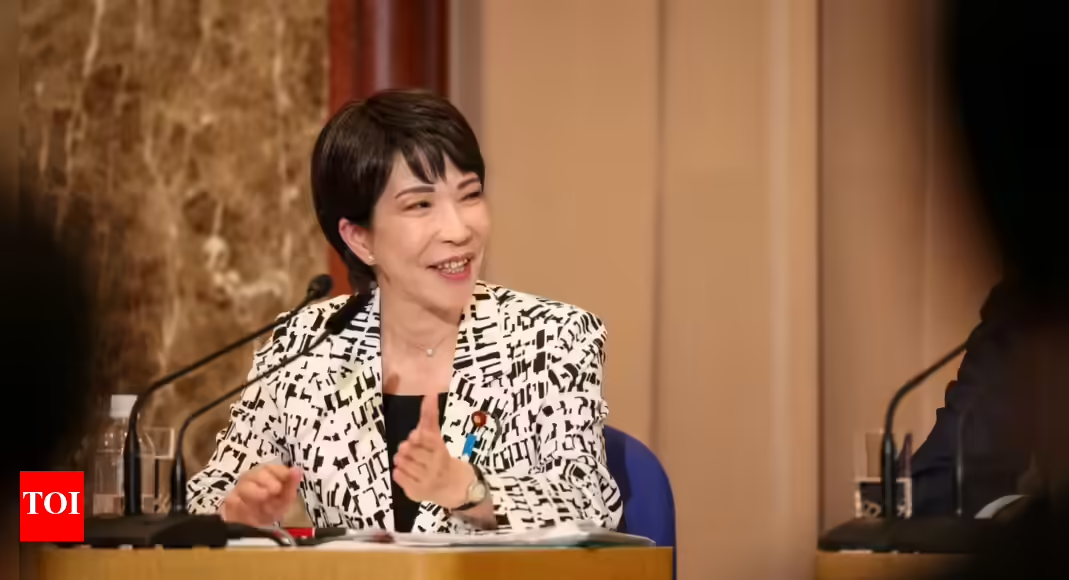
When Sanae Takaichi steps up to the podium, she embodies more than just another contender in Japan’s endless carousel of prime ministers. She represents the possibility of a hardline conservative firebrand reinventing herself as an economic populist. With the Liberal Democratic Party (LDP) preparing to choose its new leader on October 4, Takaichi has drawn attention by promising to cut income taxes and send direct cash handouts to households—policies more often associated with left-leaning populists than with her brand of ideological conservatism.
But this mix of pledges also reflects the economic and political realities of 2025 Japan. Inflation has been gnawing at household budgets, wages have risen but not enough to satisfy ordinary families, and a restless electorate has shown it will punish ruling parties at the ballot box. At the same time, the government carries the heaviest debt burden among advanced economies, standing at more than 250 percent of GDP. That dual pressure—relief for households, responsibility for the books—is the tightrope Takaichi is trying to walk.
Her leadership bid is more than a fight for party votes. It is a referendum on what kind of economic future Japan wants in an era defined by demographic decline, fiscal stress, and intensifying global competition.
A Candidate with History and Controversy
Takaichi is not new to the national stage. Known as a close ally of former Prime Minister Shinzo Abe, she has built her reputation as one of the most unapologetically conservative figures in the LDP. Her positions on constitutional revision, defense expansion, and a hard stance against China have long defined her. Yet she also carries a pragmatic streak that surfaces when economic survival is on the line.
Her supporters highlight her consistency and toughness—an antidote, they argue, to the frequent turnover of prime ministers who arrive with reformist zeal only to depart after one or two years. Her critics, meanwhile, worry that her ideological leanings could polarize both the party and the public. But what is undeniable is that Takaichi has become a serious contender not simply because of who she is, but because of what she now proposes.
Tax Cuts and Handouts: An Unlikely Mix
The centerpiece of Takaichi’s platform is twofold: income tax reductions and direct cash payments to households.
Tax cuts have been a rallying cry for conservatives worldwide, and Japan is no exception. Families complain that despite rising wages, tax burdens remain high. For businesses, particularly small and medium-sized enterprises, reduced income taxes could provide breathing room to invest and hire.
But the cash handouts are what raise eyebrows. Japan has used direct payments during extraordinary times—the pandemic stimulus packages in 2020 and 2021 being the most notable examples. For Takaichi to propose them in a leadership campaign suggests she wants to capture the imagination of households still struggling with higher food and energy prices. It is retail politics in its purest form: tangible relief that voters can see, touch, and spend.
Some analysts describe the proposal as an attempt to bridge factions within the LDP. Tax cuts appeal to business-minded conservatives. Handouts resonate with ordinary voters who might otherwise drift toward opposition parties. By straddling both sides, Takaichi hopes to widen her base beyond her traditional conservative bloc.
The Fiscal Responsibility Pledge
Still, she cannot afford to ignore Japan’s debt mountain. With a debt-to-GDP ratio hovering above 250 percent, every new spending pledge invites scrutiny. Takaichi has pre-empted critics by pairing her populist promises with a vow to reduce the ratio gradually.
The word “gradual” is important here. No Japanese leader can realistically slash the debt in dramatic fashion without choking the economy. Instead, the strategy must be to stabilize the ratio—preventing it from climbing further—and then slowly nudge it down as growth, inflation, and revenue collection improve.
Her challenge will be to convince both markets and party elders that she is serious. Global investors watch Japan closely; even small signs of fiscal indiscipline can rattle bond markets. Within the LDP, the Ministry of Finance’s influence remains strong, and bureaucrats are not shy about pushing back on leaders who they believe threaten fiscal stability.
Political Calculations Ahead of the Vote
The October 4 leadership election will decide more than the LDP’s direction. Because the LDP dominates Japanese politics, the winner is virtually guaranteed to become prime minister. That makes Takaichi’s promises not mere campaign rhetoric but potentially the policy of Japan’s next government.
Her main rivals include Shinjiro Koizumi, the moderate reformist who appeals to younger voters, and several faction leaders who prioritize stability over bold pledges. Takaichi’s strategy is clear: differentiate herself with populist economic promises while doubling down on her reputation for toughness on security and foreign policy.
Within the LDP, factional politics play a decisive role. Leaders of party factions hold sway over blocs of votes, and their endorsement can swing the outcome. Takaichi has never led a large faction of her own, but she has cultivated loyalty among conservatives and nationalists, many of whom still see her as the heir to Abe’s vision of a more assertive Japan.
Why the Economy Matters Most
In normal times, debates over constitutional reform or defense policy might dominate an LDP leadership race. But these are not normal times. Inflation has eroded purchasing power, the yen has experienced bouts of volatility, and younger Japanese remain skeptical about whether they can achieve the same standard of living as their parents.
That is why economic pledges resonate so strongly in 2025. Cutting taxes offers immediate relief. Handouts provide a quick infusion of spending power. Both policies, if executed effectively, could generate a short-term boost to consumer confidence—a crucial factor for a nation where domestic demand drives much of the economy.
Yet there are risks. Economists warn that tax cuts and cash handouts, if not carefully designed, could fuel inflation rather than ease it. They could also add to the government’s fiscal burden. This is where Takaichi’s fiscal responsibility pledge comes into play: she must show that the policies are targeted, temporary, and balanced by longer-term measures to stabilize the debt.
Japan’s Debt Dilemma
To understand the stakes, one must grasp the scale of Japan’s debt problem. Unlike other advanced economies, Japan’s debt is largely held domestically, meaning that Japanese institutions and citizens buy government bonds. This has shielded the country from the kind of debt crises that struck Europe in the 2010s.
But this insulation is not permanent. Demographic decline is shrinking the pool of domestic savers. As retirees draw down their assets, demand for government bonds may weaken, forcing Japan to rely more on foreign investors who could be less forgiving. At that point, interest rates could rise, making debt service costs balloon.
For Takaichi, this means her promises must not only deliver political dividends but also reassure markets that Japan is not sliding into fiscal recklessness. Balancing populism with prudence will be the defining test of her leadership credibility.
The Voter’s Perspective
Beyond macroeconomics and fiscal ratios, the human side of this story is equally important. Many Japanese households feel squeezed between rising prices and stagnant opportunities. Younger workers worry about career prospects in a contracting labor force. Parents wonder how to fund education. Elderly citizens depend on pensions that seem increasingly precarious.
In this context, cash handouts are not just a policy—they are a statement that the government recognizes people’s struggles. Tax cuts, meanwhile, signal that the state is willing to give back some of what it collects, acknowledging that households know best how to spend their money.
Whether these policies are sustainable is one question. But politically, they offer something powerful: hope of immediate relief. And in politics, timing often matters more than technical perfection.
Broader Implications for the LDP
If Takaichi wins, her leadership could alter the identity of the LDP itself. Traditionally, the party has leaned on stability, continuity, and a cautious economic approach. A Takaichi premiership built on bold relief measures and populist pledges could reset expectations.
Her leadership might also influence how Japan positions itself internationally. A leader known for hardline stances on defense combining that with domestic economic populism could strengthen ties with Washington while straining relations with Beijing and Seoul. The contrast between her hawkish foreign policy and her household-friendly economics would mark a new chapter in Japan’s political evolution.
The Road Ahead
As October 4 approaches, the contest will intensify. Rival candidates will challenge Takaichi’s arithmetic, asking how she can cut taxes, hand out cash, and reduce debt all at once. Skeptics will argue that the numbers simply do not add up. Supporters will insist that Japan cannot afford another leader who tinkers around the edges without bold action.
The outcome will not just determine who sits in the prime minister’s office. It will signal what kind of economic philosophy guides Japan at a pivotal moment. Is the future one of cautious belt-tightening, or one of bold, populist measures balanced by promises of discipline?
Conclusion: A Defining Choice for Japan
Sanae Takaichi’s leadership bid forces Japan to confront its economic crossroads. Her tax cut and cash handout proposals are more than populist gestures; they reflect a recognition that the old formula of slow reform and endless patience no longer satisfies an electorate under pressure. At the same time, her insistence on fiscal responsibility acknowledges that Japan cannot escape its debt dilemma forever.
Whether she succeeds will depend not only on her ability to win over LDP factions but also on her capacity to persuade voters and markets alike that her vision is credible. If she becomes prime minister, she will inherit a fragile economy, a skeptical public, and a wary global audience.
Her story is one of paradox: a conservative hardliner embracing populist economics, a leader promising giveaways while preaching discipline, a candidate at once divisive and potentially transformative. Whatever the outcome on October 4, Sanae Takaichi has already reshaped the conversation about what kind of leadership Japan needs. And in that sense, she has forced the nation to ask itself the hardest question of all: can Japan’s politics finally rise to meet its economic reality?