

After an old apartment building was torn down, a single cat began living in the shadow of a nearby vending machine. She was gentle with people and often fussed over by passersby, yet no one stepped forward to take in the aging cat. One day, a couple from the neighborhood finally decided to welcome her into their home.
The middle-aged couple first noticed the cat in the summer two years earlier.
Running was their shared hobby, something they did at night after work. They would leave their apartment in central Tokyo and start their run at the bottom of a nearby slope. One evening, as they reached the foot of the hill, they noticed a cat sitting quietly in the glow of a vending machine.
She stood alone beside it, looking strangely forlorn.
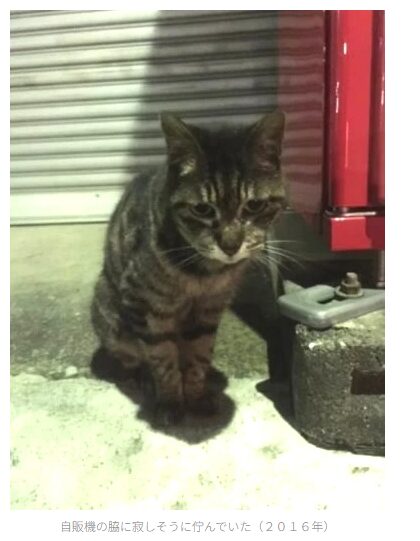
“When we asked around, neighbors said she’d suddenly appeared one day and just stayed,” the wife recalled.
She checked with the local animal welfare center, but there were no reports of a lost cat. When she took the cat to a veterinary clinic for spaying and vaccinations, they discovered she had already been spayed. Because she was so accustomed to people, the couple suspected she had once belonged to someone.
“There used to be an old apartment building near the vending machine where many elderly people lived,” the wife said. “But it was demolished. We don’t know if someone couldn’t take her along when they moved, but it felt like she’d spent a long life alongside a human.”
The couple began seeing the “vending machine cat” regularly. Children would pick her up, and neighbors would stop to dote on her. Still, there were worrying signs. She drank water excessively, and sometimes her fur was soaked, as if the vending machine provided little protection from the rain. Watching her live out on the street slowly became harder to ignore.
Even so, they couldn’t bring her home right away. At the time, they already had two young rescue cats. These were the first cats they had ever taken in.
“We were still beginners,” the wife said. “Our rescue cats had only just settled in and found their rhythm. We both worked full-time, and we kept wondering whether we could properly care for an elderly cat.”
The old cat remained by the vending machine for one month, then two. No one claimed her. She lived on as the town’s cat while the air gradually grew colder.
“It felt cruel to leave her out there in the cold,” the wife said. “There were even moments when it seemed like someone might harass her. We started talking seriously about bringing her home.”
“One day it began raining,” the husband added. “We thought, if we leave her like this, she might die. That’s when we decided.”
Three months after they first spotted her, in November, they made up their minds.
The husband remembers the day clearly.
“It was the day Trump won the U.S. presidential election. The TV was in an uproar. And Nyaromi was in an uproar at our house.”
As soon as she entered the apartment, Nyaromi froze with tension. In the middle of the night, she let out cries that sounded almost like distant howling. Still, she adapted quickly and had no trouble using the litter box.
At the veterinary clinic, she was estimated to be around fourteen or fifteen years old. She appeared to have lost her hearing. There were no infectious diseases, but she had chronic kidney problems, and from the very first visit they received guidance on kidney care. They began managing her diet carefully and started weekly IV fluids.
Nyaromi was thin when she was rescued, and even now she struggles to gain weight. Still, she has maintained the 3.2 kilograms she weighed when she was taken in. Her relationship with the younger cats is neither close nor hostile; they keep a comfortable distance from one another.
“At first, we kept her in a separate room,” the wife said. “But after about two weeks, she started venturing into the living room where everyone else was, and she’s stayed there ever since. Even when all three are in the same space, each cat relaxes in their own favorite spot. I think they’ve found a good way to coexist.”
Lately, her favorite place to sleep has been on top of a carrier bag.
Because of her age, signs of decline are unavoidable.
At night, her cries echo through the living room: “Myaa-o, myaa-o.” Nyaromi lies beneath the table or in her cat bed, calling out.
“What’s wrong, Nyaromi?” the couple asks as they stroke her gently. Reassured, she quiets down.
Around her sleeping mat, several pet sheets are spread out.
“She’s had a few more accidents lately,” the wife said. “Her eyesight is fading, and she can’t climb onto the bed like she used to. She sleeps most of the time, but her appetite is still strong. When we come home from work, she senses us and wakes up, calling out for food. I think her voice has gotten louder.”
Sometimes they let her sleep in the bedroom on a futon, only to be startled by the volume of her cries. On the other hand, when she sleeps too quietly, they worry, leaning in close to check, half-joking, “You’re still alive, right?”
“We just want her to feel safe and enjoy her days,” the wife said.
“And to live as long as she can, feeling comfortable,” the husband added.
Watched over by the couple, Grandma Nyaromi slowly rose to her feet, as if answering them with a calm, unhurried “All right then.”