
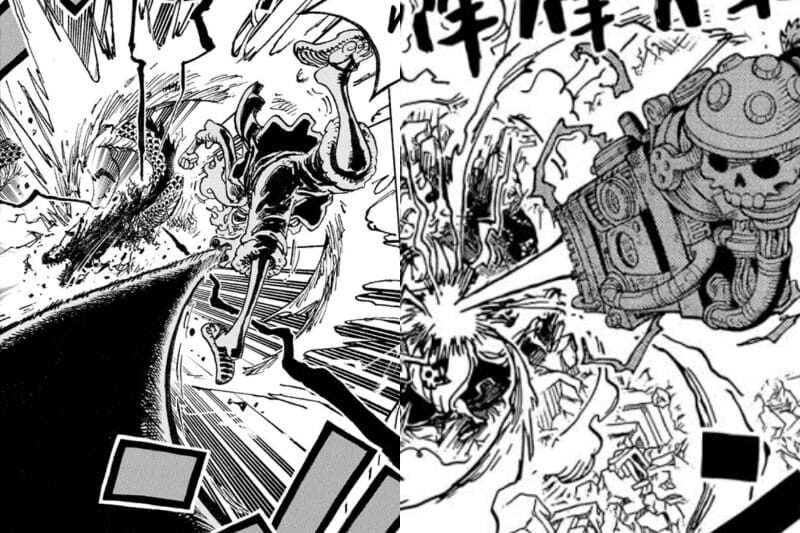
The debate sounds simple on the surface. If Shanks truly defeated Loki one-on-one, fair and square, then why does so much of One Piece’s power structure still point in a different direction? Why did Big Mom treat Whitebeard as the greater threat? Why did the Marines cling to the idea of Whitebeard as the “strongest man in the world”? And why has no one in-story ever framed the Red Hair Pirates as an uncontested apex force?
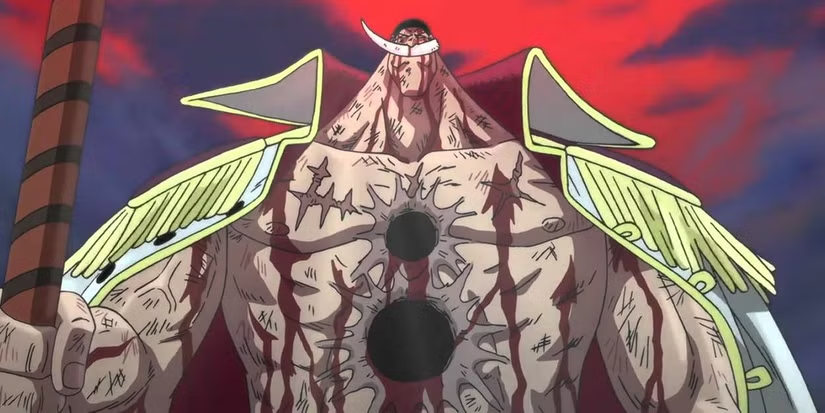
Once you pull on that thread, the whole tapestry starts to stretch.
At the center of the argument is Shanks and his alleged victory over Loki, the disgraced giant prince of Elbaf. If Shanks really soloed Loki, a figure tied to giants, ancient power, and a massive bounty, then the implications are enormous. A captain who can casually put down a threat of that scale should logically warp the balance of the seas. Yet the world of One Piece never reacts that way. Instead, the narrative keeps circling back to one name as the ultimate benchmark: Whitebeard.
That contradiction is what’s driving fans a little feral.
Big Mom’s worldview is often the first stop in these discussions. She knew about Loki. She wanted Loki. She was willing to marry her daughter into Elbaf to secure the giants’ military power. And yet, when she spoke about true threats on the sea, Whitebeard stood above the rest. Not Shanks. Not Kaido. Whitebeard. If Shanks had personally crushed Loki, a figure central enough to Elbaf’s political and military future, Big Mom’s priorities start to look irrational. Unless, of course, raw strength was never the point.
Because Big Mom was not shopping for a duelist. She was shopping for armies.
Elbaf was never just Loki. It was the promise of endless giant soldiers, a living stockpile of vice-admiral-level monsters, and a cultural force that could tilt global power. From that angle, Loki’s personal strength matters less than what he represents. Even if Shanks could beat Loki in a straight fight, that does not mean Shanks could withstand Loki plus the full weight of Elbaf plus the Big Mom Pirates. Power in One Piece is rarely additive in neat, powerscaling-friendly ways, but Big Mom thinks in coalitions, not highlight reels.
That same logic explains why Whitebeard loomed so large for so long. Whitebeard was not feared merely because he could punch hard. He was feared because he was a walking cataclysm with decades of uncontested dominance, a crew bound by loyalty rather than fear, and a Devil Fruit that could erase islands. Even sick, even aging, his reputation carried the inertia of history. Nobody tested it. Titles in One Piece persist not because they are constantly re-earned, but because no one survives long enough to disprove them.
This is where the “perception versus reality” argument becomes unavoidable. Information in One Piece is fragmented, distorted, and often wrong. The World Government is powerful, but it is not omniscient. The Marines misread threats all the time. They turned Buggy into a Yonko by accident. They underestimated Luffy repeatedly. They overestimated others. It is entirely plausible that the details of Loki’s downfall were never fully known, or were misinterpreted. Maybe the world assumed the Red Hair Pirates handled Loki together. Maybe Loki himself was mythologized beyond his true capabilities. Maybe Harald’s strength was exaggerated. Or maybe Whitebeard was simply never re-evaluated because no one wanted to be the one to find out the hard way.
There is also a quieter truth that fans often resist: Shanks does not seek domination. He does not posture. He does not broadcast victories. He intervenes, stops disasters, and leaves. Kaido backs down. Wars end. Balance is restored. And then Shanks disappears again. A man like that does not accumulate the kind of public myth that fuels fear-based rankings. He is powerful, yes, but more importantly, he is selective.
That selectiveness may be why the Red Hair Pirates are described as “the most balanced” rather than “the strongest.” Balance implies restraint, coordination, and reliability, not brute supremacy. A crew that doesn’t rely on overwhelming numbers or apocalyptic abilities does not scream “unstoppable” to outside observers, even if it is. The world of One Piece measures danger by collateral damage as much as by strength. Whitebeard shattered seas. Shanks prevented them from shattering in the first place.
So if Shanks did defeat Loki alone, what does that really mean?
It does not automatically crown him above Roger or Whitebeard. It does not collapse the Yonko hierarchy. It does not invalidate decades of fear attached to Whitebeard’s name. What it does is expose how fragile power narratives are in One Piece. Strength is filtered through rumor, politics, timing, and memory. Victories that are not loudly witnessed do not fully exist. Legends outlive their bodies. And sometimes the most dangerous man on the sea is the one who never bothers to prove it.
If anything, the real takeaway is uncomfortable for powerscalers but deeply consistent with Oda’s writing. One Piece has never been about clean ladders of strength. It is about who controls the story, who survives long enough to be remembered, and who understands when not to swing first.
If Shanks really did beat Loki alone, the question is not why the world failed to adjust. The question is why we expect it to.