
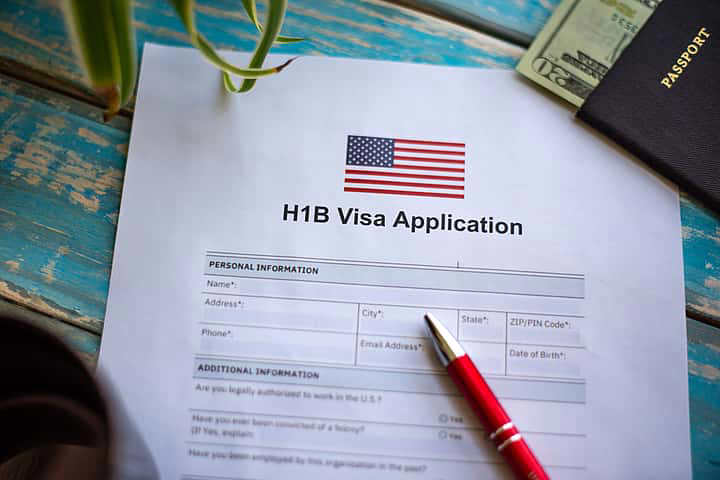
The United States has long prided itself on being a magnet for global talent. From Silicon Valley’s tech hubs to world-class research labs and hospitals, the country’s success has been intertwined with its ability to attract skilled professionals from abroad. Yet the Trump administration’s newly unveiled immigration overhaul has ignited one of the fiercest debates in decades over who gets to come, who gets to stay, and at what price. At the center of the storm is the H-1B visa, a program that has fueled the rise of industries but is now facing a drastic transformation.
The most dramatic change: an annual fee of $100,000 per visa. For a program that has historically cost employers a few thousand dollars in filing and legal expenses, this fee represents a seismic shift. The administration insists it is a necessary corrective to ensure American workers are prioritized, but critics argue it could cripple small businesses and startups that depend on international talent. And in a twist that reveals the administration’s dual strategy, alongside this steep barrier comes the proposal of a “Gold Card” pathway—offering expedited visas and potential residency for wealthy or elite professionals who meet certain thresholds. Together, these moves promise to reshape the landscape of U.S. immigration in ways that reach far beyond the corridors of tech giants or universities.
A Program Under Fire
The H-1B program, first established in 1990, was designed to allow U.S. companies to employ foreign workers in specialized fields where there was a shortage of American applicants. Over the years, it became synonymous with the tech sector, with companies like Microsoft, Google, and Intel relying heavily on H-1B talent. But the program has also been controversial, accused of displacing American workers, undercutting wages, and enabling large outsourcing firms to dominate the lottery system.
Trump has long criticized the program, calling it “abused” and “broken.” His administration now appears intent on rewriting its terms entirely. The $100,000 fee is being framed as a “premium” that ensures companies are truly in need and willing to invest in foreign hires. Officials have argued that if a company cannot afford the cost, it suggests the position could be filled domestically or is not essential enough to merit a visa.
But business groups see it differently. A coalition of startups and small to mid-sized tech firms warned that the new fee would essentially shut them out of the global talent pool. While giants like Google or Amazon could absorb the cost, emerging firms competing for the same engineers or researchers would be priced out, skewing the playing field in favor of corporations with deep pockets. In their view, the policy does not level the labor market—it tilts it.
The “Gold Card” Gambit
Running parallel to the H-1B changes is the administration’s introduction of new visa categories designed to attract the ultra-wealthy and highly skilled. Dubbed the “Gold Card” in political shorthand, the proposal would create a pathway for individuals who meet certain income, investment, or achievement thresholds to gain expedited entry and potentially permanent residency.
The idea is not without precedent. Countries like Singapore, Canada, and several EU states have introduced investor or talent visas to lure high-net-worth individuals and global innovators. By attaching residency benefits to wealth or professional stature, they aim to boost domestic economies while keeping their labor markets competitive.
For the U.S., the Gold Card is being pitched as a way to keep America at the top of the global talent ladder. Administration officials argue that if the H-1B reforms restrict the “quantity” of entrants, the Gold Card will ensure the “quality” of those who do come is unmatched.
Yet the juxtaposition is striking: one program raises barriers so high that many companies will retreat, while another lowers them for those who can pay or prove exceptional worth. To critics, it smacks of a two-tiered immigration system that values wealth over contribution, and exclusivity over inclusivity. To supporters, it is a rational recalibration that prioritizes America’s best interests.
Industry Fallout: Tech, Healthcare, Academia
The implications of these reforms ripple across multiple sectors. In technology, where the competition for engineers, data scientists, and AI specialists is global, the new fee could radically alter hiring strategies. Large firms may continue to bring in top foreign talent, albeit at higher costs, while smaller innovators could lose access to the same pipeline. This raises the specter of industry consolidation, where talent migrates to the companies that can afford the fee, stifling innovation from younger competitors.
Healthcare presents another challenge. U.S. hospitals, particularly in rural and underserved areas, rely on foreign doctors and nurses to fill chronic shortages. For them, the $100,000 price tag per worker is simply unrealistic. Medical associations warn that the policy could worsen staffing crises and reduce care in communities already struggling to attract physicians.
Academia too is bracing for change. Universities have historically used H-1B visas to bring in postdoctoral researchers, professors, and specialists. These institutions operate under tight budgets and could face impossible choices between hiring the brightest global minds or meeting financial limits. The irony, critics say, is that while American students benefit from learning under international experts, this new framework risks walling off that exchange.
The Politics of Immigration
Beyond the economic calculus, the H-1B overhaul is steeped in political strategy. Trump has positioned himself as a defender of American workers, and immigration remains one of his most potent rallying points. The $100,000 fee is a symbolic gesture as much as it is a policy tool—a way to signal toughness on immigration while framing it as protecting domestic labor.
But the politics cut both ways. The business community, long an ally of Republican administrations, has reacted with unease. Tech leaders who rely on foreign talent warn that the reforms risk driving innovation overseas, with Canada and Europe already eager to welcome displaced talent. Democrats, meanwhile, see an opportunity to position themselves as champions of inclusivity and competitiveness, but they also face the delicate task of balancing worker protection with openness to global labor.
The clash is not just over economics—it is over what vision of America should prevail: one that prizes exclusivity and national preference, or one that embraces diversity as an engine of growth.
Legal and Logistical Questions
Implementing the $100,000 fee raises complex legal and logistical questions. Immigration law has always walked a fine line between regulation and discrimination, and there are already murmurs of challenges on constitutional grounds. Can the government effectively impose a financial barrier that disproportionately impacts smaller firms and less wealthy institutions? Will lawsuits argue that the policy creates an unfair labor market or violates equal protection principles?
Then there is the question of enforcement. How will the government ensure compliance? What happens to existing visa holders whose employers cannot or will not pay the new fee? Will there be exemptions for nonprofits, hospitals, or universities? These are not minor details but fundamental issues that will determine how the policy plays out in reality.
The Global Ripple Effect
Immigration is not a domestic issue in isolation—it reverberates across the world. India, which provides the largest share of H-1B recipients, has already expressed concern that the reforms could devastate its IT and outsourcing industries. China, too, stands to see its talent pipelines disrupted. For both countries, the reforms may accelerate efforts to build domestic opportunities for skilled workers who might once have looked to the U.S. as their first choice.
Meanwhile, countries like Canada, Australia, and Germany are seizing the moment. With more welcoming policies, they are positioning themselves as alternatives for talent disillusioned by U.S. restrictions. If the United States erects higher barriers, others are more than happy to open their doors wider.
Supporters’ Case: A Strategic Reset
Supporters of the reforms argue that critics are missing the bigger picture. They contend that the U.S. has long been too lenient with its visa programs, allowing companies to use H-1B as a shortcut rather than investing in American training and education. By making visas prohibitively expensive, the policy forces employers to think harder about whom they bring in and why.
They also see the Gold Card as a masterstroke—an instrument to keep America competitive in the global “war for talent.” In their view, the reforms do not close the door but simply narrow it, ensuring that those who do enter are the most valuable and capable.
Opponents’ Case: A Self-Inflicted Wound
Opponents counter that the reforms are a self-inflicted wound at a time when the U.S. can least afford it. With global competition fierce in areas like artificial intelligence, biotechnology, and green energy, they argue that restricting access to talent undermines America’s own strategic interests. Innovation is not just about a few billionaires with Gold Cards—it is about a broad ecosystem of ideas and skills.
They warn that the policy could accelerate the offshoring of talent and innovation, weaken U.S. leadership in science and technology, and erode the country’s reputation as a destination of opportunity.
What Comes Next?
The H-1B overhaul is not yet fully enacted, and the coming months will bring intense debate in Congress, the courts, and the public square. Lobbyists are mobilizing, industry leaders are issuing warnings, and immigrant communities are bracing for uncertainty. At stake is not just the future of a visa program but the broader identity of America as a nation of immigrants, innovators, and opportunity-seekers.
Will the reforms mark a bold reset that strengthens domestic labor and secures elite global talent? Or will they prove to be a costly miscalculation that pushes the best and brightest elsewhere?
The answer to that $100,000 question may well define the trajectory of America’s economy—and its soul—for years to come.