
When the earth shook on March 11, 2011, time itself fractured. Towns along the Tōhoku coast splintered under waves taller than rooftops. Families were torn apart in seconds. And in the weeks that followed, as survivors gathered in makeshift shelters, silence became its own disaster. It hung over gymnasiums filled with futons, over school classrooms turned into dormitories, over rows of shoes lined neatly at the entrance.
Among those who had lost almost everything was a boy of six. His name is withheld in the news clippings, but the people in the shelter remember him clearly: small, dark-eyed, clutching a jacket far too big for his frame. His parents had been swept away by the sea. He had been found clinging to a neighbor’s hand. Since that moment, he had not spoken a single word.
Weeks of Silence
The shelter volunteers tried everything. Toys. Picture books. Gentle questions. But the boy’s lips never moved. He would nod when food was offered, shake his head if asked about sleep, but no sound crossed his throat. Doctors called it trauma-induced mutism. Neighbors called it heartbreak.
Each evening, as the lights dimmed, the boy would sit with his knees to his chest, staring at nothing. The adults whispered, wondering how long he could go on like that. Children heal fast, they told each other—but what if his silence became permanent? What if he grew up carrying an invisible wound that would never close?
The Arrival of the Labrador
Then, one morning, a volunteer arrived with a black Labrador. He was a rescue himself, pulled from a collapsed home further up the coast. Strong, calm, his fur still smelled faintly of mud and sea. His eyes, though, carried something steady—an anchor in the middle of chaos.
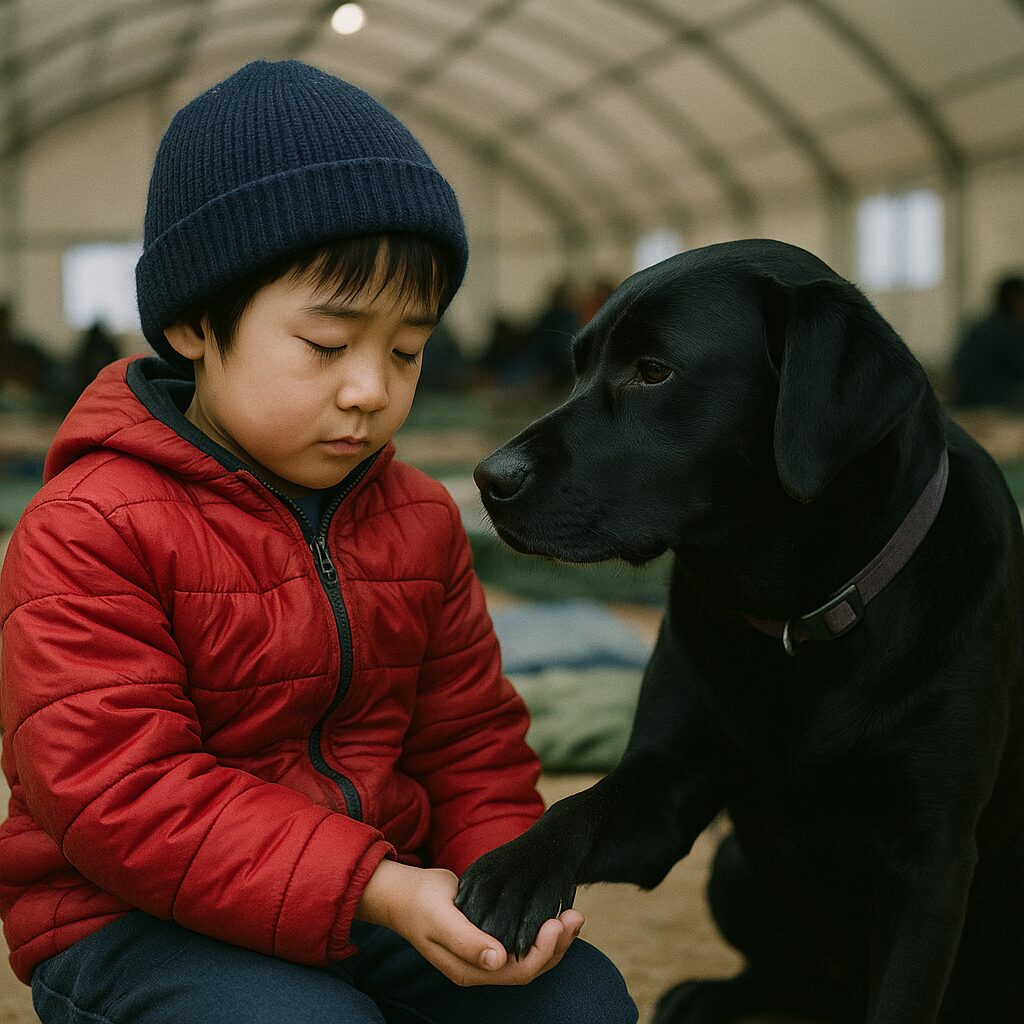
The dog padded across the shelter floor, ignoring the adults who reached to pat his head. He went straight to the boy. No hesitation, no sniffing circles. Just a quiet approach, and then, gently, a paw laid across the child’s thin hand.
The boy froze. His shoulders trembled. For a moment it seemed he might pull away. But then, in a voice so faint that people thought they’d imagined it, he whispered a single word:
“Tomodachi.”
Friend.
A Word Like Dawn
The room seemed to exhale all at once. A volunteer wept. The boy’s neighbor covered her mouth. And the Labrador—he didn’t move. He only kept his paw there, a weight both grounding and impossible.
From that moment, the silence began to thaw. Not all at once. The boy didn’t burst into chatter or laughter. But each day, he tried a little more. A “yes” here. A “no” there. By the second week, he was calling the dog’s name—though the shelter never gave the dog one. The boy simply called him Tomodachi, and the name stuck.
Where the boy went, Tomodachi went too. To line up for meals. To the bathroom stalls. To the futon at night, curling close enough that the boy could feel his heartbeat through the dark.
Healing Together
Therapists came to observe. They explained how animal companionship can restore a sense of safety, how touch can unlock memory and emotion. But the people in the shelter didn’t need science to understand. They saw it daily. A boy who had been swallowed by silence was now humming to himself while stroking Tomodachi’s ears. He began to eat more. He began to sleep without trembling. And once, someone overheard him laughing—high and breathless, the way children are meant to.
The dog healed, too. His ribs filled out. His coat regained its gloss. The haunted look he’d carried since being pulled from debris softened, replaced by the calm certainty of having a purpose.
Beyond the Shelter
Months passed. Families relocated. New houses were built. Some children were taken in by relatives. The boy moved with an aunt who promised to raise him as her own. But there was one condition she refused to break: Tomodachi came too.
In the years that followed, the pair became inseparable. Teachers reported that the boy grew steadily in confidence. He spoke about his parents with sorrow, yes, but not with silence. He joined soccer club, and Tomodachi would wait faithfully outside practice. During the Obon festival, the boy folded lanterns for the river, one for his parents and one for “the dog who saved me.”
When asked why, he answered simply: “Because without Tomodachi, I wouldn’t be here to remember anyone.”
Legacy of a Word
Not every disaster story ends in healing. For thousands, the pain of 2011 never loosened its grip. But the boy and the black Labrador became a quiet legend in their town—a living reminder that even when everything is broken, one connection can build a bridge back to life.
People still talk about the moment they heard that first word: Tomodachi. They say it felt like spring breaking through winter. Like the sound of waves after a long silence. Like hope, small and fragile, daring to speak again.
And somewhere in the north of Japan, there is a grown man who still tells people, when they ask about his childhood, that his best friend was a dog who found him in the ruins.
A dog named Tomodachi.