
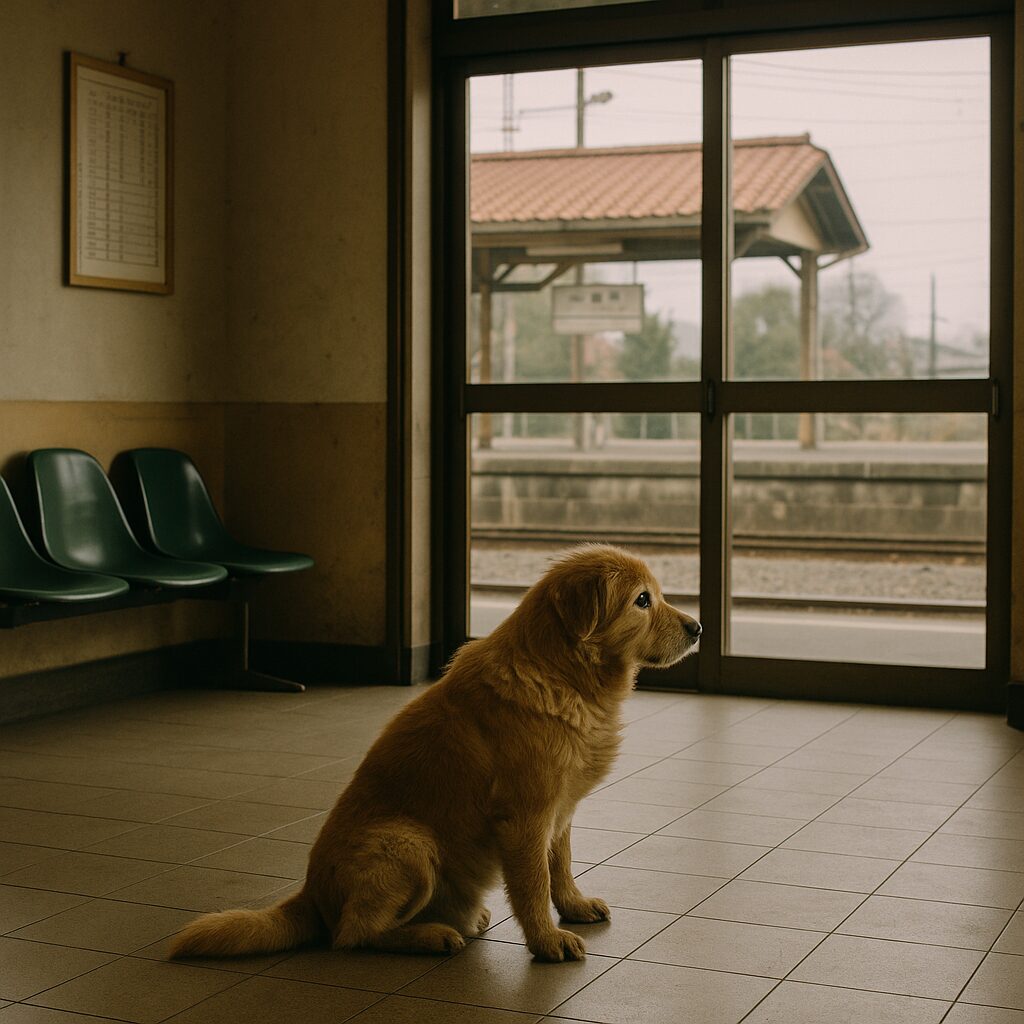
In the heart of Ishioka, a quiet town nestled in Ibaraki Prefecture, there once lived a dog whose story would echo through the decades — a story of devotion so steady, so gentle, that it seemed to bridge the line between life and memory. His name was Taro.
For 17 years, rain or shine, Taro walked the same 2-kilometer path between a small elementary school and the local train station. Every morning, as the first bell rang and children arrived at school, he would trot down the familiar road, tail swaying slightly behind him. And every evening, when the sun dipped low and the train rumbled into the station, Taro would appear again — sitting silently by the platform, eyes fixed on the horizon as if waiting for someone who would never return.
This quiet ritual would come to define not just Taro’s life, but the town’s collective heart. And now, more than half a century later, his story is being immortalized in a film titled “Ishioka Taro.”
A Stray Becomes Family
Taro’s journey began in 1964, a year of great change in Japan. The country was buzzing with excitement as Tokyo prepared to host its first-ever Olympic Games. But in a small corner of Ishioka, far from the spotlight, a lonely stray puppy wandered the streets, unnoticed by most.
That is, until a group of children from a local elementary school found him. They were the kind of children who couldn’t walk past a creature in need — and in that instant, Taro’s life changed. The school adopted him as their own. The teachers built him a small shelter near the entrance, and the students took turns feeding him, brushing his fur, and giving him the affection he had likely never known.
Soon, Taro became more than a school pet. He became a symbol — a constant companion in the lives of hundreds of children who passed through that little school. Every morning, he’d greet them with bright eyes and a wagging tail. Every afternoon, he’d walk with them partway home, his paws padding softly along the roadside, as if ensuring they made it safely back to their families.
No one knew why he eventually began making the full journey to the train station. Perhaps he once accompanied a teacher or student there and remembered the route. Or perhaps, as many have come to believe, he was waiting for someone who had taken that train long ago and never came back.
The Ritual That Lasted 17 Years
What made Taro’s daily walks remarkable wasn’t just their constancy — it was his discipline. Locals recall how he would arrive at the same times each day, almost like a station attendant keeping to a schedule. Morning and evening, without fail, through heat waves, snowfalls, and typhoons.
In the station’s waiting room, he had a favorite spot by the window, where the view stretched out to the tracks. There, he would sit quietly, his head tilted slightly, eyes gazing at the arriving trains. Passengers came and went, children grew up and moved away, but Taro remained.
Commuters learned to recognize him. He became part of the rhythm of Ishioka Station itself — a furry fixture of the community. Some would bring him food, others would stop to gently pat his head before boarding. For those who passed through daily, seeing Taro was like catching a glimpse of something eternal — a simple, silent reminder that loyalty can outlast time itself.
A Mirror of Humanity
Over the years, Taro’s quiet presence began to draw reflection. People who saw him began to project their own hopes and regrets onto him. Was he waiting for a lost master? A teacher who had moved away? A child who had grown up and never returned?
No one could say for certain. But that uncertainty gave his story its power. In a rapidly modernizing Japan, where towns were changing, schools consolidating, and old traditions fading, Taro stood as a living piece of the past — steadfast, patient, and pure in purpose.
Many locals began to refer to him as the town’s “guardian spirit.” He seemed to belong not just to one person, but to everyone who had ever loved and lost. His watch at the station became a ritual that spoke to something universal: the longing for connection, the endurance of love, and the quiet pain of waiting without answers.
The Town That Remembered
When Taro passed away after 17 years of these daily walks, the town mourned him as if they had lost an old friend. For many, his presence had become a comforting certainty in their lives. He had watched generations of children grow, families move, and lives change — and then, one day, he was gone.
But his story didn’t fade. In Ishioka, memories of Taro continued to circulate like gentle folklore. Older residents told their grandchildren about “the dog who waited.” Some even claimed to have seen his shadow at dusk near the station platform, where he used to sit. Whether fact or myth, Taro’s spirit lingered.
His legend was often compared to Japan’s most famous symbol of canine devotion — Hachiko, the Akita dog who waited at Shibuya Station for nine years after his master’s death. But Taro’s tale was different in tone. Hachiko’s story is one of tragedy and loyalty tied to a single human bond; Taro’s, in contrast, is one of communal love — a dog who belonged to a whole town, whose devotion was both mysterious and shared.
“Ishioka Taro”: The Film Project
In 2025, filmmakers and local supporters launched a project to bring Taro’s story to the screen under the working title “Ishioka Taro.” The goal was not just to recount the facts, but to capture the emotional essence of his journey — the way his quiet footsteps connected the laughter of children, the bustle of the station, and the loneliness of waiting.
The production, based in Ibaraki, involved local schools, volunteers, and even former students who remembered hearing about Taro as children. Many described the project as a way of “giving back” — of preserving a piece of small-town spirit in an era when community ties often feel fragile.
The film promises to be both nostalgic and deeply human. Early previews hint at sweeping cinematography of Ishioka’s countryside, gentle scenes of daily life, and an underlying sense of time passing — as if every frame is whispering: things change, but love remains.
The Meaning of Taro’s Journey
What is it about stories like Taro’s that resonate so deeply with people, even decades later? Perhaps it’s because loyalty, in its purest form, is something we long to believe in. In a world where relationships are often fleeting and attention is divided, the idea of a creature who walks the same path, day after day, simply because it feels right — that kind of devotion feels sacred.
Dogs, in their quiet wisdom, remind us of truths we forget in our rush to be busy and important. They don’t overthink. They love completely. They remember faithfully. Taro didn’t wait for applause or reward — he simply did what his heart told him to do. And that sincerity speaks to something ancient and enduring in us all.
Reflections from Ishioka
Today, Ishioka is a modest but proud town, known for its historical streets and seasonal festivals. But ask around, and locals will still tell you — “There was once a dog who walked to the station every day.”
At the old station site, there are discussions about placing a small bronze statue of Taro. It wouldn’t be grand or dramatic — just a humble figure sitting by the waiting room window, looking out at the tracks. Something to remind visitors that loyalty and kindness don’t need to be loud to be profound.
Some of the town’s elders, who were schoolchildren when Taro was alive, describe him as more than a pet — as a teacher. “He showed us what it meant to care without expecting anything,” one said. Another added, “Even now, when I walk to the station, I still look for him.”
A Symbol Beyond Time
The story of Taro isn’t just a tale from one small Japanese town — it’s a parable about the quiet strength of love. His 17 years of walking were not wasted moments; they were acts of remembrance. Every step he took down that 2-kilometer path was a step deeper into the hearts of those who saw him.
Perhaps that’s why his legend has endured. In Taro’s unwavering routine, people find hope — that loyalty still exists, that waiting can be an act of love, and that devotion, even without words, can become eternal.
The film “Ishioka Taro” will no doubt touch hearts across Japan and beyond. But for the people of Ishioka, it’s not just a movie. It’s a homecoming — a way of saying thank you to a little dog who gave their town something beautiful: a living reminder that love, once given, never really leaves.
Epilogue: The Waiting Never Ends
Imagine the quiet of the station in the early morning. The air is cool, the tracks gleam faintly in the light. Somewhere, the faint echo of paws touches the ground — soft, steady, familiar.
If you listen closely, perhaps you can still hear Taro walking. Not because he’s lost, but because his devotion has become part of the rhythm of the town itself. His wait, after all these years, has become timeless.
And maybe that’s the greatest legacy any of us can hope for — to walk our path with such quiet love that even when we’re gone, the world still remembers the sound of our footsteps.