
There are mornings when the air feels made of paper. Thin and pale and rustling, it turns even the smallest sound into a sentence you cannot ignore: the click of a bowl, the drag of a chair foot over wood, the soft huff of a dog who believes in breakfast more than most of us believe in anything. These are not dramatic moments. They seldom arrive with music or announcement. They are the slow clockwork of living with another being, the practice of letting your days be altered by a gaze and a heartbeat that are not your own.
Two stories have been haunting me in the gentlest way. One is about an elderly dog, nearly twenty, who was handed a future that looked like a closing door and then, against the odds, opened it again. The other is about a dog named Haku who, at five in the morning, sits at the family table and waits with the kind of patience that can change the shape of a day. If you follow the thread long enough, Haku’s patience draws a circle and brings family back to family. If you look closely at the elder dog, you see that love can be stubborn in the best way, and sometimes the body listens.
These are small stories. But small stories are where our lives hide. They are the pebbles that turn in our pockets and keep us company while we walk.
The Dog Who Was Almost Out of Time
He was just shy of twenty. That is a long time for a dog, a tether across seasons and jobs and houses, the kind of companionship that leaves its outline on the furniture and the floorboards and in the way you move around the kitchen. The family had already begun the sad mathematics of last things. Three veterinarians had seen him. Three found what looked like a serious illness. The words did not arrive all at once, but they gathered weight in the room. I imagine the family pressing against each other, the way you do when a wave seems taller than you expected.
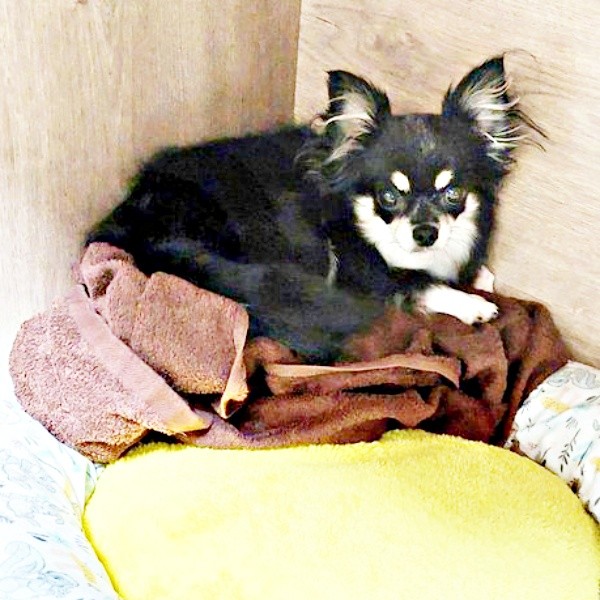
Old age brings a new vocabulary. There are pill sorters and pee pads and ramps over stairs. There are hands that grow gentle with practice, fingers that massage stiff hips, hours marked by syringes of water and careful meals. You learn how to count a good day without the arrogance of thinking you can make it last forever. The elder dog’s eyes follow you anyway, trusting, and that is sometimes the hardest part.
What happened next was not the kind of miracle that throws open the skies. It was the kind that takes place in the quiet corridors of a body that decides, for reasons we do not fully understand, to try. Follow-up tests cut against the grain of certainty. Markers eased. Symptoms softened. The dog did not turn into a puppy again. He did not leap across rooms. He simply began to be more himself, and the home bloomed around that small permission. You could call it a misdiagnosis, a correction in the ledger, biology’s version of a comma where a period had been placed. Or you could call it grace. The language we use will always tell on us.
I once knew a woman whose spaniel reached sixteen and then, after a frightening week, returned to her with a new steadiness. She told me the miracle was not that he lived longer, but that she was given time to love him without fear for a while, like a second childhood that belonged to both of them. I think of this when I picture our almost twenty-year-old. I imagine the hallway light at dusk, the gentle paw-drag of nails, the lost appetite that remembers itself at the smell of rice and chicken. I see the family learning the rhythm of small victories. He lifts his head. He drinks. He stands, briefly. Each movement is a letter written back from the edge.
The scientific part of me wants to rummage for explanations, for the particular pathways where bodies heal in tiny, stubborn increments. But the heart understands a different ledger. Sometimes recovery is the word we use for the space love keeps open, long enough for the body to make its own plans. Sometimes recovery means that the living you shared was not done with you yet.
Haku’s Five O’Clock Kitchen
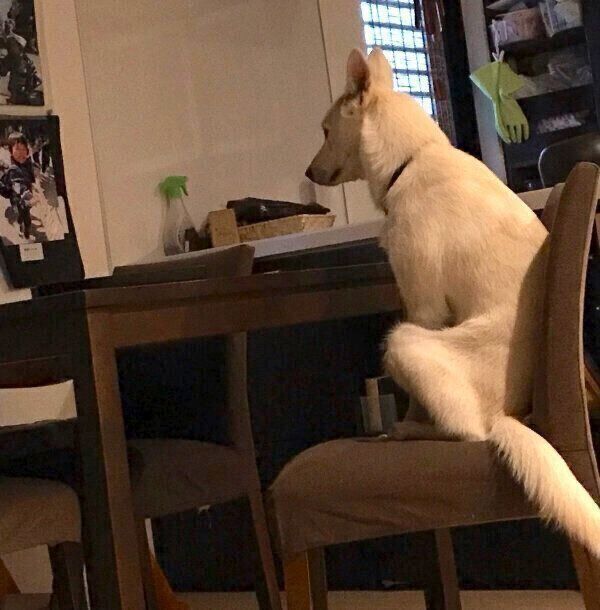
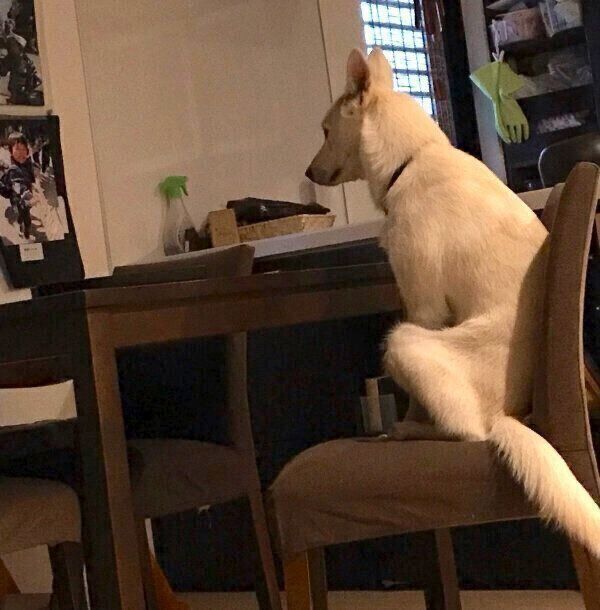
There is another house, another kitchen, and a dog who watches the dawn with a seriousness that makes everyone else adjust. His name is Haku, and he believes breakfast is the first sacred rite of the day. At five in the morning he sits at the table, not rudely, just present, like a quiet elder who has risen before the others to prepare himself for the world. There is a courtesy in his waiting. I imagine him occasionally blinking, adjusting his posture, tracking the earliest light along the floor like a needle along a seam.
When his human first shared this habit online, it was meant as a simple joy, the sort of thing you post when your home surprises you with its own sweetness. People fell in love with the image: a dog sitting upright in a chair, eyes soft with expectation, the room still blue with night. The post sailed outward like a lantern, and in that light a sister appeared.
Haku had been a rescue. At some point in time, there had been another like him, a sibling dog who had once shared the smell of the same basket, the soft warmth of the same mother. The internet is not often a cathedral, but sometimes it arranges coincidences so tenderly that you have to stop and pay attention. The post that captured Haku’s morning patience sparked recognition. A conversation unspooled. A message was sent. And then a reunion was made. The story that began at a kitchen table gathered itself into a larger table, one that could fit the lost and found.
There is an old joke that the internet is for cats. I think the internet is also for the quiet absolutions we cannot pull off on our own. We have long believed that dogs make us more human, but what Haku’s story exposes is the way our sharing can make the world bend toward kindness. A chair at five in the morning makes a path to a sister. A small thing becomes a bridge.
On Tears, Science, and the Warmed Place on a Rug
If you search for it, you will find that researchers in Japan have measured tears in dogs’ eyes when they reunite with their people. It is not the proof that matters to me so much as the image of a doctor holding a thin strip of paper at the corner of an animal’s eye, counting moisture the way you count rain in a cup. To imagine that a dog can cry from happiness is to recognize that the daily choreography we share has edges deeper than we thought. Breakfast is not just breakfast. A nap is not just a nap. The smell of your shirt is not just a smell. In the life of a dog, we are the weather, the furniture, the sky. We are also the small miracle that returns every time the door opens.
I think of the old dog’s family and how their home must have shifted in order to keep him comfortable. The soft bedding arranged like a nest. The rugs secured so paws would not slip. The favorite sun square on the floor that migrated as seasons turned. How much of our love occurs in these arrangements that look like housekeeping. How much of our devotion hides in an extra towel warmed in the dryer, in broth simmered a little longer, in the willingness to carry another’s weight up the stairs.
When I picture Haku, I see the same choreography. Someone sets a chair. Someone fills a bowl before the day can crowd out the patience of early hours. Someone takes a photograph and, in doing so, preserves that integrity of waiting. The image travels. A sister is found. Later, perhaps, two dogs doze in a patch of light, their breaths finding each other. The world is changed in no obvious way, and yet look at how different everything feels.
The Grammar of Old Age and Early Morning
There are two horizons in these stories. One is the thin place at the day’s start, where dawn is less a color than a promise you make with yourself. The other is the far shore on which every creature eventually rests. Old age and early morning teach similar lessons. You move more slowly. You pay attention. The light is a teacher, and so is the body. There is a holiness to small appetite returning, to paws finding their confidence, to the sound of a kettle and the clink of ceramic.
When illness enters a home, time shifts its furniture. Hours grow long or thin. Plans soften. Everyone becomes a student of one another again. I have watched families build new languages during these seasons. They become fluent in the small sounds a dog makes when he needs help adjusting his blanket. They learn the difference between a bathroom request and a dream whimper. They begin to name the day by what was possible rather than by what was planned. That is a form of love that requires you to apprentice yourself to reality, then lift it, gently, toward comfort.
When you are a creature who rises at five to wait for breakfast, you apprentice yourself to hope. You do not demand. You do not pout. You sit. You look toward where the morning will come from. Maybe this is why Haku’s image traveled so well. He was not only waiting for food. He was demonstrating how to inherit the day without anxiety, how to trust that the people you love will meet you where you are.
What We Carry Forward
People sometimes say that dogs teach us how to live. I think they also teach us how to be remembered. Long after a dog has gone, the home keeps their grammar. You catch yourself stepping over a space that was once a sleeping shape. Your hand reaches for the bottom shelf because that is where the treats always lived. The way you nap on a rainy afternoon is forever changed by the rhythm of a chest that once rose and fell against your thigh. Love turns our habits into altars.
For the family of the elder dog, the word miracle might feel both too large and exactly right. They will go on counting days, honoring the stretch and give of a body that is doing its best. They will discover that laughter returns even in houses where worry has made a bed. They will learn the soft politics of letting a good day be simply that, without trying to hoard it against the future.
For Haku’s humans, five in the morning will never be an empty hour again. The kitchen will keep that imprint. The chair will always look a little more dignified. And somewhere in the greater web of homes, a sister will rise to greet the same light. There will be a day when both dogs are old. There will be bowls and beds and the carefully measured treats that make an old dog’s mouth soften in joy. The photos will accumulate, but the true archive will be the sounds and scents and routines that entwine around everyone’s ankles like friendly vines.
On Misgivings, Misreadings, and Mercy
The elder dog’s story brushes against a fear many of us carry. What if the worst word arrives too soon. What if we sign away time that was still ours. We live in a world that likes to be certain. There is a comfort in a medical term, a chart, a line on a graph. Yet bodies, like hearts, are not always so obedient to our lines. Recovery sometimes comes as a small correction, a quieter phrase inserted where a loud one used to be.
Mercy is a strange kind of math. It can look like a new result from a lab. It can look like an appetite returning at dusk. It can look like a family choosing to sit on the floor beside a bed rather than leaving the dog to sleep alone. The forms of mercy are practical. They smell like broth and the cleaned blanket, like the morning air when you open the door even though it took you twenty minutes to put on the harness.
Haku’s story pulls another thread. It reminds us that ordinary acts, when seen and shared, can locate missing pieces of our lives. The internet at its worst is a field of noise. At its best, it is a letter folded into a bottle that finds the very shore you did not know to draw on a map. The reunion that followed a photograph did not bring the world to its knees. It simply corrected a loneliness that was two small steps from joy. That is the kind of world I want to live in.
Rooms, Routines, and Reverence
When I was a child, our neighbor’s dog learned the time by the sound of the school bus gears. On days when the bus was late, he would tip his head and reassess the truth of the world. On days when I was home sick, he would still trot to the door at three, because the body loves a ritual even when the mind has new instructions. This is part of why living with dogs can make even a chaotic life feel anchored. They compose the hours. They stitch the edges.
In the elder dog’s home I picture a chair that has become a station, a folded towel that marks a favorite corner, a bowl that is brought closer because the neck has less range. I picture the conversations that happen at bedtime, the porch light left on, the way the family learns to listen for the sound that means I need you. There is reverence in this, the kind of reverence that does not need incense or scripture but finds holiness in clean water and a lifted spoon.
In Haku’s home there is another kind of reverence. The family honors the morning by not rushing it. They let the dog’s patience be a teacher. They name the hour and it names them back. When the photograph was taken and shared, the wider world recognized itself in the scene. So many of us are waiting in our own chairs for the good we believe in to arrive. What if we could wait like Haku, with dignity and a soft gaze, without panic. What if waiting was not absence, but devotion.
The Art of Staying
Love, for dogs and for people, is a practice of staying. We stay beside the old ones while they sleep. We stay on the cool kitchen floor with the young ones when thunder snarls. We stay until the morning arrives and the body remembers how to be a body again. We stay when it is inconvenient, and especially when it is quiet enough to hear our own hearts argue for something easier.
The elder dog teaches us that staying can be rewarded in ways you did not plan for. The miracle here is not victory over time. It is a reprieve that returns the ordinary to those who had already said goodbye to it. The gift is not a headline. It is a bowl licked clean, a steady step, a nap that ends with a stretch and a sigh that you have been listening to for nearly twenty years.
Haku teaches us that staying can build a bridge you cannot see until you set your chair down and wait. His morning ritual was not staged for applause. It was made of habit and hope. And yet the act of sharing it invited the world to answer back with a sister’s name. Sometimes we are the caretakers of an hour that belongs to many more creatures than we realize.
A Gentle Field Guide for the Days Ahead
If these two dogs could mentor us, I think they might make a modest list for the humans in their charge:
- Start early when you can. The day is kinder when you greet it before it begins to ask too much of you. If you can, make breakfast its own ceremony. Sit. Wait. Breathe.
- Stay with the old ones. They are charting a map you will one day need. Carry water. Warm blankets. No one outgrows tenderness.
- Trust the small miracles. Not every improvement announces itself with trumpets. Sometimes a new appetite is a hallelujah in a whisper.
- Share the good. You never know whose sister or brother might be listening for a familiar face in the stream of your life.
- Practice patience as a language. It is one the world understands. It is one your body recognizes, too.
What The Stories Keep
I keep thinking of the light in both houses. The first is evening, the amber that makes white muzzles glow like frost while the air tills itself into night. The other is morning, the blue trim on a day that has not yet been spoken. In both rooms there is a chair, a bowl, a being who will outlast us and will not, and a family learning to hold that truth with an open palm.
The elder dog is not immortal. One day the family will carry a different kind of quiet. But there is kindness in the time they have reclaimed. The days add up. The rug warms. Someone laughs in the kitchen and the sound does not feel like a trespass against sorrow. The home relearns joy at a volume the body can handle.
Haku will keep sitting at five, whether the internet is watching or not. His family will keep honoring the hour, even when sleep clings or rain argues against routine. There will be mornings when the chair is empty, because that is the world’s hard promise. But the ritual will have done its work. The family will know how to wait for what is good, and how to notice it when it arrives.
I think we sometimes expect love to be a thunderclap. More often it is the slow, steady metronome of care. It is the soft paw on your ankle at dawn. It is the encouragement a body hears when a voice says, quietly, here you go, old friend, try a little more. It is the faith that what you give to another creature makes the world a fraction more livable for everyone who touches it.
Two stories, then. An old dog who surprised the dark by turning toward the window again. A patient dog whose breakfast vigil drew a lost sister across the invisible bridge between strangers. Their lessons meet in the middle: stay, listen, share, hope. If you do, the day might change around you in ways you cannot predict. And even when it does not, you will have lived it well.