
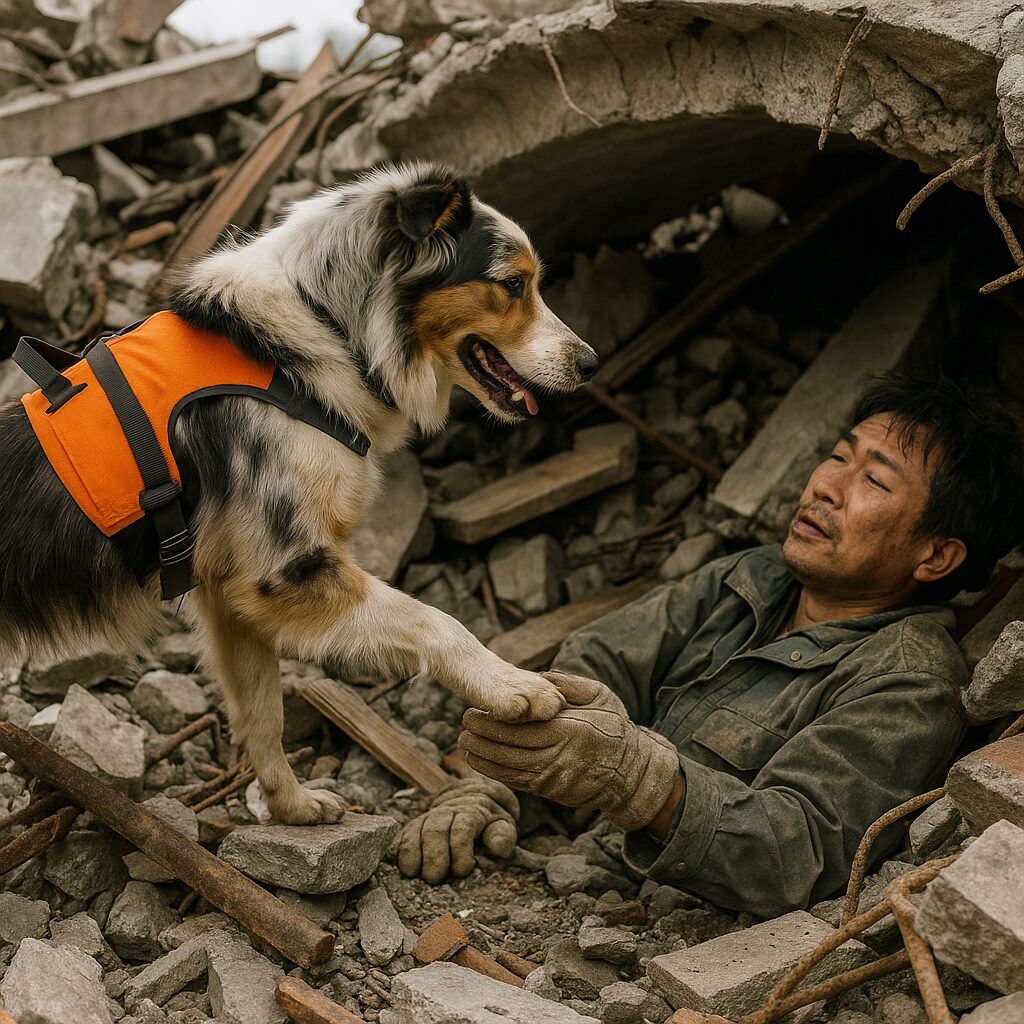
At 16:10 on January 1, 2024, just as families across Japan were settling in for the first meal of the new year, the earth convulsed. A violent series of earthquakes ripped through the Noto Peninsula, tearing roads into jagged scars and collapsing houses into heaps of dust and splinters. Power vanished in an instant. Smoke mingled with the salty winter air. In villages along the rugged coastline, silence fell between the aftershocks, a silence punctuated only by sirens and the desperate cries of those searching for loved ones.
While most people ran from the danger, one responder moved toward it. Four legs, a vest, and a tail that cut through the dust like a flag: Roger, a disaster rescue dog. By nightfall, he and his handler, Junko Onishi, were on the ground. Their task was simple to describe but perilous to perform: find the missing, navigate fractured ruins, squeeze into voids no human could reach, and transform chaos into a map of scent that might lead to life.
For the families huddled in the cold, waiting for news, Roger’s bark would become something more than noise. It was the sound of a chance.
Who Roger Is and Why Dogs Like Him Matter
Roger isn’t a mascot. He isn’t a mascot in the way a firehouse dalmatian might be, or a feel-good therapy dog brought to ease the stress of a disaster site. Roger is a working professional, trained for years to do one thing in the most hostile conditions imaginable: locate people who cannot be seen or heard.
In the immediate aftermath of a quake, speed is everything. Survivors trapped under debris may have only hours before oxygen runs out or injuries turn fatal. Dust clouds choke the air. Aftershocks threaten to finish what the first tremors began. Heavy machinery often can’t reach fragile ruins without making collapse worse. But a dog can. Agile, fast, and equipped with one of the most advanced scent-detection systems on Earth, dogs like Roger go where technology hesitates.
His job is brutally clear. He races across unstable debris, nose twitching, filtering out a storm of smells: charred wood, gasoline, mold, seawater, until he locks onto the faintest trace of human scent. And then he does the one thing that tells his handler everything: he barks.
That bark is not just noise. It is the announcement that life might still exist beneath the rubble. For rescuers, it is the thread of hope they need to pull. For families, it may be the only thing that transforms uncertainty into action.
The Team Behind the Vest
No dog works alone. Roger is part of ARROWS (空飛ぶ捜索医療団), a Japanese rapid-response coalition designed to deliver immediate aid where it is needed most. ARROWS isn’t just about dogs. It brings together pilots, doctors, nurses, rescue specialists, and logisticians who move as a single unit. Their mission is clear: cut through chaos with speed and precision, bridging the gap between disaster and relief.
Within this orchestra of urgency, Roger and Junko Onishi form one of the most intimate partnerships. Every search pattern Roger runs is influenced by Onishi’s judgment of wind direction, terrain, and risk. Every bark is interpreted through her trained eye. They operate like two halves of one mind: the dog is the instrument capable of extraordinary detection, and Onishi is the musician who knows how to draw out its power.
This trust is not built overnight. It is carved from years of shared training, repetition, and countless hours of living as one team. For Roger, the leash is not just a tool. It is the physical thread that connects his instincts to her decisions, his discoveries to her commands.
From Pup to Professional: How a Rescue Dog Is Made
It’s tempting to believe dogs like Roger are born heroes, destined for disaster zones. The truth is less romantic and more astonishing: they are made through thousands of hours of painstaking, joyful, and sometimes grueling training.
-
Target Odor Obsession
Every rescue dog begins with one core lesson: human scent matters more than anything else. Trainers start by rewarding dogs for identifying live human scent, even when disguised by strong distractors like gasoline, dust, or food. The dog learns that ignoring every temptation—ball, treat, or animal—pays off only when they lock onto the human smell. -
Neutralizing Fear
Collapsed buildings are noisy, sharp, and unstable. Metal beams groan, concrete shifts without warning, and aftershocks create thunder underfoot. Dogs must learn to move with calm precision, stepping onto rebar, climbing ladders, and crossing shaky boards. In training, they hear sirens, bangs, and machinery until their nerves are unshakable. -
Scent in Motion
In the real world, scent doesn’t sit still. It swirls in wind, pools in corners, and shifts with temperature. Dogs like Roger practice casting in zig-zag patterns, triangulating odor plumes the way sailors read currents. They learn not just to smell, but to solve puzzles of air. -
Clear Indication
When Roger pinpoints a live scent, he doesn’t scratch randomly or wander off. He barks, loud, rhythmic, and unwavering, and then stays fixed until Onishi arrives. This behavior is drilled so deeply it survives adrenaline and exhaustion.
And the handlers? Their preparation goes beyond the leash. They learn first aid, disaster medicine basics, radio protocol, and the international search-and-rescue language used so that teams from different countries can work seamlessly. Certification is brutal by design, because hesitation in a real disaster can cost lives.
Inside a Search: What Roger Actually Does
Picture this: a two-story wooden house crumpled into a single layer of jagged debris. A gas leak whispers in the air. Dust puffs with every tremor.
Roger and Onishi arrive.
First, Onishi checks the wind, tracing invisible currents with an almost meditative calm. She releases Roger, who darts across the ruins in a disciplined zig-zag, nose tilted, filtering thousands of scents at once. His ears flick. His tail stiffens. Suddenly, his body freezes, then erupts in a volley of sharp barks aimed at a particular cavity in the wreckage.
Onishi marks the site, signals the team, and rewards Roger, yes, even now, with a quick toy tug. That small celebration locks in his certainty: he did the right thing. Medics rush forward, silence falls, and rescuers begin careful excavation.
Sometimes, what follows is a miracle: a hand reaching out, a cry answered. Other times, it is the solemn confirmation of loss. Either way, Roger must reset instantly. The next pile awaits. The mission continues.
The Weight of the Vest
Stories like these often polish rescue dogs into flawless legends. The truth carries weight. Roger doesn’t only find survivors. He also finds those who did not make it. For Onishi, the responsibility of interpreting his bark is heavy. She must absorb the human cost, shield Roger from confusion, and carry both of them forward.
That is why decompression rituals matter. After each search, Roger is rewarded with his favorite toy or a gentle walk. These aren’t trivial. They are mental resets, signals to his nervous system that he is safe, that his job is done, that he can play. Without this, even the strongest dog can burn out.
Behind every dramatic bark is a quiet truth: courage is not just running into ruins. It is the ability to keep doing it, again and again, even when the outcome is heartbreak.
A Legacy Roger Carries
Roger’s work isn’t a solo miracle. He follows in the pawprints of dogs like Hulk and Yumenosuke, who responded to disasters from the Hiroshima landslides to the Nepal and Kumamoto earthquakes. Each mission left behind not only lessons written into manuals, but also a living proof of concept: search dogs save lives.
Japan now has a structured system for training, certifying, and deploying disaster dogs. Every new recruit carries forward a body of knowledge built on real-world experience, ensuring that when the ground shakes again, response isn’t improvised, it’s instinctive. Roger is not just one dog. He is part of a lineage, a system, a promise that help will come.
What the Noto Mission Taught Us
Every disaster writes its own playbook. Noto was no exception. Narrow roads, aging wooden homes, and coastal geography turned the rescue into a logistical labyrinth. But Roger’s deployment revealed enduring truths:
-
Speed saves lives. Dogs can clear dangerous areas faster than any human crew, focusing resources where survival is possible.
-
Local knowledge multiplies impact. Villagers often guided teams to likely locations—kitchens where families cooked, tatami rooms where elders rested, or fishing sheds where neighbors worked.
-
Multidisciplinary teams win. When pilots, medics, logisticians, and canine units moved as one, the response became faster and safer.
The Science of Hope: Why Dogs Outperform Sensors
Technology is powerful. Thermal cameras detect body heat, seismic sensors pick up vibrations, and fiber-optic cameras snake through crevices. Yet all have limits. Heat signatures can blur in debris, sounds can be muffled, batteries can fail.
A dog’s nose, however, is unmatched. Capable of detecting parts per trillion, it can separate human scent from a sea of dust, smoke, and gasoline. Scent does not require line of sight or silence. It seeps, drifts, and clings. Dogs are the interpreters of this invisible map, moving with an efficiency no machine can rival.
Hope, in a disaster zone, is not abstract. It has a nose, lungs, and a bark.
The Quiet Heroism You Don’t See on the News
Television crews often arrive late, and cameras prefer the drama of flames or collapsed highways. What rarely makes headlines is the still, intense labor of canine teams. You won’t see the scribbled wind maps on the back of a glove, or the moment when Onishi kneels, forehead to Roger’s, steadying his breath after a grueling find.
Yet for families who hear that bark and watch rescuers dig where Roger insisted, these unseen moments become unforgettable. Sometimes the gift is reunion. Other times it is certainty, granting dignity to grief. In both, Roger’s work changes lives.
How to Support Teams Like Roger’s
If Roger’s story moves you, here’s what matters:
-
Sustain the training. Rescue capability isn’t something you activate at the sound of a siren. It’s built day after day, funded in advance. Donations to reputable organizations keep dogs and handlers ready with fuel, medical kits, and training grounds.
-
Spread preparedness. Share information about “go bags,” anchored furniture, and evacuation plans. Every prepared household frees responders to focus on those who need the most help.
-
Respect the leash. In a disaster, unleashed pets and curious bystanders can disrupt searches. If you ever see a dog like Roger at work, give them space. Their focus may be the difference between life and death.
Roger’s Real Message
It’s tempting to frame Roger as a superdog. But his true power lies in the ordinary discipline of his training, the trust of his partnership, and the resilience of showing up again and again. His courage is not magic. It is a practiced habit.
And that is the best news of all. Because when the ground shakes again, and it will, hope will not be a vague feeling. Hope will arrive with four paws, a sharp bark, and a handler holding the other end of the leash.
Roger teaches us that courage is not about being fearless. It is about stepping forward, again and again, into uncertainty, and choosing to search anyway.