
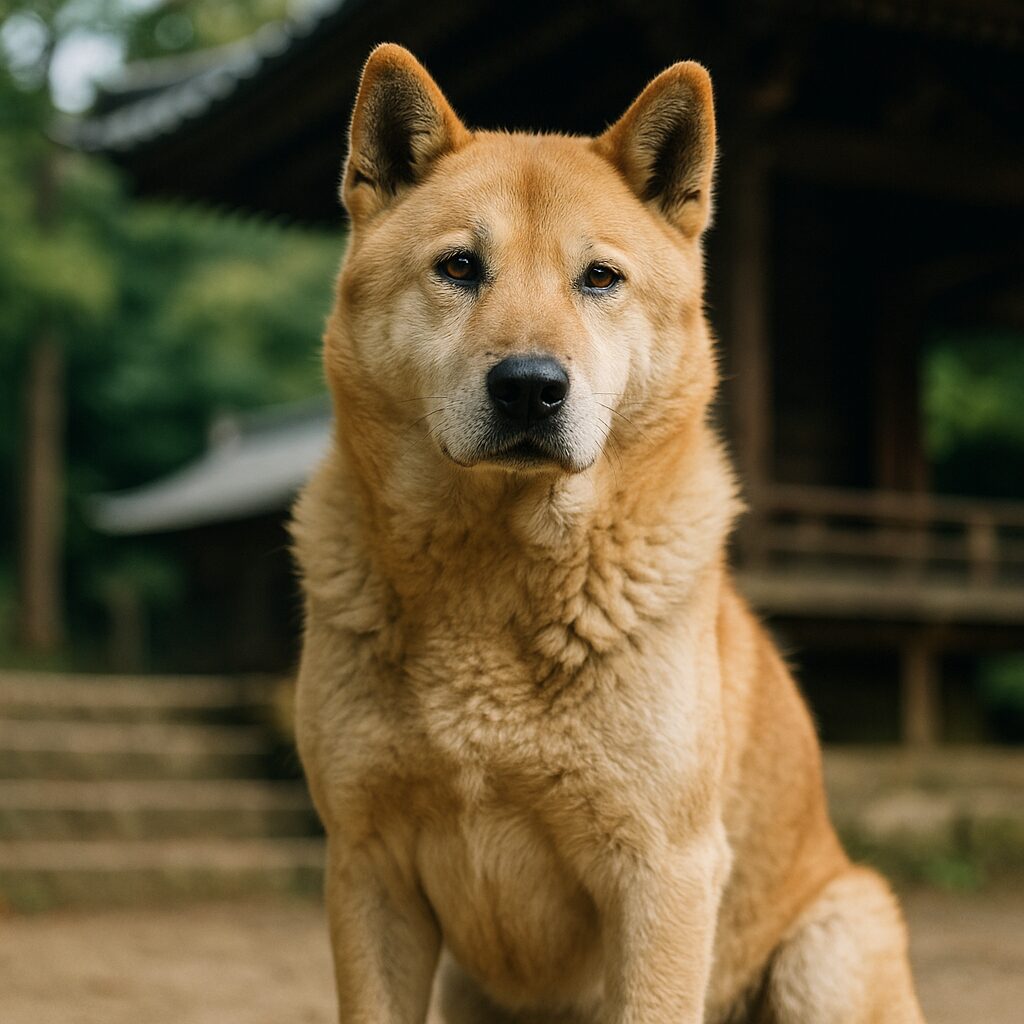
High in the wooded hills of Gifu Prefecture, there stands an old Buddhist temple — serene, timeless, and surrounded by the whispers of cedar trees. For many visitors, it’s a place of prayer and reflection. But for nearly a decade, it was also home to a quiet pack of dogs — survivors of neglect, perhaps abandonment, perhaps generations of life untethered to any human home. Among them was one dog who stood out from the rest: a proud Hokkaido named Valiant.
When rescuers finally found him, he was nine years old — his fur thick and weathered, his body lean but strong, and his eyes sharp with years of vigilance. He wasn’t the kind of dog to run or hide. Instead, he stood watch at the edge of the temple grounds, cautious yet calm, as if protecting something sacred. It was as if he had taken on the duty of a guardian — not only for his fellow dogs but for the place that had become their world.
This is the story of how that silent guardian, once hardened by survival, learned to trust again.
The Forgotten Temple Pack
The story of Valiant began long before his rescue. Like many strays in rural Japan, he and his companions were not so much “wild” as they were forgotten. In the aftermath of population decline in Japan’s countryside, many villages have dwindled, their schools and shops closed, and even their temples left without caretakers. When humans leave, animals often stay behind.
Local residents in Gifu had begun to notice the pack years earlier. They roamed quietly near the temple, sometimes appearing at dusk when the air cooled, scavenging from offerings left by visitors or discarded food left near bins. Occasionally, one or two would wander into the nearby town, but they always returned to the forested slopes — back to the safety of their hidden home.
Valiant was the largest among them, and by all accounts, the leader. He had the sturdy frame and keen intelligence typical of the Hokkaido breed — dogs once bred to hunt in snowbound terrain alongside the Ainu people. They were known for loyalty, bravery, and resilience — traits that had clearly served him well in his years of isolation.
But leadership in the wild is rarely about dominance. Those who later met Valiant described him as watchful, not aggressive — a protector rather than a tyrant. He would step forward first when strangers approached, positioning himself between the humans and his companions, silently gauging the intent of the newcomers.
It was that quiet strength that earned him his name: Valiant.
The Day of Rescue
It was a spring morning when the rescue finally happened. Volunteers from a local animal welfare group had been tracking the pack for months, working slowly to earn their trust. They had set up feeding stations and remote cameras to observe their habits.
When they finally approached with humane traps, the dogs scattered at first. But one — Valiant — didn’t run. He stood still, alert but unafraid. The rescuers noticed that the others seemed to take their cues from him; when he didn’t panic, they hesitated too. Slowly, cautiously, the rescuers managed to bring the dogs in, one by one.
Valiant was the last.
When the gate closed behind him, there was no struggle. He simply sat, silent and steady, as if sensing that his long watch had ended.
The rescuers would later say that it was unlike any rescue they had ever seen — no snapping, no frantic barking, just a dignified calm. It was as though Valiant understood that the people before him were not enemies but a new kind of guardians.
Life After the Mountains
Valiant’s first days at the shelter were quiet. He ate sparingly, slept lightly, and kept his distance from humans. The staff quickly realized that while he had been physically tough, emotionally he was fragile. Every sudden movement made him flinch. Every unfamiliar voice made him freeze.
But slowly, through routine and patience, the walls began to crumble.
The shelter volunteers made a simple plan: consistency. The same people fed him at the same times each day. They spoke softly, moved slowly, and avoided forcing affection. Dogs like Valiant, who have survived for years on their own, must first relearn what safety feels like — not in the form of comfort, but predictability.
One of the volunteers, a woman named Keiko, was the first to see a change. She would sit outside his kennel, reading aloud from a book or talking gently about her day. At first, Valiant ignored her completely. But after several weeks, she noticed something subtle: when she arrived, he would lift his head.
That small gesture was the beginning of something extraordinary.
Soon, he began to accept treats from her hand — trembling slightly, but willing. Then came the first touch: a hesitant brush along his neck, met with a long sigh, as if he had forgotten how it felt to be cared for.
For the first time in years, Valiant leaned into a human’s hand.
The Heart of a Hokkaido
The Hokkaido is one of Japan’s six native dog breeds, alongside the Shiba Inu, Akita, Kishu, Kai, and Shikoku. Known for their thick double coats and wolf-like alertness, Hokkaidos are famously loyal but cautious with strangers. Historically, they were working dogs — hunters of bear and deer, companions to the Ainu, and protectors of homesteads in Japan’s northernmost island.
They are dogs of instinct and intelligence, deeply bonded to their environment and pack. When left alone for years, those instincts don’t fade — they sharpen. That’s why Valiant survived when others might not have. He adapted.
But that same independence makes rehabilitation slow. Building trust with a Hokkaido requires patience, respect, and emotional honesty. They do not yield easily — but when they do, they give their hearts completely.
Valiant’s progress soon became a quiet inspiration for the volunteers. His transformation was not dramatic, but steady. The first tail wag. The first playful bark. The first time he fell asleep beside a human, completely at peace. Each small moment carried enormous meaning.
From Survivor to Symbol
As months passed, Valiant’s story began to spread. Visitors came to the shelter to meet the famous “temple dog,” many struck by his gentle dignity. Children would stand at the edge of his enclosure, whispering, “He’s so brave.”
Photographers captured him in soft morning light — his fur shimmering gold, his eyes calm and deep. The images circulated online, resonating far beyond Japan. People from as far away as Canada and Australia wrote to the shelter, expressing admiration for his resilience.
One comment captured the sentiment best:
“He looks like he’s seen everything — pain, hunger, loneliness — and somehow still believes the world can be kind.”
The shelter received numerous adoption offers, but the staff were cautious. They wanted a home that could understand Valiant’s quiet nature — someone who would not demand affection, but earn it.
Eventually, they found that person: an older man named Hiroshi, a retired teacher who had recently lost his own dog. He visited several times before the adoption was finalized, sitting near Valiant, speaking softly, never forcing a connection. On the third visit, Valiant walked up to him and placed his head against the man’s leg.
That was all the answer anyone needed.
A New Beginning
Today, Valiant lives in a quiet home on the outskirts of Gifu, surrounded by trees that remind him of his old mountain refuge. He sleeps on a thick futon near the window, where he can watch the world outside — rain, wind, and drifting leaves.
Neighbors often see him on gentle walks with Hiroshi, moving in perfect sync. Sometimes they stop at the local temple, and Valiant sits still, his gaze distant, as if remembering the friends and seasons of his past life.
Hiroshi says that though Valiant rarely barks, his presence fills the home.
“He doesn’t need to speak,” he says. “You can feel his gratitude in every look.”
Every evening, Valiant rests his head on Hiroshi’s knee as the sun sets through the shoji doors. In those quiet moments, the years of hardship seem to melt away — replaced by something timeless and pure: trust.
The Lesson of Valiant
In Japan, where urban life hums with efficiency and tradition often coexists with modern disconnection, stories like Valiant’s remind people of something fundamental — that empathy is a form of courage.
Rescuing a dog like Valiant isn’t just about saving an animal; it’s about acknowledging that gentleness can rebuild what time and pain have broken. It’s about remembering that even in silence, there is emotion. Even in fear, there is hope.
Valiant’s story resonates because it mirrors our own human struggles — the instinct to protect, the fear of being hurt again, and the longing to find a place where we can finally rest without looking over our shoulder.
For years, he lived as a guardian without anyone to guard him. Now, he is safe, and perhaps more importantly, he is seen.
The Legacy of the Temple Dogs
The temple pack of Gifu no longer exists — at least, not as it once did. Thanks to the same group of rescuers, nearly all were found, treated, and placed in shelters across the region. Some were adopted, others remain under care, still learning what it means to be part of a human world.
Their legacy, however, continues. Animal welfare groups have since launched campaigns to monitor abandoned rural areas, promote spay-and-neuter programs, and educate the public on responsible pet ownership.
Valiant, unknowingly, became the face of this movement — the living proof that rehabilitation is possible, no matter how many years have passed.
Closing Reflections
If you visit Gifu today, you can still find the temple where Valiant once stood guard. Locals sometimes leave offerings there — dog biscuits, flowers, or notes of gratitude. One message left by a child reads:
“Thank you for protecting everyone, Valiant.”
And perhaps that’s the essence of his story — not just a tale of survival, but of service. Even when no one was watching, he fulfilled his duty with quiet bravery. And when kindness finally came for him, he allowed it to enter his life with the same dignity that had carried him through the years.
Valiant reminds us that healing doesn’t erase the past — it transforms it. The scars remain, but they shine differently under the light of love.
So when you look into the eyes of an old rescue dog, remember: behind that calm, steady gaze is an entire world of endurance, loyalty, and grace.
Valiant is living proof that no heart, no matter how guarded, is beyond saving.