
About a year ago, in a quiet coastal town in Japan, a couple decided to open their home again. Theirs was not a decision made lightly, nor out of simple longing for a pet. It came from the still, aching space left behind by the loss of their previous dog, a companion who had, for many years, shaped the rhythm of their lives. When she passed away, their world fell silent. The walks that had once framed their mornings were empty now; the soft sound of paws against the floor, the familiar sigh from her favorite spot by the window, all had vanished, leaving a kind of hush that pressed at the edges of their days.
For months they couldn’t bring themselves to fill that silence. Love like that, they thought, doesn’t get replaced. It changes you, rearranges your habits and your sense of time. And when it’s gone, you learn how much of your life had been built around small, wordless companionship. Yet somewhere inside that absence, a thought began to take shape, a thought not about moving on, but about giving back. The love they had once received so freely could become something they offered in return. When they finally decided to adopt again, they knew it wouldn’t be about starting over. It would be about honoring the life that had already touched theirs, and letting that love ripple outward.
They called it a way of returning the favor.
A Photograph and a Gaze
Lulu’s story began, as so many do, with a photograph. She was a rescue dog who had been waiting for months at a small shelter on the outskirts of Chiba Prefecture. The picture showed her sitting on a thin blanket, her eyes hesitant but searching. She wasn’t the kind of dog who immediately draws attention: no flashy markings, no wide grin. There was something quieter about her, something that spoke of uncertainty and endurance. Her gaze carried both resignation and hope, the look of a creature who has learned to wait.
The couple saw her photo late one evening while scrolling through a shelter’s website. They had been talking about adoption in vague terms for weeks, never quite ready to act. But when Lulu’s image appeared, something stirred. “She looks like she’s still listening,” the woman said softly. “Like she hasn’t given up yet.”
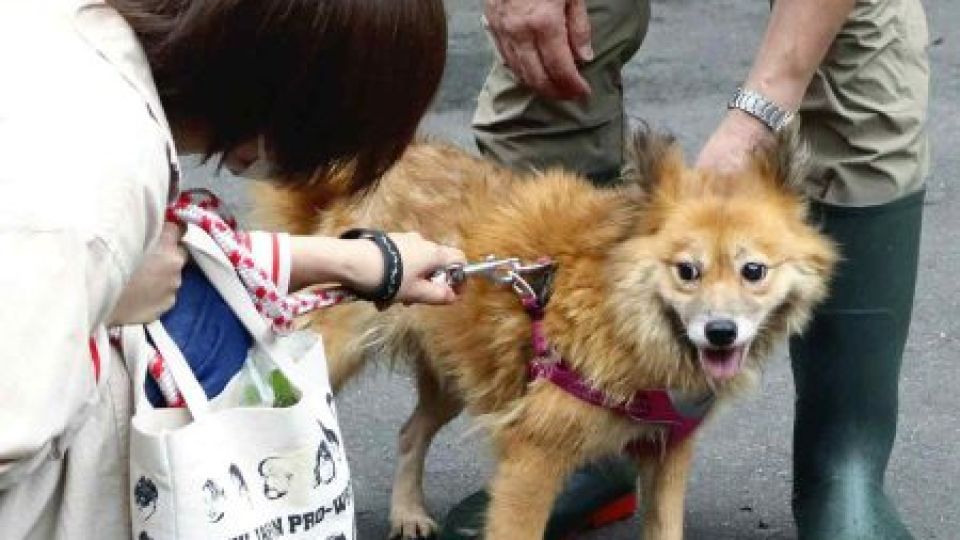
They returned to that photo the next day, and the day after that. It stayed with them, not as an impulse but as a gentle calling. Finally, they wrote to the shelter and arranged a visit. It was early autumn when they met Lulu in person. The air was crisp, the leaves just beginning to change. She was smaller than they had imagined, her fur a patchwork of browns and white, and when the shelter volunteer brought her out, she hesitated at the threshold before stepping forward. Her tail wagged once, cautiously.
It wasn’t love at first sight; it was recognition. Something about her quiet dignity mirrored their own reserve. They knelt, spoke to her in soft voices, and let her come closer on her own terms. She sniffed the woman’s hand and leaned, almost imperceptibly, into her touch. That was enough.
The first few days at home were awkward. Lulu paced through each room as though taking inventory of this new life, pausing at corners, peering into mirrors, testing every sound. The couple followed her with gentle patience, offering reassurance without expectation. They had learned from loss that love, especially with rescue animals, grows by invitation, not insistence.
At night, Lulu slept in the hallway outside their bedroom, her breathing quick and alert. But on the third night, when the wind howled and rain lashed against the windowpanes, they woke to find her curled beside the bed. By morning, she was still there, one paw resting against the woman’s blanket, as if anchoring herself to something she could finally trust.

Gradually, the rhythm of the house began to change again. There were bowls to wash, leashes to hang, morning routines to rediscover. The sound of paws, new ones now, lighter and unsure, echoed in familiar patterns. The husband said it felt like their home had exhaled for the first time in a year.
Each morning they walked Lulu by the sea. Their small town, stretched along the coast, had a path that ran beside the breakwater. The ocean there could be calm or wild depending on the day, and Lulu, in her first weeks, approached it with caution. Waves unnerved her; the sound was too big, too unpredictable. But as the weeks passed, she began to approach the shoreline, her tail slowly lifting, her nose twitching at the salt air. One day she chased a foam crest that broke near her paws, darting back with a startled bark, and then, unexpectedly, she wagged. It was the first true wag they had seen.
The couple laughed out loud. It felt like a small miracle.
For them, Lulu’s arrival was less about filling a void and more about acknowledging one. Their grief for their previous dog hadn’t disappeared. It never would. Instead, it had transformed into something quieter, something capable of coexistence. They realized grief and gratitude often share the same space: one deepens the other.
They often spoke of their old dog while caring for Lulu. They didn’t hide the memories or avoid comparison. Instead, they treated each recollection as a thread that connected one life to another. “She taught us how to love,” the husband once said, “and Lulu is teaching us how to give that love back.”
The shelter staff had told them that Lulu had been found wandering the edge of a rice field months earlier, thin and nervous, likely abandoned. She had trusted no one easily, though she had never shown aggression. There was a fragility about her, one that made her gentleness even more moving. It reminded them that healing often begins not in grand gestures but in the smallest acts of consistency: a bowl filled each day, a kind word repeated, a safe space kept open.
The woman began writing short diary notes about Lulu’s progress:
“Day 5: Lulu followed me into the kitchen and watched me cook.”
“Day 17: She let me brush her fur without moving away.”
“Day 41: She barked for the first time. It startled all of us.”
In those notes, you could sense both her tenderness and her awe. Watching a once-abandoned dog rediscover confidence was like watching sunlight return to a room that had been dim for too long.
By winter, Lulu had become their daily companion along the shore. They wrapped her in a light jacket and walked through the biting sea air, the horizon washed in pale silver light. The beach near their town was often empty in the cold months, the sand smooth except for the prints of seabirds and, now, Lulu’s paws. She learned to stop and face the wind, her ears streaming back, her nose tilted up as if catching the scent of something eternal.
The woman once said the sea reflected their own hearts: ever-changing, unpredictable, yet faithful in its return. There were days when they walked in silence, the three of them moving as one small constellation against the wide expanse. Lulu’s presence didn’t erase the past, but it gave it new meaning. Every gust of wind seemed to whisper the same quiet truth: love doesn’t end; it changes form.
Sometimes, at dusk, they would sit together on a low stone wall overlooking the water. The sun dipped low, staining the waves gold. Lulu would rest her head on the man’s knee. He’d stroke her ears absently, lost in thought. These were the moments, he said later, when he understood the simplicity of second chances, not as a heroic act but as a natural continuation of love.
The turning point came not in any single event, but in an accumulation of small, everyday gestures. Lulu began to greet them at the door with her tail wagging high. She learned the sound of their car and ran to the window when she heard it. She began sleeping deeper, her body relaxed, her paws twitching in dreams. Once, when thunder cracked across the sky, she ran, not to hide, but toward the couple, pressing herself between them for reassurance. They realized then that trust, once earned, is the purest form of love.
The shelter had warned them that rescue dogs can carry invisible scars: habits of fear, sudden anxiety, even moments of withdrawal. And yes, there were setbacks. A loud noise could still send Lulu under the table. The sight of a stranger approaching too quickly made her tremble. But rather than frustration, the couple met these moments with quiet understanding. Healing, they knew, isn’t linear. It circles, pauses, retreats, and then moves forward again.
They started volunteering occasionally at the same shelter where Lulu had come from. “We can’t take them all home,” the woman said, “but we can help more Lulus find theirs.” They shared Lulu’s story on the shelter’s website, posting pictures of her seaside walks and naps in the sun. The response was unexpectedly warm. Other adopters reached out with their own stories of grief and renewal. What began as one couple’s private healing turned into a small wave of shared compassion.
In Japan, rescue adoption still carries certain social challenges. Many people prefer to buy dogs from breeders or pet shops, often out of habit or the misconception that shelter animals are “damaged.” But organizations across the country, from Peace Wanko in Hiroshima to Animal Refuge Kansai, have been working for decades to change this view. The couple admired these groups quietly; they saw their own choice as part of a wider current of change.
To them, “giving back” meant something deeply personal. It wasn’t charity. It was continuity, the belief that love should keep circulating. Their first dog had taught them companionship, patience, and devotion. By adopting Lulu, they were allowing that lesson to continue through another life. In this way, they weren’t closing a chapter but extending a story.
The husband once reflected, “When we lost her, I thought our time with dogs was over. But maybe love asks us not to stop, only to pass it on.”
Spring returned, and with it came a series of small transformations. Lulu began to play with other dogs at the park. She no longer flinched at sudden noises. Her fur grew glossier, her gait more confident. She even developed a mischievous streak, stealing socks from the laundry basket, hiding them in her bed like trophies. The couple couldn’t stay mad. Every stolen sock was proof that she felt at home enough to be herself.
By summer, Lulu had discovered her favorite ritual: morning seaside walks followed by a long nap on the veranda. The woman often photographed her lying in the sunlight, the ocean glittering beyond. “She looks like she’s smiling,” she wrote in one caption. “Maybe because she knows she’s home.”
They framed that photograph later, their new family portrait. In it, Lulu sits between them, her fur ruffled by the wind, her eyes bright and unguarded. It hangs in the hallway now, beside a smaller frame containing a picture of their first dog. The two portraits face each other, as if in conversation across time.
It’s easy to speak of rescue dogs as if humans are the sole saviors. But anyone who’s lived with one knows the truth: rescue is rarely one-sided. Lulu may have been the one taken in, but she was also the one who rescued them from inertia, from the quiet ache of absence, from the fear that love once lost cannot be found again.
Through her, they relearned simplicity. They relearned patience. They remembered how to pay attention to the turn of the tide, to the smell of rain, to the small joys tucked between the ordinary hours. Lulu didn’t just bring warmth into their home; she restored rhythm. She reminded them that love doesn’t demand perfection. It asks only presence.
There are still moments when they think of their old dog and feel the ache sharpen. But grief now lives beside gratitude, like two waves overlapping. They’ve learned that you don’t have to “move on” from love; you can let it evolve. In Lulu’s steady gaze, they sometimes see an echo of the friend they lost, a reminder that affection leaves traces that outlast even death.
Now, on most evenings, if you walk the narrow road that winds along the seawall, you might see them: a couple walking side by side, and a dog trotting happily between them, her fur glinting in the low sunlight. Lulu stops often to sniff the breeze, then looks back to make sure they are still there. She no longer carries that uncertain gaze from her shelter photograph. Her eyes are clear now, full of the quiet confidence of one who belongs.
Sometimes children from the neighborhood stop to pet her. She accepts it all, the laughter, the pats, the camera flashes, with calm grace. She has become something of a small local celebrity: the dog who once waited and now walks by the sea, teaching everyone who meets her that rescue is another name for renewal.
At home, after their walks, she curls up near the sliding door that overlooks the water. The sound of waves seeps through the glass. The woman prepares tea, the man reads the paper, and Lulu sighs, drifting into sleep. The scene is unremarkable, ordinary even, and yet within it lies everything that makes life meaningful: love given and received, grief softened by time, and the quiet joy of having chosen to try again.
A year after Lulu’s adoption, the couple visited the shelter once more. They brought donations with food, blankets, and a framed photo of Lulu by the sea. They wanted the staff to see what their patience had made possible. One of the volunteers smiled and said, “She looks completely different.” The woman replied, “She looks like herself.”
That afternoon, back at home, they watched Lulu race along the shore. The tide was low, the sand glistening. She ran in wide loops, her ears flying, pausing only to look back at them with a joyful bark. The man took a picture and later, as they looked at it together, he said, “Do you remember her first photo? The one from the shelter?” The woman nodded. “Yes,” she said. “She was waiting for us even then.”
Love, they have learned, doesn’t always arrive when you expect it. Sometimes it waits quietly and faithfully until you are ready to meet it again. Lulu’s story is proof of that, proof that giving back is not a repayment but a continuation. That even after loss, life has ways of returning what’s been given, transformed but intact.
And so their days go on gently. The sea keeps rising and falling, the seasons turn, and Lulu sleeps soundly beside them, her dreams rippling like waves across the shore of time. In those dreams, perhaps, she is running again, toward the horizon, toward love, toward the next small miracle waiting just beyond sight.