

There are kinds of love that do not depend on language, nor on the assurance of forever. They live instead in the quiet gestures—the soft weight of a paw resting on your leg, the way a head tilts when you sigh, the silent vigil beside your bed when your body or heart begins to fail.

In Japan, where stories of devotion often pass through the lens of restraint and endurance, two such stories have recently touched the hearts of thousands. Both unfold not in grand gestures or cinematic climaxes but in the patient rhythm of care, one between a man and his dog who outlived a diagnosis, the other between an aging Toy Poodle and the human who walked beside him until the very end.
These are stories of hope not in its loudest form, but in its most tender: love that stays.
A Miracle Measured in Days
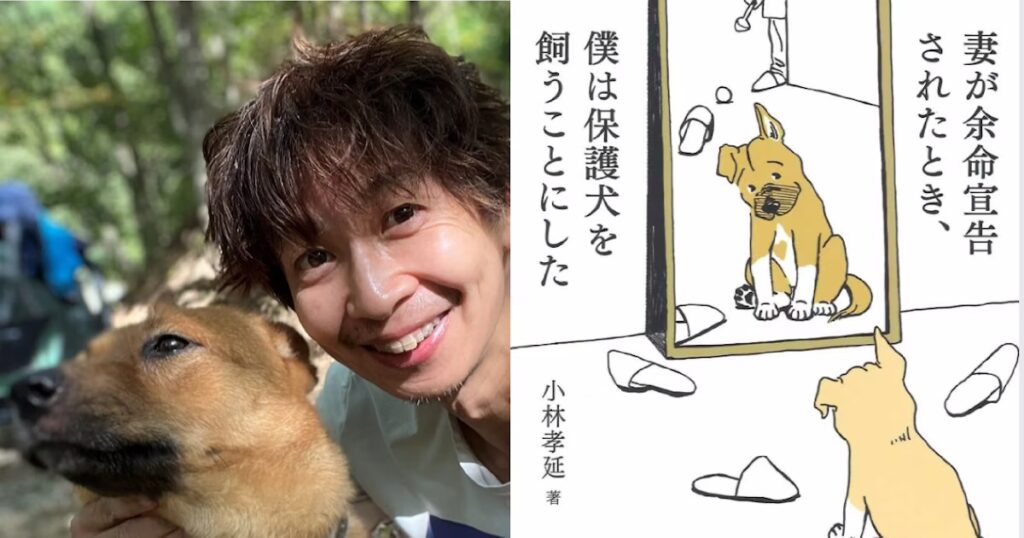
When the doctor told him he had two or three years left, the man did not cry. He simply nodded, went home, and closed the door to a life that suddenly felt smaller.
At first, he let the world fade. He stopped answering the phone. Meals went unfinished. The television played softly in the background, more for noise than comfort. His body ached, but it was his spirit that sank deeper into that strange stillness where even time seems to hesitate.
Only one creature refused to leave him there.
His dog, a small, mixed-breed companion with the patient eyes of someone who understood loss, remained beside him. Each morning, the man would wake to the faint pressure of fur against his arm. Each night, he would feel that same warmth at his side. The dog did not know what “terminal” meant. He only knew that his person smelled different, moved slower, and needed company more than ever.
Animals have a way of reading grief the way we read weather. Their loyalty is not heroic in the way of legends; it is simple, stubborn presence. When the man stopped eating, the dog pawed at his bowl. When he lay in bed for hours, the dog nudged his hand until it lifted, until it rested in familiar rhythm on his fur.
And one morning, something in the man stirred. He noticed, for the first time in weeks, how the sunlight pooled on the tatami floor. He noticed his dog’s steady breath, the faint sound of birds outside. Life, fragile and unpromised, was still here.
He began treatment again, not because he suddenly feared death, but because he saw, in his dog’s devotion, that love deserved effort.
Recovery was not sudden. There were long hospital days, sleepless nights, moments of doubt. Yet each small victory, the return of appetite, the steadier walk, the first time he smiled again, was shared. His dog waited outside clinics, wagged at the sight of him, and followed him home like a shadow made of hope.
Months turned into years. The illness receded. The doctors called it a “partial remission,” but the man called it something else.
A miracle, yes. But a quiet one.
Not the kind that descends from the heavens. The kind that grows, almost invisibly, from the simple wish to stay beside someone a little longer.
The Long Goodbye of True
If the first story was about returning to life, the second was about holding it gently as it faded.
“True” was his name, a Toy Poodle whose very existence had once pulsed with youth. For nearly two decades, he and his owner shared everything: morning walks, winter naps by the heater, the familiar squeak of toys long worn out. But time, that patient sculptor, had begun to carve new lines into both of their lives.
At nineteen, True began to forget.
It started subtly. He would stare into corners, confused. Sometimes he walked in small circles, as if searching for something that had quietly slipped away. His once-bright eyes grew cloudy. He barked at shadows or at nothing at all. Dementia, the veterinarian said gently, a word that breaks something inside those who hear it.
For his owner, it felt like watching a beloved star dim night by night. But love, in its truest form, adapts.
The daily routine became a ritual of patience: soft meals carefully mashed for weak teeth, small steps during walks so True wouldn’t stumble, the soft hum of familiar songs whispered into fading ears. Every gesture carried a message: I’m still here. You’re still you.
Some nights were harder than others. There were accidents on the floor, sudden cries in the dark. The owner often woke before dawn to soothe him, knowing sleep would not return. But even in exhaustion, there was gratitude—for another morning, another chance to hold him close.
It is a peculiar kind of grace to care for someone who can no longer recognize you. In those moments, love becomes less about being seen and more about being constant.
True’s owner once said, “He taught me that love isn’t only joy. It’s also endurance.”
When True could no longer walk, his owner carried him in a soft sling during their evening strolls. Together they watched the sunset from the same park bench they had visited for years. Neighbors sometimes stopped to greet them, lowering their voices as if entering a sacred space. There was no tragedy in it, only the slow, quiet beauty of two lives that refused to part, even as time pulled gently between them.
On the morning True passed, the owner was there, stroking his back, whispering the same phrase he had said for nineteen years:
“It’s okay, I’m right here.”
And that was the truth of it. True had never really left.

The Unseen Labor of Love
In Japanese culture, there is a quiet reverence for perseverance, gaman, the endurance of hardship without complaint. These stories, though intimate, carry that same quiet strength. But they also show another side of endurance: not stoicism, but tenderness as an act of will.
The man who fought to live again and the owner who cared for True until his final breath were both sustained by something larger than themselves. Love, when it deepens over years, becomes its own language of healing.
Science has long studied the emotional and physiological bond between humans and dogs. The presence of a pet has been shown to lower stress hormones, improve cardiovascular health, and reduce symptoms of loneliness and depression. Hospitals in Japan and around the world now allow therapy dogs in oncology wards and senior homes, recognizing what compassion has always known: sometimes the best medicine has four paws.
But beyond the measurable effects lies something that resists quantification. Dogs have an uncanny way of anchoring us to the present. They do not worry about the past or bargain with the future. They remind us, through gaze, touch, and routine, that this moment is enough.
The man who chose to fight again may have been healed by treatment, but he was also healed by companionship. Every walk to the clinic, every shared meal, every night spent side by side became its own kind of therapy, one of presence over prognosis.
And True’s owner, though he could not stop the march of time, found meaning in the very act of care. Each small gesture became a way to honor the life they had built together, to affirm that love does not vanish even as memory fades.
Beyond the Edge of Loss
There is a saying often used in Japan: “Inochi wa meguri”—life is a cycle, a turning. It reflects the Buddhist notion that life and death are not opposites but continuations of one another, intertwined in rhythm.
For those who have loved and lost animals, this phrase offers both comfort and ache. We see our companions grow old, their energy softening into something slower, gentler. And when they go, something inside us feels gone too, but only for a while.
Because love, once given fully, does not end. It changes form. It becomes the voice that whispers when we walk alone, the warmth that lingers on the bedspread, the reason we still look toward the door at dusk.
In both these stories, the dogs were not simply pets. They were bridges between despair and hope, between illness and recovery, between forgetting and being remembered. Their presence guided their humans toward a kind of clarity that perhaps only unconditional love can reveal: that to truly live is to keep showing up for someone, even when words or years begin to fail.
The man who survived his illness once said to a local journalist, “He didn’t save me by doing anything special. He just stayed.”
And perhaps that is the simplest and hardest thing any of us can do for those we love: stay.
What Dogs Teach Us About Time
Dogs live shorter lives, and that is their greatest cruelty and their greatest gift. Because of it, they teach us urgency—the need to appreciate mornings, to forgive easily, to delight in small things. Their days remind us that love is not measured by length but by depth.
The man who rediscovered life and the owner who accompanied True through decline both experienced this truth in different ways. One was pulled back into the world by devotion, the other learned to release with grace. Both found meaning not in grand outcomes but in presence, the kind that sits quietly beside you through sickness, memory loss, or the slow unraveling of years.
There’s something profoundly human in these exchanges, though they pass between species. They speak to a hunger we all share: to be needed, to be loved without performance, to matter in the daily rhythm of another’s existence.
If you’ve ever been greeted at the door by a wagging tail after a long day, you’ve known a small piece of that miracle. The one where the world, for a moment, feels right again.
A Culture of Quiet Companionship
Japan has long held a special place for animals in its moral and emotional landscape. From the Shinto belief that spirits reside in all living things to the Buddhist compassion for sentient beings, companionship with animals carries spiritual resonance. Temples like Zōjō-ji in Tokyo even host memorial services for pets, where owners light incense and recite prayers for the souls of their animal family members.
In recent years, as Japan’s population ages and loneliness deepens among its elderly, pets have become a lifeline. Government studies estimate that over one-third of Japanese households now include at least one pet, with dogs leading the count. For many seniors, especially those living alone, these companions provide both structure and solace—someone to greet, to feed, to talk to when the world grows quiet.
Yet these bonds also bring inevitable heartbreak. The average lifespan of a dog, ten to fifteen years, means that nearly every owner will face the long twilight of decline. Japanese media outlets often report such stories not as tragedies but as celebrations of enduring love. They remind readers that the end of a pet’s life is not simply an ending, but a continuation of shared gratitude.
Perhaps that is why stories like True’s or the cancer survivor’s resonate so deeply. They reflect the cultural ideal of omoiyari, a gentle empathy toward others, expressed through action rather than words. Caring for a dying pet, or finding the will to live because of one, are acts steeped in that quiet empathy.
The Heart’s Mirror
There’s a moment familiar to anyone who has lived long enough with a dog: the silent look that passes between you, their gaze steady, your reflection clear in their eyes.
That look asks nothing. It offers everything.
For the man in remission, that gaze became his reason to fight. For True’s owner, it became a memory he would carry forever.
And for the rest of us, who read their stories from afar, it becomes a mirror, reflecting what we most long for: constancy, understanding, a love that remains when all else falls away.
The Measure of a Life
When we think of legacies, we often imagine achievements, titles, milestones. But sometimes, the measure of a life is found in the quiet spaces: the sound of breathing beside you during an illness, the soft rustle of fur on aging skin, the patience to stay one more day.
Both these stories ask us to reconsider what endurance looks like. It is not only the fight to survive, but the choice to care, to meet fragility with gentleness.
In a way, these dogs remind us how to be human. They show us that devotion can outlast despair, that companionship can restore meaning where it was lost, and that love, even in its smallest gestures, has the power to turn suffering into grace.
Epilogue: The Long Light
At dusk, the man often walks with his recovered strength, his dog trotting beside him. Sometimes they stop to watch the sunset spread over the city, soft gold melting into pink. He bends down, pats his companion’s head, and whispers something only they can hear.
Elsewhere, perhaps in another quiet home, True’s owner keeps a framed photo by the bed. In it, the little poodle’s eyes still sparkle, caught mid-blink as if about to smile. The room feels emptier now, but also full, with memories, with gratitude, with love that has changed shape but not substance.
The light falls gently across both these lives, across all of ours, really, reminding us that love, once kindled, never fully disappears. It simply lingers, softer now, illuminating what remains.
And that, perhaps, is the truest miracle of all.