
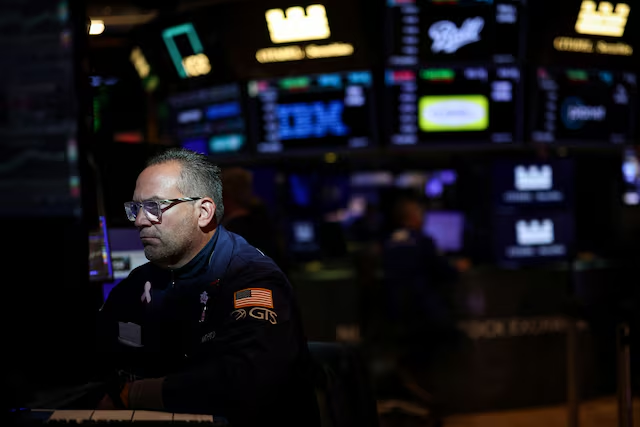
The U.S. stock markets experienced a pullback this week after Federal Reserve Chair Jerome Powell struck a cautious tone in his remarks, suggesting that equity valuations are elevated and leaving the timing of future rate cuts uncertain. The comments reverberated across Wall Street, halting what had been a strong summer rally and injecting fresh anxiety into investor sentiment.
The Nasdaq fell roughly 1 percent, while the broader S&P 500 and Dow Jones Industrial Average also slipped. Key technology stocks — which have fueled much of the market’s gains over the past year — led the decline, reflecting their sensitivity to interest rate expectations. Powell’s emphasis on balancing inflation risks with labor market stability left markets unsure about the Fed’s next move. Investors are now eagerly awaiting the release of inflation data, particularly the Personal Consumption Expenditures (PCE) report, for clearer signals on the path ahead.
The Fed’s Balancing Act
Since the pandemic, the Federal Reserve has been at the center of a monumental policy experiment: aggressive stimulus followed by one of the steepest tightening cycles in decades. Interest rates were slashed to near zero in 2020 to cushion the economy, then rapidly increased beginning in 2022 to rein in runaway inflation.
By 2023 and 2024, inflation had cooled significantly but remained sticky in areas like housing and services. Powell and his colleagues shifted to a cautious stance, wary of declaring victory too soon. Their priority became a careful balance — ensuring inflation trends downward toward the Fed’s 2 percent target without causing undue damage to employment or economic growth.
This balancing act has defined Powell’s tenure. Unlike some predecessors who leaned decisively toward either fighting inflation or spurring growth, Powell has positioned himself as a pragmatist. Yet this pragmatism often leaves markets guessing, and his recent remarks underscored that uncertainty.
Elevated Equity Valuations
One of Powell’s most striking comments was his acknowledgment that U.S. stock valuations appear “fairly highly valued.” For months, analysts have warned that Wall Street’s relentless rally, driven largely by tech megacaps, had pushed prices far ahead of fundamentals.
Companies like Apple, Microsoft, and Nvidia have posted strong earnings, but their valuations have stretched to historic multiples. The Nasdaq’s gains have been particularly eye-catching, fueled by investor enthusiasm around artificial intelligence, cloud computing, and digital transformation. Yet such lofty valuations are vulnerable whenever the Fed hints at tighter or even neutral policy.
By flagging valuations directly, Powell implicitly reminded investors that the Fed watches financial conditions beyond just inflation and jobs. Overheated asset markets can pose risks to stability, and his comments signaled that policymakers are unlikely to provide a quick easing of rates simply to sustain stock rallies.
Market Reaction
The immediate market reaction was swift.
-
Nasdaq: Fell about 1 percent, led by declines in tech giants.
-
S&P 500: Lost ground as investors pulled back across sectors.
-
Dow Jones Industrial Average: Also slipped, though less sharply than the Nasdaq.
Tech stocks bore the brunt of selling pressure. Nvidia and other semiconductor firms saw notable declines, while Apple and Tesla faced renewed volatility. Financials and industrials also weakened, though defensive sectors such as healthcare and utilities held up relatively better.
Bond markets reacted as well. Treasury yields ticked upward, reflecting diminished expectations for imminent rate cuts. The dollar strengthened modestly, while gold prices dipped — classic signals of investor repositioning amid policy uncertainty.
Inflation and Labor Market Risks
Powell’s cautiousness stems from the Fed’s dual mandate: price stability and maximum employment. On inflation, the trend has been encouraging but uneven. Goods inflation has subsided, but services inflation remains stubborn. Housing costs, in particular, continue to put upward pressure on prices.
On the labor side, the U.S. job market has cooled from its post-pandemic peak but remains resilient. Unemployment is low by historical standards, and wage growth, while moderating, still runs above pre-pandemic norms. For Powell, this means the Fed has room to keep rates higher for longer without immediately triggering mass layoffs — but it also means inflationary pressures could reemerge if demand remains strong.
This delicate calculus is why Powell avoided committing to a timeline for rate cuts. Instead, he framed the Fed’s approach as data-dependent, with upcoming inflation reports, including the PCE index, playing a pivotal role.
The Role of Tech in Market Volatility
Technology stocks have been the engine of U.S. equity markets, accounting for a disproportionate share of gains in the S&P 500 and Nasdaq. From AI-driven hype to real earnings growth, companies like Microsoft, Alphabet, Amazon, and Nvidia have set the tone for broader market sentiment.
But these stocks are also the most vulnerable when interest rates remain elevated. Growth stocks derive much of their value from future earnings, which are discounted more heavily when rates are high. Thus, Powell’s hesitation on rate cuts triggered outsized declines in the sector.
The rise and fall of tech valuations have become a proxy for the market’s mood about the Fed. If policymakers signal cuts, tech rallies; if they signal caution, tech sells off. This dynamic explains why Powell’s latest remarks hit the Nasdaq hardest.
Investor Sentiment and Fear of Missing Out
Another element shaping market behavior is psychology. Over the past year, investors have been caught between fear of missing out (FOMO) on surging tech stocks and fear of being caught in a downturn.
Powell’s warning about valuations punctured some of that euphoria. Suddenly, investors were reminded that the Fed could keep conditions tight for months to come. For those who had piled into high-priced stocks, the risk of a correction became very real.
Still, sentiment remains mixed. Some analysts argue that corrections of 1–2 percent are healthy in a long-term bull market. Others warn that Powell’s words could mark the start of a broader pullback, particularly if inflation surprises to the upside.
The Global Dimension
U.S. monetary policy doesn’t operate in a vacuum. Global markets quickly responded to Powell’s tone.
-
Europe: Stock indices in Frankfurt, Paris, and London slipped in sympathy with Wall Street.
-
Asia: Tech-heavy markets like South Korea and Taiwan saw declines as investors feared reduced demand for semiconductors and electronics.
-
Emerging Markets: The stronger dollar added pressure to emerging economies reliant on dollar-denominated debt.
Central banks abroad are also navigating their own inflation and growth dilemmas. Powell’s cautious stance signals that global monetary easing may be slower than many had hoped, complicating recovery plans worldwide.
Looking Ahead: The PCE Report and Beyond
All eyes now turn to the Personal Consumption Expenditures (PCE) report, the Fed’s preferred inflation gauge. If the report shows significant cooling, markets may regain confidence that rate cuts are coming sooner rather than later. But if inflation remains sticky, Powell’s cautious tone will be vindicated, and markets could slide further.
Beyond PCE, investors will watch upcoming labor market data, corporate earnings reports, and geopolitical risks. With uncertainty swirling, volatility is likely to remain elevated.
Historical Context: Powell vs. Past Fed Chairs
To understand the market’s sensitivity to Powell’s words, it’s useful to compare him with past Fed leaders.
-
Alan Greenspan: Famously coined the phrase “irrational exuberance” in the 1990s, signaling concern about asset bubbles. Markets reacted violently to his speeches, much as they do with Powell today.
-
Ben Bernanke: His comments about tapering bond purchases in 2013 triggered the “taper tantrum,” a sharp sell-off in bonds and stocks.
-
Janet Yellen: Adopted a more dovish tone, generally reassuring markets but still sparking volatility when discussing rate normalization.
Powell falls somewhere in between. He avoids overly academic language but is careful to temper market expectations. His direct reference to valuations mirrors Greenspan’s cautionary style, while his data-driven approach echoes Bernanke.
Risks of Overcommunication
One irony of modern central banking is that efforts to be transparent often create volatility. Powell aims to prepare markets for gradual adjustments, but even mild phrases can spark outsized reactions.
By acknowledging valuations, Powell may have intended to gently cool investor exuberance. Instead, his words triggered immediate declines. This dynamic underscores how sensitive markets are to Fed signals, especially after years of ultra-low rates conditioned investors to expect support.
Implications for Everyday Americans
For average Americans, Powell’s comments and the subsequent market slide might seem distant. Yet the ripple effects are real.
-
Retirement Accounts: Millions of Americans have 401(k)s or IRAs tied to the stock market. A sustained pullback directly affects their savings.
-
Housing Market: Higher-for-longer rates keep mortgage costs elevated, delaying homeownership for many families.
-
Jobs: If tight policy eventually cools the labor market more sharply, employment prospects could weaken.
Thus, the Fed’s cautious approach has consequences that extend beyond Wall Street traders.
Political Dimensions
The timing of Powell’s remarks also carries political implications. With a presidential election cycle approaching, the Fed is under intense scrutiny. Candidates will likely seize on market volatility and the cost of borrowing as campaign issues.
The Fed prides itself on independence, but Powell knows his actions reverberate in Washington. Balancing technocratic decision-making with political realities is another layer of complexity in an already fraught environment.
Conclusion: An Uncertain Road Ahead
The U.S. stock markets’ pullback following Jerome Powell’s cautious remarks is more than a temporary blip. It reflects deep anxieties about the path of interest rates, the sustainability of tech-driven rallies, and the broader health of the global economy.
While Powell reiterated the Fed’s commitment to balancing inflation and employment, his warning about elevated valuations struck a nerve. Investors now face a period of uncertainty, with inflation data, corporate earnings, and geopolitical events all capable of swinging sentiment dramatically.
For Powell, the challenge is immense: guide the U.S. economy toward a soft landing without sparking either runaway inflation or a deep recession. For investors, the message is clear — the days of easy gains may be over, and navigating this market will require vigilance, discipline, and resilience.